Eligibility verification system: Secure Compliance 2025
What Is an Eligibility Verification System?
An eligibility verification system is a digital platform that automatically checks if someone qualifies for specific services, benefits, or employment by comparing their information against government databases and other trusted sources.
Quick Answer for HR Managers:
- Purpose: Confirms eligibility for employment, healthcare, or government benefits
- How it works: Cross-references submitted data with official databases (SSA, DHS, etc.)
- Key benefits: Reduces compliance risk, prevents payment issues, streamlines onboarding
- Main types: E-Verify for employment, insurance verification for healthcare, SAVE for benefits
- Result: Instant confirmation or flags requiring manual review
These systems act as a digital compliance guardian, preventing costly mistakes like hiring unauthorized workers or providing services to ineligible patients. As one finance director noted, this gives “extra confidence that a bill will be collected quickly.”
The stakes are high. If you don’t verify eligibility before providing services, you might not get paid. Failing to complete Form I-9 can bring significant penalties, and healthcare providers face claim denials if patient insurance isn’t verified upfront.
Three major sectors rely heavily on these systems:
Employment verification uses E-Verify and Form I-9 to confirm work authorization. All U.S. employers must complete Form I-9 for every hire, and government contractors must use E-Verify.
Healthcare verification ensures patients have valid insurance coverage. Systems like the Provider Online Service Center (POSC) help medical facilities verify benefits before treatment, preventing payment delays.
Government benefits verification confirms eligibility for programs like Medicaid, SNAP, and housing assistance through systems like the National Verifier and SAVE.
The Verification Blueprint: How These Systems Work
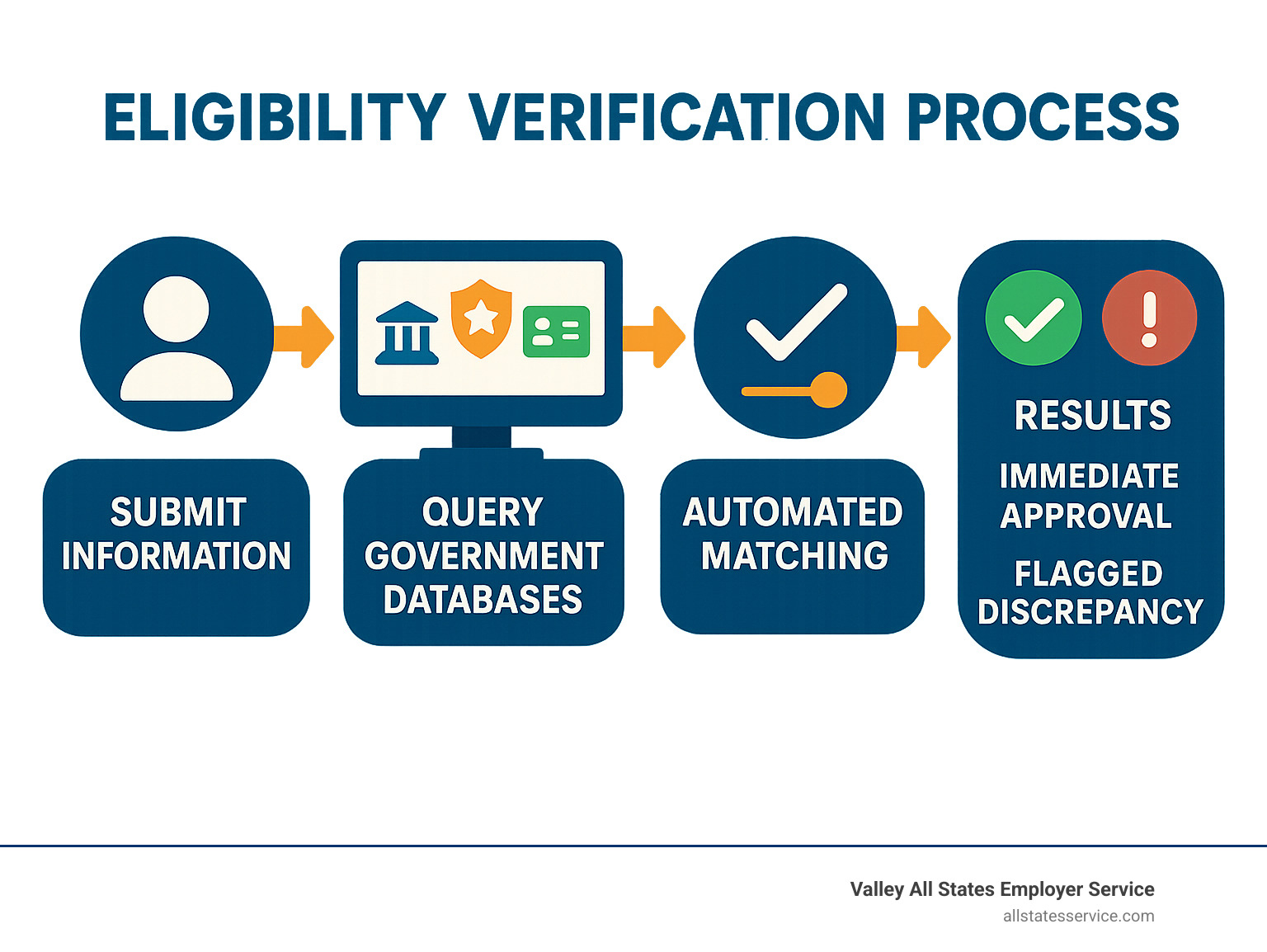
When you click “submit” on a verification form, an eligibility verification system springs into action. It works like a digital detective, confirming requirements for employment, benefits, or services at lightning speed.
The process begins with data submission. An employer, provider, or administrator enters personal details into the system, like Social Security numbers, birth dates, or insurance policy numbers.
Next, automated cross-referencing begins. The system races through massive government databases, comparing your information against official records. For employment, E-Verify queries DHS and SSA databases. For benefits, systems use Computer Matching Agreements (CMAs) to check state and federal program databases. This all happens in seconds.
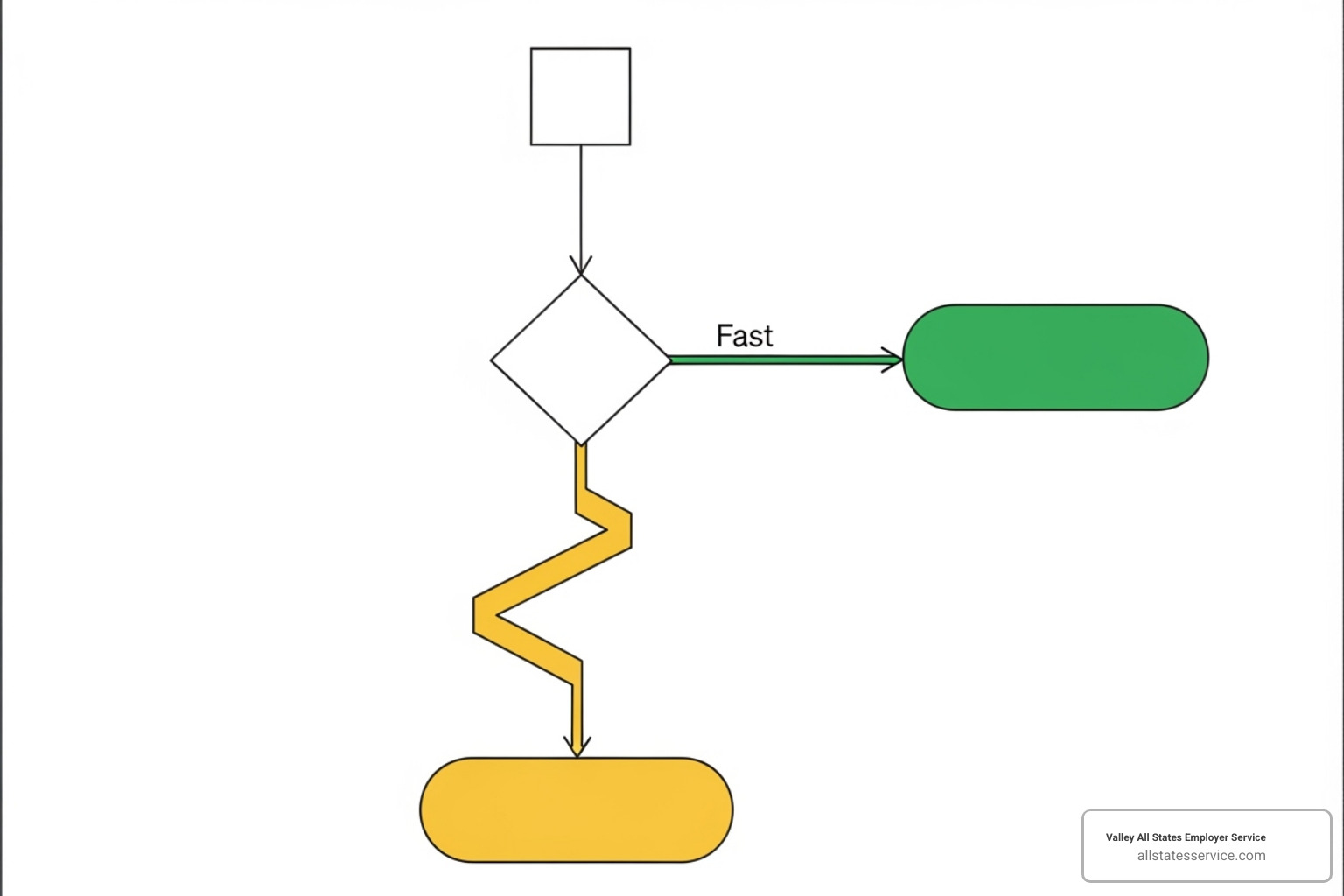
Most of the time, you’ll get instant confirmation. But if the system hits a snag, like a name mismatch, it flags the information for manual review. A person investigates further. In E-Verify, this creates a Tentative Nonconfirmation (TNC), giving the individual a chance to resolve the issue with the relevant government agency.
Throughout the process, data privacy and security protocols protect sensitive information.
Key Components and Processes
An eligibility verification system is built from several essential parts working together.
The foundation is its data sources, the official databases holding eligibility information. For employment checks, the Social Security Administration (SSA) verifies identity details, while the Department of Homeland Security (DHS) confirms work authorization.
Third-Party Identity Verification (TPIV) services add another layer of security. For example, the National Verifier uses the USPS Address Matching Service (AMS) to confirm addresses for programs like Lifeline.
The verification steps follow a logical path: information collection, automated querying of databases, data matching against official records, and result generation that provides confirmation or flags an issue.
When data doesn’t match, discrepancy resolution begins. For an E-Verify Tentative Nonconfirmation (TNC), the individual can contact the SSA or DHS to update their records. For programs like Medicaid, states may request further documentation to resolve a mismatch. You can find more info about the I-9 verification process to help steer these requirements.
Ensuring Data Privacy and Security
Your personal information deserves strong protection, and eligibility verification systems take that responsibility seriously. Trust is earned through rock-solid security measures.
HIPAA compliance sets the gold standard in healthcare. This federal law has strict requirements for protecting patient health information, and any healthcare eligibility system must meet them.
Technical safeguards include data encryption, which scrambles your information into an unreadable code. Secure connections (HTTPS) create an encrypted tunnel between your browser and the server. Official government websites like E-Verify always use HTTPS, signaled by the lock icon in your browser.
Computer Matching Agreements (CMAs) are formal agreements that govern how government agencies share data. They have strict rules for data use and protection. The National Verifier uses CMAs to verify program participation while keeping information secure.
User access controls ensure only authorized people see your data. Systems use role-based access, so employees can only view information necessary for their job.
Using official government portals and working with compliance experts is essential for keeping your sensitive information safe while meeting verification requirements.
A Sector-by-Sector Look at the Eligibility Verification System
Think of an eligibility verification system as a Swiss Army knife for compliance. While the basic tool remains the same, each sector needs different blades for different jobs. What works perfectly for verifying a patient’s insurance coverage won’t cut it for confirming a new hire’s work authorization.
Each industry brings its own industry-specific needs to the table. Healthcare providers must steer HIPAA requirements while checking insurance benefits. Employers juggle federal mandates alongside state-specific E-Verify rules. Government agencies coordinate multiple benefit programs with strict fraud prevention measures.
The custom regulations can feel overwhelming. Healthcare facilities follow different protocols than construction companies, and what’s mandatory in Arizona might be optional in Oregon. Even the data points vary dramatically. A hospital might need insurance policy numbers and coverage dates, while an employer focuses on Social Security numbers and work authorization documents.
Understanding these differences isn’t just helpful—it’s essential for staying compliant and avoiding costly mistakes.
Employment Eligibility Verification (E-Verify & Form I-9)
Every single employer in America faces the same fundamental requirement: you must verify that your new hires are legally authorized to work in the United States. There’s no getting around it, whether you’re hiring your first employee or your thousandth.
Form I-9 requirements form the foundation of this process. Think of Form I-9 as the universal starting point. Every employer must complete this form for every hire, no exceptions. Your employee responsibilities are straightforward: they attest to their work authorization status and present acceptable documents proving both their identity and employment eligibility. A U.S. passport works perfectly, or they might combine a driver’s license with a Social Security card.
Your employer responsibilities involve more than just collecting paperwork. You need to physically examine these documents to ensure they appear genuine and relate to the person presenting them. Then you record the document information on Form I-9 and store it safely. Keep these forms for three years after the hire date or one year after termination, whichever comes later.
But Form I-9 is just the beginning for many employers. Enter the E-Verify system, a powerful online tool managed jointly by the Department of Homeland Security (DHS) and the Social Security Administration (SSA). After completing Form I-9, you enter that same information into E-Verify, which then cross-references it against government databases to confirm work authorization.
Here’s where it gets interesting: E-Verify started as voluntary, but the mandatory vs. voluntary use landscape keeps evolving. Federal contractors typically must use E-Verify for all employees. Some states like Arizona require most employers to use it, while others make it optional. The rules can change based on your business size, location, and contract types.
Navigating these requirements doesn’t have to be overwhelming. We specialize in helping businesses understand exactly what applies to them. Our Workforce Eligibility Verification services take the guesswork out of compliance, and we handle both E-Verify and I-9 processes to keep your business protected.
Healthcare and Insurance Verification
In healthcare, getting paid depends entirely on knowing your patient’s coverage before you provide services. It’s that simple and that critical. An eligibility verification system in healthcare acts as your financial safety net, confirming insurance coverage before treatment begins.
Preventing claim denials should be every healthcare provider’s top priority. When a patient’s insurance isn’t active or doesn’t cover the services you’re providing, your claim gets denied. That means lost revenue, additional paperwork, and frustrated staff trying to collect payment after the fact. Smart providers verify eligibility upfront to avoid this expensive headache.
The key to ensuring payment for services lies in verification timing. Our research consistently shows that if you don’t verify a member’s eligibility before providing services, you might not get paid at all. That’s not a risk worth taking.
Modern systems offer flexible verification options. Real-time checks work perfectly for walk-in patients or urgent care situations. You get instant confirmation right at the point of service. For larger patient volumes, batch checks prove incredibly efficient. Weekly batch processing automatically monitors your entire patient list, catching coverage changes without relying on patients to notify you.
These systems handle everything from Medicaid and private insurance to Medicare and specialized government programs. Take Massachusetts MassHealth’s system as an example. Their Provider Online Service Center (POSC) concept gives providers 24/7 access to complete member eligibility information. You can confirm benefit details instantly, eliminating time-consuming phone calls and manual verification processes.
The goal is simple: clean claims that get paid quickly. When you know a claim meets all funding source requirements upfront, you can submit it with confidence. That peace of mind translates directly to better cash flow and reduced administrative burden.
Ready to streamline your healthcare verification process? Our Automated Eligibility Verification System can help you integrate these efficiencies into your daily workflow.
Government and Federal Benefits
Government benefit programs serve millions of Americans, making accurate eligibility verification absolutely crucial for program integrity and taxpayer protection. These systems manage enormous populations while ensuring benefits reach only those who truly qualify.
The Lifeline National Verifier demonstrates how sophisticated these systems have become. This program provides discounted communication services to low-income consumers, but determining eligibility requires checking multiple criteria simultaneously. The system automatically verifies identity, addresses, and participation in qualifying programs like Medicaid, SNAP, or Federal Public Housing Assistance through established Computer Matching Agreements with various agencies. It even prevents duplicate benefits by checking for multiple applications from the same person or address.
Systematic Alien Verification for Entitlements (SAVE) serves a different but equally important function. Managed by U.S. Citizenship and Immigration Services, SAVE helps federal, state, and local agencies verify immigration status and citizenship for benefit applicants. This online service ensures that only eligible individuals receive public benefits while reducing administrative burdens on government workers.
These verification systems support an impressive range of programs. Verifying eligibility for SNAP, TANF, housing assistance and other benefits happens through interconnected databases that share information securely and efficiently. The systems also handle Medicaid, Children’s Health Insurance Program (CHIP), Veterans benefits, and federal student aid programs.
The beauty of these government systems lies in their ability to cross-reference multiple data sources instantly. Instead of requiring applicants to provide extensive paperwork for each program, the systems can often verify eligibility automatically through existing records. This speeds up the application process while maintaining accuracy and preventing fraud.
Want to learn more about how these systems work? The SAVE program website provides detailed information about immigration status verification for government agencies.
Benefits, Challenges, and Future of Verification
Eligibility verification systems have become the backbone of compliance across industries, revolutionizing how organizations handle risk management and regulatory requirements. But like any transformative technology, they bring both tremendous opportunities and real-world challenges.
Let’s take an honest look at what these systems deliver, where they sometimes fall short, and what exciting developments lie ahead.
The Benefits of an Automated Eligibility Verification System
The shift from manual to automated verification has been remarkable. Organizations that make this change typically see immediate improvements across their operations.
Increased accuracy stands out as a significant benefit. Human error in data entry can be costly. Automated systems eliminate these slip-ups by performing precise data matching against authoritative government databases.
Reduced administrative burden cannot be overstated. Modern systems “eliminate time-consuming, manual work,” freeing your staff to focus on more strategic initiatives rather than repetitive verification tasks.
Improved compliance becomes more manageable with a system designed to keep pace with regulatory changes. Whether staying current with Form I-9 requirements, E-Verify updates, or HIPAA regulations, automated systems help ensure you’re meeting the latest standards, reducing the risk of costly penalties.
Minimized financial risk is substantial. Healthcare providers who verify insurance eligibility upfront avoid unpaid claims. As our research states, “If you do not verify a member’s eligibility before providing services, you might not be paid for those services.” For employers, proper verification prevents fines associated with hiring unauthorized workers.
Faster onboarding and service delivery create better experiences. New employees can start working sooner, and patients receive care without unnecessary delays. The ability to perform batch checks also dramatically improves efficiency across the board.
Common Challenges and How to Overcome Them
Despite their many advantages, eligibility verification systems aren’t perfect. We’ve worked with enough organizations to know where pain points occur and how to address them.
Data discrepancies are a frequent challenge. Sometimes information doesn’t perfectly match government records, resulting in a Tentative Nonconfirmation (TNC) in E-Verify. The key is having a clear discrepancy resolution process, promptly notifying individuals and guiding them on correcting their information with the appropriate agency.
System integration issues can derail the benefits of automation. Your eligibility verification system needs to work seamlessly with existing HR or patient management platforms. Poor integration creates duplicate data entry and eliminates efficiency. The solution involves choosing systems with robust API capabilities and working with experienced integration partners.
Staying on top of complex regulations is an ongoing challenge. Compliance requirements change regularly. Organizations must dedicate resources to monitoring these changes and updating their processes accordingly.
Even with automation, manual review bottlenecks can slow things down. If your team isn’t properly trained to handle exceptions, the process can grind to a halt. Optimizing use through training ensures your staff understands how to use the system and follow proper resolution procedures. For complex situations, partnering with experts for HR Compliance Assistance allows your team to focus on core business activities while ensuring compliance remains rock-solid.
Future Trends in Eligibility Verification Technology
The eligibility verification system landscape continues evolving, driven by technological advances that promise even greater accuracy, efficiency, and security.
Artificial Intelligence (AI) and machine learning for fraud detection are already making significant impacts. These technologies analyze enormous datasets to identify patterns and anomalies that human reviewers might miss, improving their ability to spot potentially fraudulent applications.
Biometric verification is gaining momentum as a highly secure identity confirmation method. Fingerprints and facial recognition could eventually provide seamless identity verification, particularly for high-security applications.
Blockchain for secure identity represents another approach. This technology could create tamper-proof digital identities that individuals control directly, allowing them to share verifiable credentials without exposing underlying sensitive data.
Perhaps most immediately impactful is the trend toward greater API integration between systems. We’re moving toward a more connected ecosystem where different verification platforms can securely exchange information in real-time. This seamless data flow will minimize manual intervention, reduce errors, and accelerate processes across all sectors.
Frequently Asked Questions about Eligibility Verification
When organizations first explore implementing an eligibility verification system, they often have similar concerns and questions. We’ve helped countless businesses steer these waters, so let’s address the most common questions we hear.
What is the difference between Form I-9 and E-Verify?
This question comes up almost daily, and it’s understandable why there’s confusion. Here’s the simple breakdown:
Form I-9 is the foundation. Every U.S. employer must complete this form for every single person they hire. Think of it as the paperwork phase where your new employee shows you their driver’s license, passport, or other acceptable documents. You examine these documents to make sure they look genuine and belong to the person, then record the details on Form I-9.
E-Verify is the electronic double-check. After completing Form I-9, you take that same information and enter it into the E-Verify system. This online platform, run by the Department of Homeland Security (DHS) and Social Security Administration (SSA), compares your employee’s information against government databases to confirm they’re authorized to work.
So Form I-9 is mandatory for everyone, while E-Verify adds an extra layer of verification that’s required for some employers (like federal contractors) and optional for others.
Can any business use an eligibility verification system?
Absolutely! These systems aren’t reserved for big corporations or specific industries. Whether you’re running a small dental practice, managing a construction crew, or operating a large hospital network, there’s likely an eligibility verification system that fits your needs.
Healthcare providers use them to verify insurance coverage before treating patients. Employers of all sizes use them for workforce verification, especially with E-Verify and Form I-9 compliance. Government agencies rely on specialized systems for benefit programs.
The key is that access is carefully controlled. You can’t just sign up and start checking anyone’s information. These systems require proper authorization to protect sensitive data and comply with privacy laws like HIPAA. But once you’re set up as an authorized user, the technology scales beautifully whether you’re verifying one person or thousands.
What happens if a verification check results in a discrepancy?
Don’t panic if you see a mismatch! A discrepancy doesn’t automatically mean someone isn’t eligible. It simply means the information doesn’t perfectly align with what’s in the government databases.
In E-Verify, this shows up as a Tentative Nonconfirmation (TNC). When this happens, the system doesn’t slam the door shut. Instead, it opens a window for resolution. Your employee gets notified and has eight federal working days to contact the appropriate agency (either SSA or DHS) to sort things out.
Maybe their name changed after marriage but they haven’t updated their Social Security record yet. Perhaps there’s a simple typo in the government database. These things happen more often than you’d think.
Your role as the employer is to guide them through this process without making assumptions. You can’t take any adverse action during those eight days. The goal is always to resolve the inconsistency and confirm the person’s actual status, not to find reasons to exclude them.
The beauty of working with experts like us is that we handle these situations regularly. We know exactly how to steer TNCs and other discrepancies, taking the stress off your shoulders while ensuring everything is handled properly and legally.
Conclusion: Streamlining Your Compliance with Expert Help
Think of an eligibility verification system as your business’s safety net. Throughout this guide, we’ve seen how these digital guardians protect organizations from costly mistakes, whether that’s hiring someone without work authorization or providing healthcare services to patients whose insurance won’t cover the bill.
The importance of verification extends far beyond simple compliance checkboxes. These systems serve as a critical business function that directly impacts your bottom line. Healthcare providers who skip eligibility checks risk payment denials. Employers who don’t properly verify work authorization face hefty fines. The stakes are real, and the consequences can be severe.
We’ve explored how these systems work their magic, automatically cross-referencing submitted information against trusted government databases. We’ve seen their applications across different sectors, from E-Verify confirming employment eligibility to insurance verification ensuring healthcare payments. The technology continues evolving, with AI and machine learning making these systems smarter and more accurate every day.
But here’s the reality: managing Form I-9 and E-Verify compliance isn’t just complicated, it’s constantly changing. New regulations emerge, court decisions affect eligibility rules, and one small mistake can lead to significant penalties. Many employers find themselves overwhelmed by the technical requirements and administrative burden.
That’s exactly why Valley All States Employer Service exists. We specialize in taking the complexity out of workforce eligibility verification. Our team handles the intricate details of E-Verify processing, ensuring your documentation is accurate and your compliance is bulletproof. We’ve seen too many businesses struggle with these requirements when they could be focusing on what they do best.
Why juggle compliance headaches when you can hand them off to experts? We minimize errors, reduce your administrative burden, and give you peace of mind knowing your employment verification process meets all federal requirements.
Ready to transform your compliance from a source of stress into a seamless operation? Simplify your employment verification process with our dedicated E-Verify Services.