
Getting Started: An Employer’s Guide to Background Investigations
A pre employment background investigation is the process of verifying a candidate’s history, including criminal records, employment, education, and other relevant information, to help employers make informed hiring decisions and reduce workplace risk. It’s conducted by employers or third-party agencies to confirm qualifications and ensure a safe, trustworthy workforce.
Quick Answer: What You Need to Know
| Key Aspect | What It Means |
|---|---|
| Purpose | Verify candidate qualifications, reduce risk, ensure compliance |
| What’s Checked | Criminal history, employment, education, driving records, credit (when relevant) |
| Legal Requirements | FCRA consent, EEOC compliance, adverse action notices |
| Timeline | Typically 3-5 business days |
| Who Conducts It | Employer or Consumer Reporting Agency (CRA) |
The Reality of Hiring Today
You’re about to extend a job offer. The candidate interviewed well, their resume looks solid, and they seem like a perfect fit. But here’s the uncomfortable truth: not everyone is honest on their application.
According to research, 95% of employers with at least one U.S. location conduct one or more types of employee background checks. They do this for good reason. Misrepresented credentials, hidden criminal records, or fabricated work history can lead to workplace safety issues, legal liability, and damaged company reputation.
What This Guide Covers
In the sections ahead, we’ll walk you through exactly how pre-employment background investigations work. You’ll learn what information gets uncovered, which federal and state laws you must follow, and how to conduct checks that are both thorough and fair.
We’ll also show you how to avoid common pitfalls like negligent hiring claims and discriminatory practices. Whether you’re running your first background check or refining your existing process, this guide gives you the practical knowledge you need.
What is a Pre-Employment Background Investigation and Why Is It Crucial?
A pre employment background investigation is more than just a formality; it’s a critical step in building a strong, reliable team. It involves systematically gathering and verifying information about job applicants to ensure they are who they say they are and possess the necessary qualifications and character for the role. This process helps us vet candidates thoroughly, verifying everything from their past employment to their criminal history.
By conducting these investigations, we’re not just checking boxes. We’re actively engaged in risk management, protecting our workplace, our current employees, and our customers. It also ensures we meet various regulatory compliance standards, which can be complex and ever-changing.
The Importance of a Pre-Employment Background Investigation
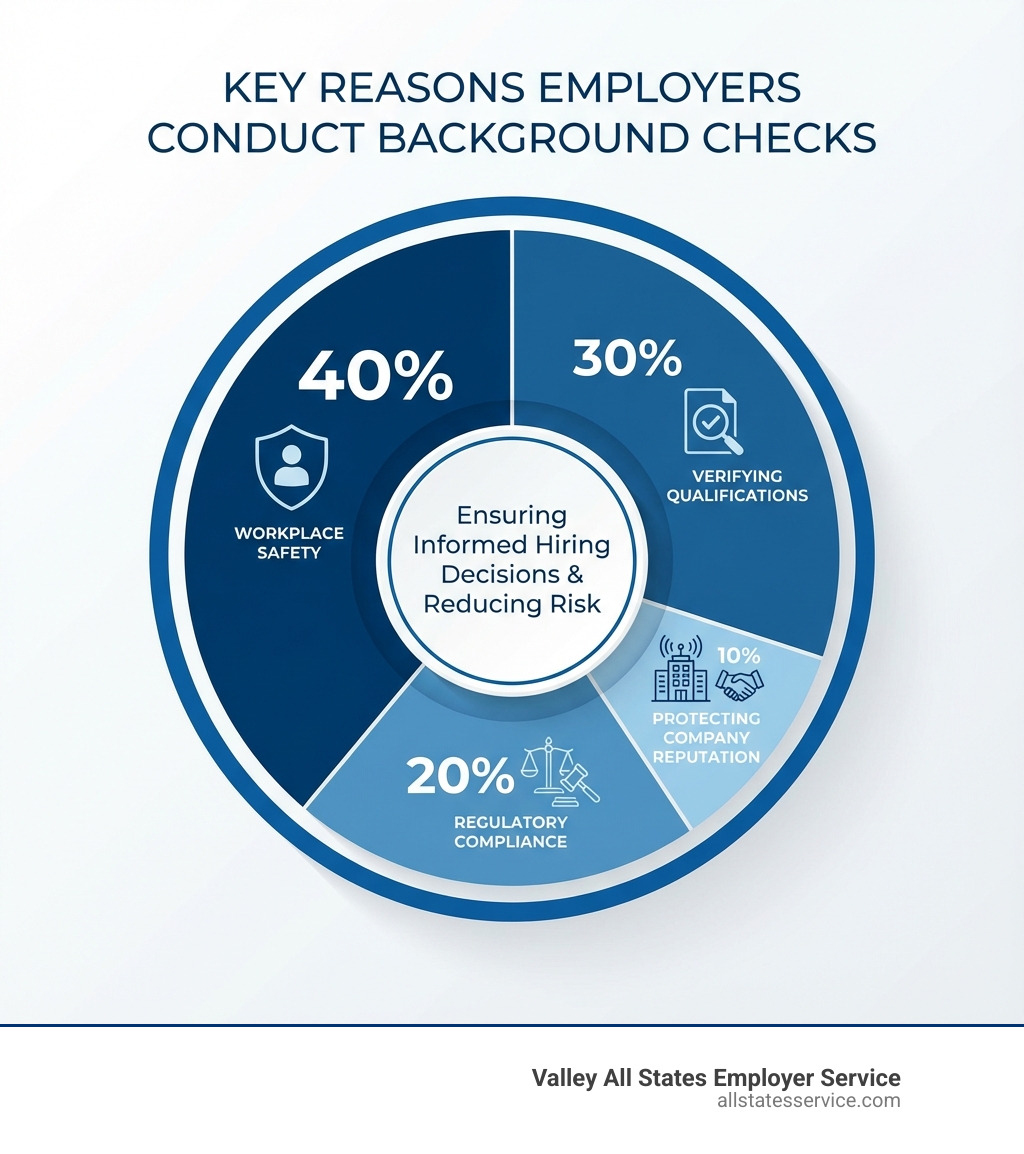
Why do employers prioritize this step? The reasons are compelling and directly impact our organization’s success and well-being.
- Workplace Safety: Perhaps the most immediate concern, background checks help us ensure a safe environment for everyone. By identifying potential risks, we can prevent issues before they arise, fostering a secure space for our team and clients. Hospitals and healthcare facilities, for example, have a legal duty to employ individuals who do not pose an undue risk to patients.
- Verifying Qualifications: It’s easy for candidates to embellish resumes or misrepresent their skills. A thorough background check confirms their employment history, educational achievements, and professional licenses, ensuring we hire individuals who truly meet the job’s requirements. This verification helps us make informed hiring decisions and avoid unqualified candidates.
- Fostering Public Trust: When our customers and the public know we thoroughly vet our employees, it builds confidence in our services and brand. This trust is invaluable, especially for roles that involve sensitive information or direct interaction with the public.
- Protecting Company Reputation: A single bad hire can severely damage our company’s reputation, sometimes beyond repair. By carefully screening candidates, we safeguard our brand image and maintain the high standards we’ve worked hard to achieve.
- Mitigating Risk: From financial fraud to workplace misconduct, the risks associated with hiring the wrong person are significant. Background checks are a proactive measure to mitigate these risks, protecting our assets, data, and overall business operations.
Understanding and Avoiding Negligent Hiring
The concept of negligent hiring is a serious concern for employers. It essentially means we, as an employer, can be held legally responsible if we hire an employee who then harms another person (such as a co-worker or customer) and we failed to conduct a reasonable background check that would have revealed the employee’s unsuitability for the role.
The legal consequences of negligent hiring can be severe, leading to costly lawsuits, significant financial penalties, and irreparable damage to our reputation. Our liability hinges on whether we exercised due diligence in the hiring process. This is where a comprehensive pre employment background investigation becomes our shield. It demonstrates that we took reasonable steps to assess a candidate’s fitness for the job, significantly reducing the risk of a negligent hiring claim.
The Anatomy of a Background Check: What Information is Uncovered?
When we conduct a pre employment background investigation, we’re essentially piecing together a comprehensive profile of a candidate. This involves looking at common components, often drawing from both public records and private sources. The goal is thorough data verification, ensuring the information we receive is accurate and reliable. For more details on efficient screening, you can find More info about workforce screening.
Core Components of a Background Check
Here’s a breakdown of the typical information we might uncover during a background check:
- Criminal History: This is a cornerstone of most background checks, revealing felony and misdemeanor convictions. It’s crucial for assessing potential risks and ensuring workplace safety. However, we must always consider the job-relatedness and business necessity of any criminal history found.
- Employment Verification: We confirm previous employers, job titles, dates of employment, and sometimes reasons for leaving. This helps us verify the candidate’s professional experience and validate their resume claims. Our Pre-Employment Work History Verification services can assist with this.
- Education Verification: We check academic institutions attended, degrees or certifications obtained, and dates of attendance. This ensures candidates possess the educational qualifications they claim, especially for roles requiring specific credentials.
- Driving Records (MVR): For positions that involve driving company vehicles or require a valid driver’s license, we review Motor Vehicle Records. This check reveals license status, traffic violations, and accident history. In states like Maryland, specific regulations govern how far back MVR checks can go.
- Credit History: For roles that involve financial responsibilities, handling money, or access to sensitive financial information, a credit check may be appropriate. This provides insight into a candidate’s financial responsibility. Federal regulations like the FCRA impose restrictions on when and how credit history can be used.
- Professional License Verification: For licensed professionals (e.g., nurses, engineers, real estate agents), we verify the validity and status of their professional licenses, ensuring they are current and in good standing.
How Far Back Do Checks Go and How Long Do They Take?
The “lookback period” for a background check can vary significantly depending on the type of information, federal laws, and specific state regulations.
Under FCRA rules, non-conviction civil actions, tax liens, and credit history generally have a seven-year lookback period. However, criminal convictions may be reported indefinitely, though some states impose shorter limits. For instance, in California, non-conviction records or convictions older than seven years are generally restricted from reporting by Consumer Reporting Agencies (CRAs). We must always consider the laws applicable to our specific location, such as Maryland, which may have its own regulations.
The length of time for a pre employment background investigation also varies. While some database screenings can return results in minutes, the average turnaround time for comprehensive employment background checks is typically three to five business days when working with a reputable CRA. Court and agency backlogs, holidays, or requests for information from outside the United States can sometimes extend this timeline. For more insights into these timelines, review our guide on Pre-employment Background Check Time.
The Modern Twist: Social Media Screening
A comprehensive pre employment background investigation often includes social media screening. It’s become increasingly important to consider, as it can provide valuable insights into an applicant’s public behavior and how it aligns with our company values.
Social media searches can reveal information that helps us make smarter hiring decisions, understanding whether an applicant will further our mission or detract from progress. Technology-enabled, AI-driven tools can comb public channels like Facebook, Twitter, Instagram, and YouTube, along with comprehensive news and web searches.
However, we must approach social media screening with caution and ensure FCRA compliance. It’s vital to focus only on job-related behaviors and avoid making decisions based on protected characteristics (like race, religion, or gender) that might be inadvertently revealed. When conducted properly, social media searches for employment purposes can be FCRA compliant, providing a modern layer of insight into a candidate’s suitability.
Navigating the Legal Maze: Compliance is Non-Negotiable

The legal landscape surrounding pre employment background investigation is intricate, involving a web of federal laws, state statutes, and local ordinances. For us, ensuring compliance isn’t just a best practice; it’s a non-negotiable requirement. It protects us from legal challenges and upholds the rights of job applicants. When you partner with a trusted provider, such as our team at Valley All States Employer Service, we help steer these complexities. You can learn more about how a dedicated Background Verification Company assists with compliance.
Understanding Key Federal Regulations
Two primary federal laws dictate how we conduct background checks:
- Fair Credit Reporting Act (FCRA): This federal law governs the collection, dissemination, and use of consumer report information, including background checks for employment purposes. If we use a third-party Consumer Reporting Agency (CRA) for background checks, we must comply with FCRA. This includes providing the applicant with a clear, written disclosure that we intend to conduct a background check and obtaining their written consent before proceeding. The FCRA also outlines the crucial adverse action process, which we must follow if we decide not to hire someone based on information in their background report. You can find the full text of the Fair Credit Reporting Act (FCRA) directly from the FTC. Applicants also have a right to a Summary of Rights under the FCRA.
- Equal Employment Opportunity Commission (EEOC): The EEOC enforces federal laws that prohibit employment discrimination based on race, color, religion, sex, national origin, age (40 or older), disability, or genetic information. Our background check policies must not have a “disparate impact” on protected groups, meaning they shouldn’t disproportionately exclude certain individuals unless the criteria are job-related and consistent with business necessity. The Equal Employment Opportunity Commission (EEOC) guidance recommends against blanket policies that automatically disqualify candidates with criminal histories. Instead, we should consider factors like the nature and gravity of the offense, the time passed, and the nature of the job.
State and Local Laws: Ban the Box and More
Beyond federal regulations, we must be keenly aware of state and local laws, which can add additional layers of complexity. Many jurisdictions, for example, have enacted “Ban the Box” laws. These laws generally restrict when employers can ask about a candidate’s criminal history, often delaying the inquiry until later in the hiring process, such as after a conditional job offer. There are over 180 states, cities, and counties that enforce Ban the Box laws, reflecting a broader movement towards fair chance hiring.
While we primarily operate in the United States, including Maryland, it’s worth noting that some states, like California, have particularly comprehensive laws, such as the Investigative Consumer Reporting Agency Act (ICRAA) and the California Fair Chance Act (FCA), which specifically regulate background checks and criminal history inquiries. Local ordinances, such as those in San Francisco and Los Angeles, can also impose unique requirements, though many are now superseded by statewide laws. We always ensure our practices align with the specific laws applicable to our operations, particularly in Maryland and any other locations where we serve clients.
The Role of Consumer Reporting Agencies (CRAs)
Navigating these regulations can be daunting, which is why many employers, including us, partner with Consumer Reporting Agencies (CRAs). A CRA is a company that compiles and sells consumer reports, including background checks, to third parties like employers.
When we work with a CRA, we leverage their expertise in gathering accurate information while ensuring compliance with FCRA and other relevant laws. They are responsible for ensuring the information they provide is accurate and up-to-date. This partnership helps us streamline the background check process, reduce administrative burdens, and focus on what we do best: helping our clients find the right talent. The average turnaround time for employment background checks is three to five business days when working with a CRA.
The Complete Guide to Your Pre-Employment Background Investigation Process
A well-structured pre employment background investigation process is essential for making informed hiring decisions while maintaining legal compliance. Here’s a step-by-step guide to help you manage this critical process effectively. For a deeper dive into these procedures, explore our Company Background Verification Process.
Step 1: Establish a Clear and Compliant Policy
The foundation of any sound background check process is a clear, written policy. This policy should outline:
- What types of checks we conduct for which positions.
- When in the hiring process these checks occur.
- How the results will be used to make employment decisions.
Our policy must ensure that all checks are job-related and consistent with business necessity. This means that any information we consider must directly pertain to the duties and responsibilities of the role and be crucial for the safety and efficiency of our operations. Consistency is key; we must apply our policies uniformly to all candidates for similar positions to avoid any accusations of discrimination. Regularly reviewing our policy with legal counsel helps us stay current with evolving regulations.
Step 2: Choose a Screening Partner and Obtain Consent
Choosing the right background screening service provider is paramount. We look for partners who offer:
- Accuracy: They must provide reliable and up-to-date information.
- Compliance Support: They should be experts in FCRA, EEOC, and state/local laws, guiding us through complex requirements.
- Turnaround Time: Efficient processing helps us make timely hiring decisions. The average turnaround time for employment background checks is three to five business days when working with a CRA.
Once we’ve selected a partner, the next critical step is obtaining candidate consent. The FCRA requires us to provide a clear, written disclosure to the applicant stating that a background check may be conducted for employment purposes. We then must obtain their written authorization before proceeding. This transparency is not just a legal requirement, it also builds trust with our candidates. For assistance in finding reliable providers, refer to our guide on Pre-employment Background Check Companies.
Step 3: Reviewing Results and Taking Fair Action
After the background check is complete, we carefully review the results. If negative information is revealed, especially criminal history, we must exercise extreme caution and fairness. We follow the EEOC’s guidance on individualized assessment, which involves considering:
- The nature and gravity of the offense.
- The time that has passed since the offense or completion of the sentence.
- The nature of the job being sought.
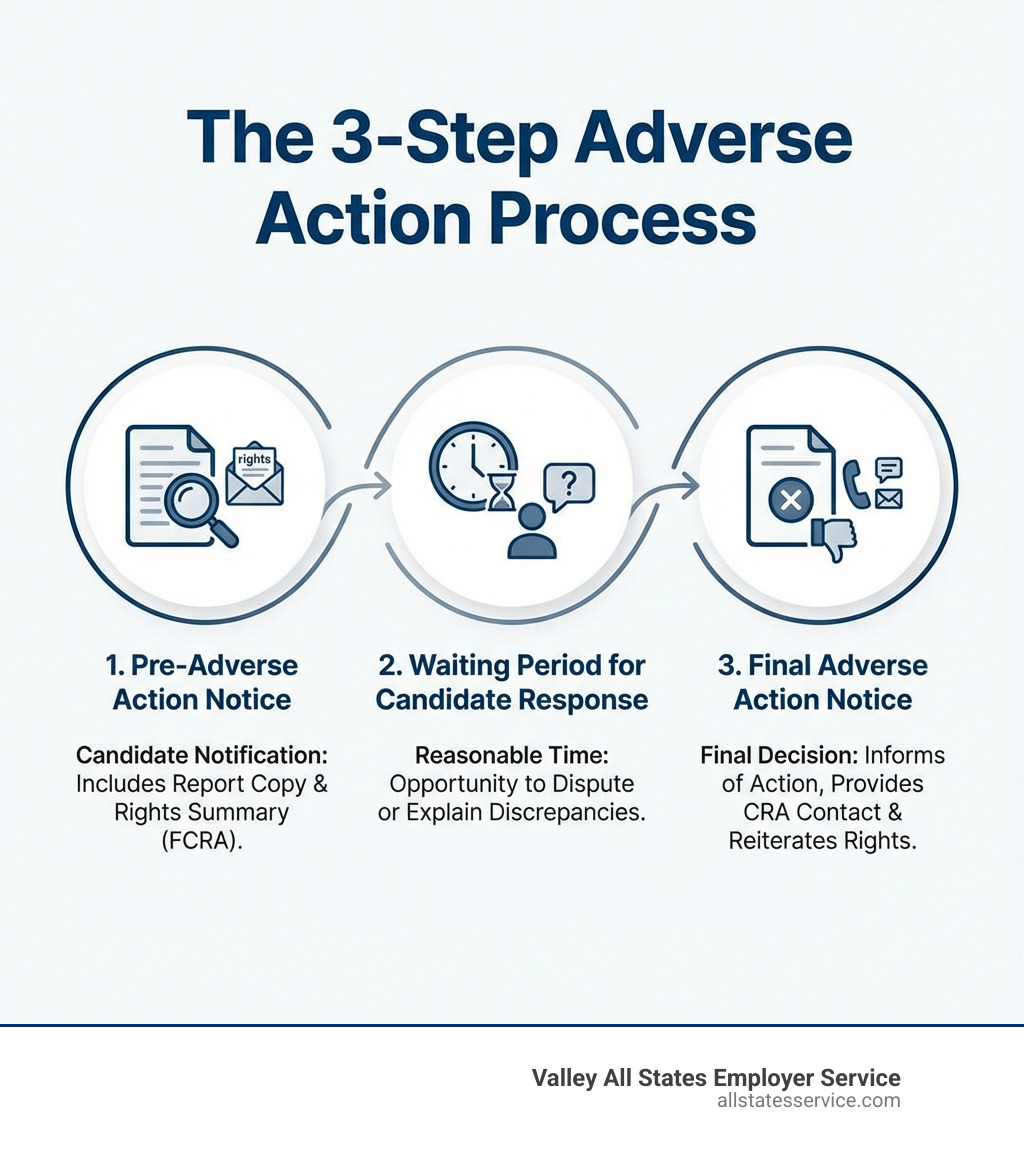
This “nature-time-nature” test helps us determine if the negative information genuinely impacts the candidate’s ability to perform the job safely and effectively. If we decide not to hire based on the background check results, we must follow the FCRA’s adverse action process:
- Pre-Adverse Action Notice: We first send the candidate a pre-adverse action notice, which includes a copy of the background report and a “Summary of Your Rights Under the FCRA.” This gives the candidate an opportunity to review the report, explain any discrepancies, or dispute inaccurate information.
- Waiting Period: We allow a reasonable amount of time (typically 5 business days) for the candidate to respond.
- Final Adverse Action Notice: If, after considering their response, we still decide not to hire, we send a final adverse action notice. This notice informs the candidate of our decision, provides the name and contact information of the CRA, and reiterates their rights.
Special Considerations for Your Pre-Employment Background Investigation
Certain industries and situations require additional scrutiny in a pre employment background investigation:
- Industry-Specific Checks:
- Healthcare: Facilities often require checks against sanction lists, such as the HHS/OIG Exclusions List, to ensure candidates haven’t been excluded from participating in federal healthcare programs.
- Education: Schools and educational institutions conduct thorough checks, often including sex offender registries and specific state-level clearances, to protect students.
- Government: Positions requiring government-issued security clearances involve extensive background investigations, often covering behavioral reliability, integrity, and personal adjustment.
- Checks on Current Employees: Yes, employers can conduct background checks on current employees for promotions, reassignments, or if a new role requires a different level of screening. The same FCRA and EEOC rules regarding disclosure, consent, and non-discrimination apply. We must ensure these checks are job-related and applied consistently.
Frequently Asked Questions about Pre-Employment Background Investigations
We understand you might have more questions about this complex topic. Here are some common inquiries we receive:
What causes a “red flag” on a background check?
A “red flag” on a background check isn’t always a definitive disqualifier, but it indicates information that requires further review. Common red flags include:
- Inconsistencies: Discrepancies between the information provided by the candidate (on their resume or application) and what the background check reveals (e.g., different employment dates, unverified degrees).
- Relevant Criminal Convictions: While not all criminal history is disqualifying, convictions directly related to the job’s duties or posing a significant safety risk would be a red flag. For instance, a conviction for embezzlement would be a serious concern for a financial role.
- Failed Drug Tests: A failed drug test during the pre-employment screening process is typically a clear red flag.
- Poor Credit (for financial roles): For positions involving financial management or handling company funds, a history of significant financial instability or fraud could be a red flag. However, credit history should only be considered if it’s directly relevant to the job’s responsibilities.
- Employer-Defined Standards: What constitutes a “red flag” can depend on our specific internal policies and the requirements of the job, always ensuring decisions are based on business necessity and are non-discriminatory.
Can an applicant run a background check on themselves?
Absolutely! We encourage individuals to run a background check on themselves. It’s a smart way to understand what potential employers might see and to identify and correct any inaccuracies. You can do this by:
- Purchasing a check from a third-party provider.
- Requesting public records directly from local law enforcement agencies or courthouses.
- Checking your credit report for free annually at AnnualCreditReport.com. Reviewing your own report allows you to dispute any mistakes before an employer sees them.
This proactive step can give applicants peace of mind and help them address any issues upfront.
What should an employer do if a background check on a closed company is needed?
Verifying employment history for a company that has closed can be challenging, but it’s not impossible. When faced with a closed company, we often explore alternative methods:
- Contacting former supervisors or colleagues: If the candidate can provide contact information for individuals who worked at the closed company, we might reach out to them for verification.
- Reviewing pay stubs, W-2s, or other documentation: Candidates may have personal records that can corroborate their employment.
- Using professional services: Some background screening providers specialize in harder-to-verify employment histories and have resources to track down information from defunct companies.
For more detailed strategies on this specific challenge, consult our Background Verification Closed Company Guide.
Building a Safer, More Compliant Workforce
Navigating the complexities of pre employment background investigation is a crucial responsibility for any employer. As we’ve explored, these investigations are indispensable for mitigating risk, making informed hiring decisions, and ensuring compliance with a myriad of federal, state, and local laws.
At Valley All States Employer Service, we understand these challenges. Our expertise lies in simplifying employment compliance, including efficient E-Verify processing, to minimize errors and administrative burdens for our clients. We help you build a safer, more compliant workforce, giving you peace of mind.
Ready to improve your hiring process with expert, impartial, and efficient screening solutions? Learn more about pre-employment screening services and how we can support your team.