Blockchain for Employee Verification: Transformative 2025
Why Traditional Employee Verification Is Costing You More Than You Think
Blockchain for employee verification is a decentralized system that stores and validates employment credentials on an immutable digital ledger. It allows employees to control their own verified records while giving employers instant, secure access to a tamper-proof professional history.
Quick Overview: What You Need to Know
- What it is: A secure, distributed database that stores verified employment records using cryptographic technology.
- How it works: Employees receive digital credentials in a personal wallet, which they can share instantly with employers who verify them against the blockchain.
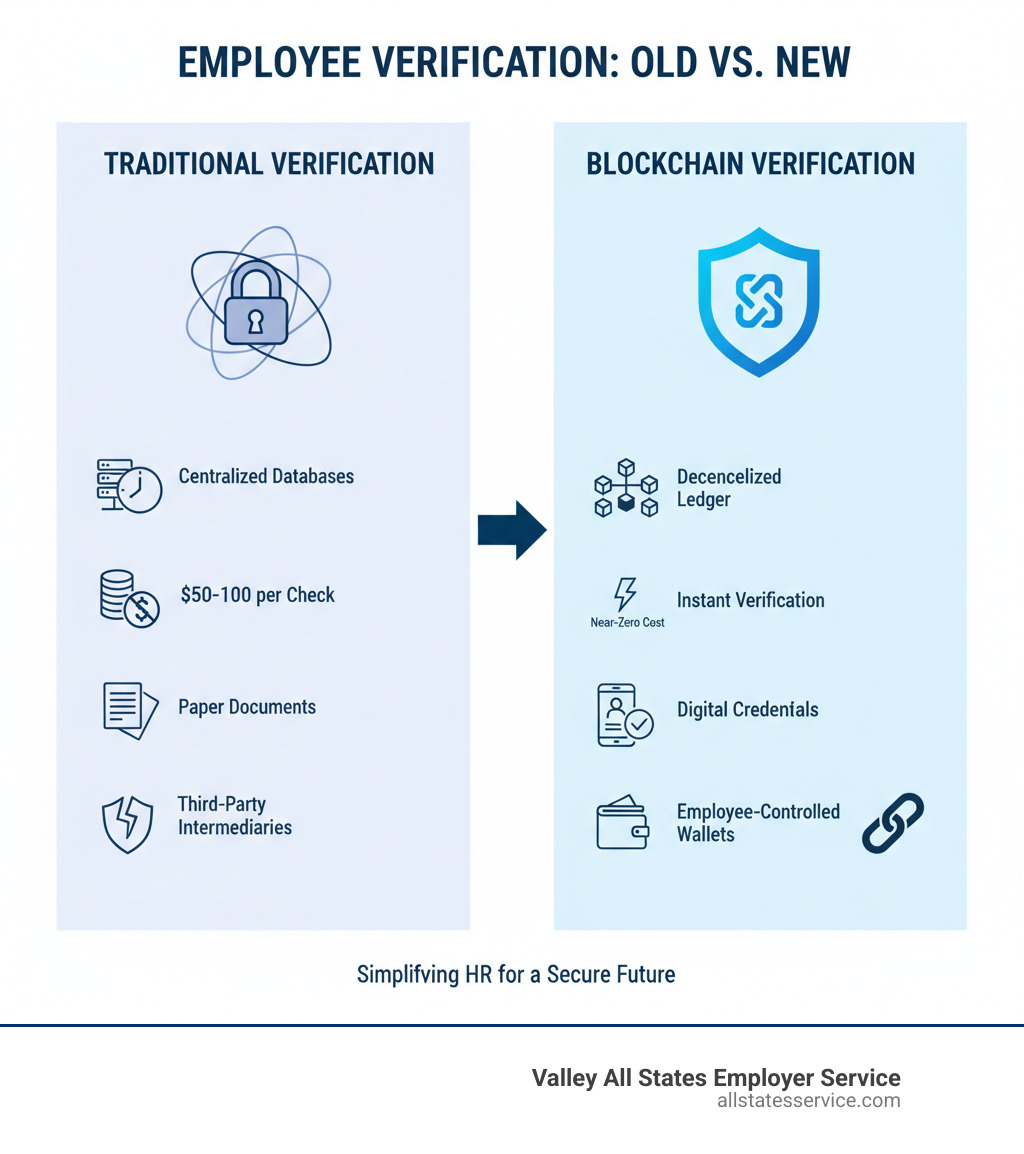
- Key benefits: Eliminates delays (2-6 weeks reduced to minutes), cuts verification costs (from $50-$100 per check to near-zero), and prevents fraud through tamper-proof records.
- Who controls the data: The employee owns and manages their credentials, not the employer or a third party.
- Current adoption: Already used by organizations like MIT, HSBC, and Estonia’s government for credential verification.
HR departments spend over $2,500 annually per employee, with a large portion lost to hidden costs in manual verification. The real price tag includes 2 to 6 weeks of waiting for background checks, $50 to $100 per verification request, and over 4,500 FCRA lawsuits filed annually.
One airline found they were dedicating 270 staff hours monthly just to verification paperwork. After switching to a blockchain system, that dropped to one hour.
Traditional verification traps employers in a system of high fees and long waits, while employees struggle to access their own records. Blockchain technology offers a different path. It creates a secure, instant, and cost-effective way to verify employment history while giving workers control over their professional records.
The High Cost and Hidden Risks of Traditional Verification
If you’re like most employers, you’ve felt the pain of traditional employee verification: weeks of waiting, high fees, and lingering doubts about accuracy. These outdated processes cost businesses far more than they realize.
The time drain is staggering. Verification can take 2 to 6 weeks, a delay that often means losing top candidates to faster-moving competitors. Time literally equals lost talent.
Manual verification is also expensive. HR teams spend countless hours on calls and data entry, while third-party services charge $50 to $100 per request. Add it all up, and the cost of background checks for a single new hire can reach $5,000 in some industries. Even service sector positions can run over $1,000 per employee.
Beyond time and money, traditional systems pose significant security and compliance risks. Centralized databases are prime targets for hackers, and a lack of transparency allows fraudulent documents to slip through.
The legal risks are severe. FCRA lawsuits have nearly tripled in the past decade, with over 5,000 cases annually and average settlements exceeding $2 million. A single procedural error, like a missed checkbox, can lead to a massive legal bill.
Candidates are also frustrated. They are stuck waiting weeks to start new jobs and are often unable to access their own employment records for loans or housing applications. The system treats their professional history like it belongs to someone else.
This broken process hurts everyone. Employers waste resources, employees lose control of their data, and the hiring ecosystem crawls. For a detailed look at just how complicated this has become, check out our guide on the Employment Verification Process.
Blockchain for employee verification offers a path forward, one that addresses these costs and risks at their source.
How Blockchain for Employee Verification Creates a Single Source of Truth
Chasing mismatched records from scattered sources is an HR nightmare. Blockchain for employee verification solves this by creating a single, tamper-proof record everyone can trust.
Instead of records being lost in filing cabinets, blockchain stores them on a decentralized, distributed ledger. Every authorized party sees the same verified information, ending the confusion of conflicting reports.

The secret is cryptographic security. Each piece of information links to the previous one using a unique cryptographic hash, like a digital fingerprint. If one link is broken, the entire system knows immediately.
This creates an immutable record. Once data is on the blockchain, it cannot be altered, which is a game-changer for preventing fraud. As TransCrypts co-founder Zain Zaidi explains, “The power of blockchain is that it enables auditability and immutability. If a record changes, we know about it instantly.”
A recent study on fraud detection found that combining blockchain with machine learning achieved 98.93% accuracy in identifying fraudulent activities. This technology delivers fraud prevention that actually works.
The biggest payoff is real-time verification. Employers can verify qualifications instantly, speeding up hiring and improving the candidate experience. To see how this transforms the process, check out our guide on Automated Eligibility Verification.
How does blockchain for employee verification improve trust?
Trust is essential to hiring. Blockchain reduces anxiety for both employers and candidates by making every credential verifiable and tamper-proof.
It acts like a digital notary for your professional history. Each credential has verifiable data provenance, so you can trace its origin and confirm it’s unaltered. This practically eliminates credential misrepresentation, like fake diplomas or embellished job titles.
This system also eliminates intermediaries. There is no more need to play phone tag with old HR departments or pay third parties to verify information. The blockchain stores it, the employee controls it, and employers access it directly with permission, building a foundation of transparency.
The Role of Smart Contracts in Automation
Smart contracts are self-executing agreements on the blockchain that automate tasks when specific conditions are met, requiring no human intervention.
In employee verification, smart contracts create automated workflows for repetitive tasks. For example, they can instantly validate a new hire’s credentials against predefined requirements or trigger a background check upon job acceptance.
This instantaneous credential validation happens in seconds, dramatically reducing HR workload. One company cut its verification time from 270 staff hours per month to just one. Smart contracts free up HR professionals to focus on human-centric tasks, like interviewing candidates and building company culture.
Smart contracts also ensure consistency by applying the same verification standards to every candidate, every time. For HR teams drowning in paperwork, they offer a lifeline by handling tedious tasks with perfect accuracy.
The Core Components of a Blockchain Verification System
To understand how blockchain for employee verification works, it helps to know its core components. The system is designed to empower employees while simplifying HR processes.
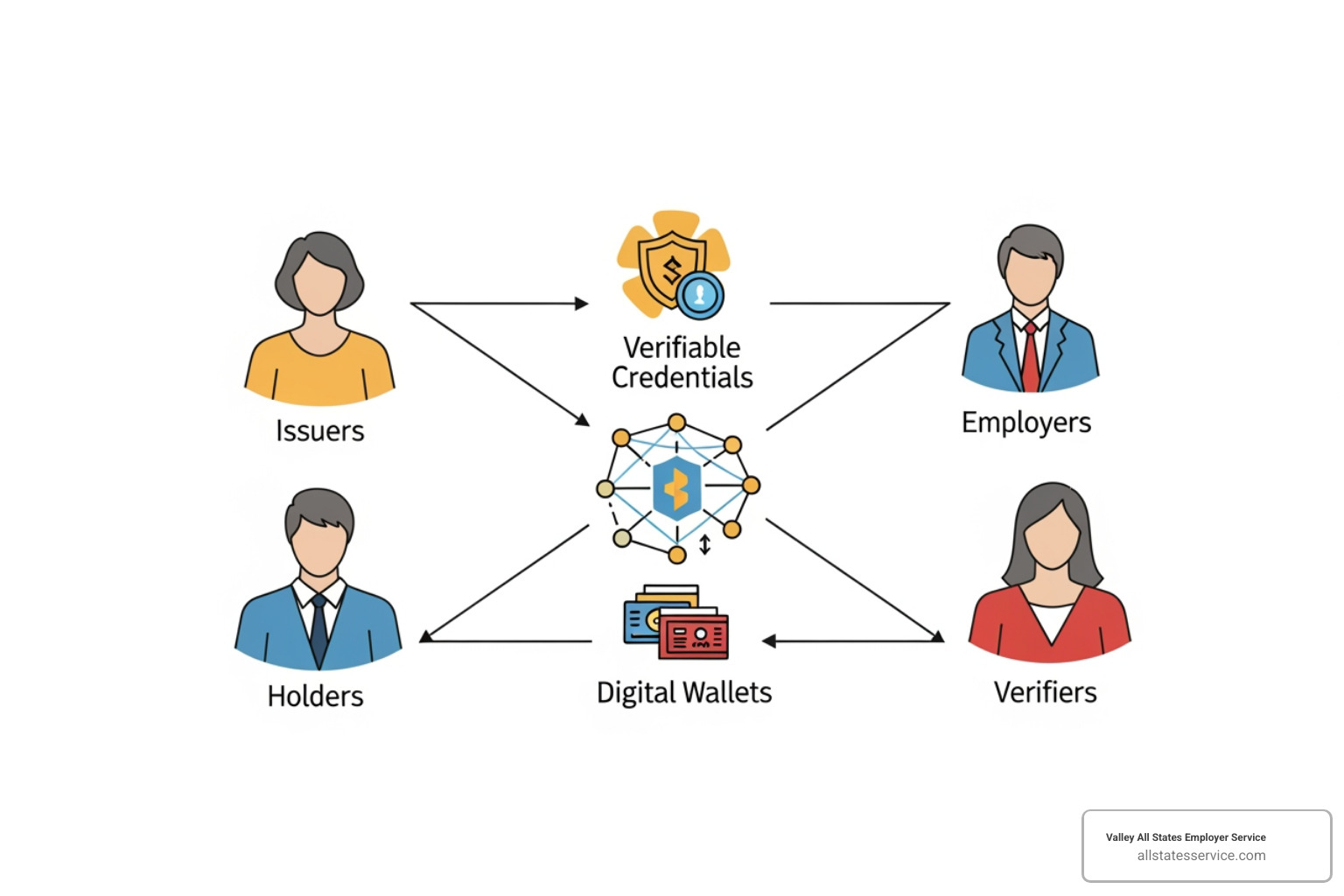
At its heart is Self-Sovereign Identity (SSI), the concept that you should own and control your digital identity. Instead of your records being held by former employers or universities, SSI gives you true data ownership.
Building on this are Verifiable Credentials (VCs). These are secure digital documents, issued by trusted entities like a university or former employer, that cryptographically prove facts about you, such as a degree or employment history.
The final piece is the Digital Wallet, a secure app where employees store their VCs. It’s a digital briefcase for your professional life, with everything you need ready to share when you choose. For more on how these documents stay secure, see our guide on Document Verification Services.
Giving Employees Control with Digital Wallets
A digital wallet shifts control of your professional history to you. Instead of credentials being scattered and inaccessible, they are stored in one secure place that you manage.
Your wallet becomes a secure storage hub for degrees, certifications, and employment history. When a new employer or a bank needs to verify your background, you decide what to share. This consent-based access means you grant specific permissions for specific credentials. You might share your degree with an employer but not your salary history.
Best of all, your credentials are portable. They move with you throughout your career, regardless of what happens to your former employers. This empowers you, making career transitions smoother and ending the frustrating cycle of re-verifying your history.
Real-World Pioneers and Platforms
Blockchain for employee verification is already in use. Pioneers like the Velocity Network Foundation are building an “Internet of Careers” for seamless validation, while platforms like TransCrypts and Dock.io provide tools for instant verification and digital wallets.
Major companies like Infosys are using blockchain for certifications, and government initiatives like Europe’s EBSI are simplifying cross-border verification. We’re also seeing exciting applications in education, where universities like MIT are issuing digital diplomas, and in healthcare, where platforms verify medical credentials to speed up hiring for critical roles.
These examples prove that blockchain verification is happening now, solving real problems and reshaping how we think about professional credentials.
The Future of Hiring and Key Implementation Challenges
The integration of blockchain for employee verification is a fundamental reimagining of professional identity and trust. We are moving toward a future where verification takes seconds, employees own their career stories, and cross-border hiring is simple.
Networks like the Velocity Network Foundation’s “Internet of Careers” are creating a connected ecosystem where credentials flow seamlessly. As these networks mature, they will create a truly global marketplace for talent. AI and machine learning will also play a role, analyzing credential data to flag inconsistencies and predict workforce trends.
For more context on how legal requirements are evolving, check out our Legal Employment Verification Guide 2025.
The Future of blockchain for employee verification
The next wave of innovation will focus on control and privacy. Decentralized Identifiers (DIDs) act as a permanent digital address that you own and control. Paired with DIDs, Zero-Knowledge Proofs (ZKPs) allow you to prove a fact (like holding a degree) without revealing the sensitive underlying data (like your grades).
These technologies enable seamless cross-border hiring. A developer in Brazil could have their credentials instantly verified by a U.S. company, respecting privacy laws in both countries. This creates a more fluid labor market where workers can pivot or relocate without losing their verified professional history.
Potential Problems to Adoption
Of course, transformative change comes with challenges. While the potential is great, organizations should be aware of several key problems:
- Scalability: Current blockchain networks may struggle with the high transaction volume of global verification, though newer solutions are addressing this.
- Interoperability: Credentials issued on one blockchain must be verifiable on another, and new systems must integrate with existing HR software.
- Regulatory Compliance: The technology must comply with evolving privacy laws like GDPR and CCPA, which can be complex.
- Initial Implementation Costs: Adopting blockchain requires an upfront investment in new systems, integration, and training.
- User Education: HR professionals, employees, and previous employers all need to be educated on how to use and participate in these new systems.
None of these challenges are impossible, but they require thoughtful planning and patience. The organizations that steer them successfully will gain a significant competitive advantage in attracting talent.
Frequently Asked Questions about Blockchain Verification
How does blockchain give employees control over their data?
Instead of your history being scattered in databases you can’t access, blockchain uses Self-Sovereign Identity (SSI). You receive verified digital credentials for degrees or jobs directly into your personal digital wallet.
When an employer needs to verify something, you grant temporary, consent-based access to only the specific information you want to share, like employment dates but not salary. This selective disclosure puts you in control, and you can revoke access at any time. Your professional history becomes truly portable and yours to manage.
Is blockchain verification compliant with regulations like the FCRA?
Yes, and it can even improve compliance. Smart contracts can automate processes to ensure legal requirements are always followed, reducing the risk of human error.
Blockchain also creates immutable audit trails of every verification request and consent granted. If a process is ever questioned, you have ironclad proof of every step taken. This automation minimizes the procedural mistakes that often lead to costly FCRA violations, as systems can be designed with built-in legal safeguards.
Can blockchain replace systems like E-Verify?
They are teammates, not competitors. They serve complementary roles in a complete hiring strategy.
Blockchain for employee verification excels at confirming the authenticity of credentials like diplomas and work history to prevent resume fraud. E-Verify, on the other hand, confirms a person’s legal authorization to work in the United States by checking government databases.
Think of it this way: blockchain ensures the documents are real, and E-Verify confirms legal work status. Both are needed for a comprehensive compliance strategy. To learn more about how E-Verify works, check out our guide on E-Verify and I-9.
Conclusion
Blockchain for employee verification is more than a new HR tool; it’s a fundamental shift in who owns professional data and how we build trust in hiring.
The old way is expensive, slow, and risky, costing thousands per hire and exposing companies to lawsuits. Meanwhile, employees are locked out of their own professional histories.
Blockchain offers a better way: instant verification through immutable records, transparency, and automated smart contracts. It creates a future where employees own and control their professional story, carrying verified credentials with them wherever their careers take them.
The road ahead includes exciting developments like Zero-Knowledge Proofs and interoperable networks that will create truly seamless cross-border hiring. While challenges exist, the momentum is undeniable. Organizations that accept these changes now will gain a significant competitive advantage.
At Valley All States Employer Service, we live and breathe employment compliance. We understand that navigating these evolving landscapes can feel overwhelming. That’s why we’re here, to help you stay ahead of the curve while ensuring your verification process meets the highest compliance standards.
The future of work is employee-owned, blockchain-secured, and surprisingly simple. Streamline your employment verification process today and find how efficient compliance can really be.