
Administrative burden reduction: Master 2026
Why Administrative Burden Reduction Matters for Your Business
Administrative burden reduction is the process of minimizing the time, money, and stress that businesses and individuals face when complying with government regulations, completing paperwork, and navigating bureaucratic processes. For HR managers and business owners, this means fewer forms to fill out, simpler compliance requirements, and more time to focus on what actually grows your company.
Quick Answer: How to Reduce Administrative Burden
- Digitize manual processes (like I-9 forms and eligibility checks)
- Leverage automated verification systems (such as E-Verify)
- Streamline documentation requirements (eliminate redundant paperwork)
- Use technology to pre-fill forms (reduce manual data entry)
- Partner with compliance experts (outsource time-consuming tasks)
“More frightening than having cancer, twice.” That’s how one person described completing disability benefit recertification forms during a public listening session with the Office of Information and Regulatory Affairs. While that example comes from healthcare, it captures something every HR manager knows: administrative burden isn’t just annoying. It’s genuinely harmful.
The numbers tell the story. Physicians spend millions of hours each year on unnecessary paperwork. In Nova Scotia alone, doctors spent about 100,000 hours annually just writing sick notes. Ontario’s regulatory burden has cost businesses over $1.2 billion in compliance expenses, with employees spending 1.8 million hours on red tape instead of productive work.
For your business, this burden shows up everywhere. Every I-9 form your team completes manually. Every eligibility verification that takes hours instead of minutes. Every regulatory update that requires staff training and process changes. These aren’t just inconveniences. They’re real costs that drain your budget and slow your growth.
The good news? Governments and businesses are finally treating administrative burden like the problem it is. From Canada’s Red Tape Reduction Act to Ontario’s modernization efforts, we’re seeing proof that simpler processes work better for everyone.
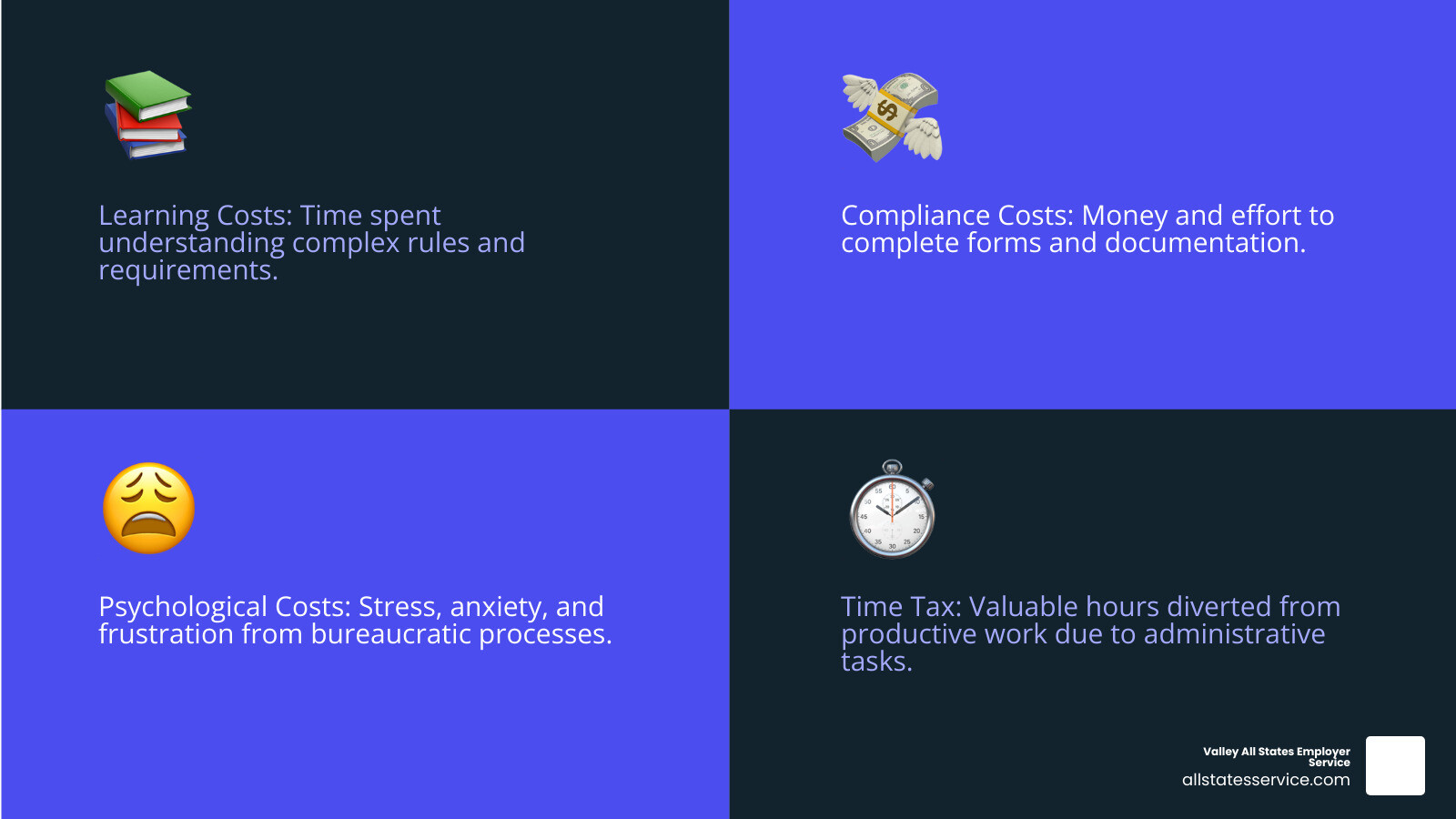
Administrative burden reduction terms made easy:
The Government’s Battle Plan: How Governments are Cutting Red Tape
Administrative burden is not just a headache for businesses, it is a recognized challenge for governments worldwide. Federal and state entities are actively developing frameworks to streamline processes, aiming to make interactions with government less cumbersome for everyone. These efforts focus on reducing the “time tax,” which is the time, effort, and money individuals and businesses spend navigating government requirements.
In the United States, the White House Office of Information and Regulatory Affairs (OIRA) has launched a significant burden reduction initiative. This initiative, started in April 2022, works with federal agencies to accurately estimate and then reduce the administrative burdens faced by the public when accessing benefits and services. The goal is to identify and implement administrative burden reduction opportunities through regulations and changes to forms, and to foster the sharing of best practices across the federal government. The Paperwork Reduction Act (PRA) serves as a foundational legal framework for these efforts, requiring agencies to minimize information collection burdens.
Across the border in Canada, a comprehensive approach to administrative burden reduction is set out in law. The Red Tape Reduction Act, assented to in 2015, specifically aims to control the administrative burden that regulations impose on businesses. A key component of this act is the “one-for-one” rule, which mandates that if a new regulation introduces an administrative burden, an existing regulation must be amended or repealed to offset that new cost.
This legislative framework helps prevent administrative burden from continuously growing. The President of the Treasury Board is responsible for establishing policies and issuing directives for this rule’s application, and annual reports are published to ensure transparency. You can learn more about federal regulatory management in Canada by visiting their Federal regulatory management page.
Similarly, Ontario, Canada, has its own robust framework. Its Modernizing Ontario for People and Businesses Act includes a “one-for-one-plus” rule, meaning that for every dollar of new compliance cost imposed on businesses, 1.25 dollars must be removed. This approach shows a strong commitment to reducing regulatory complexity and costs by focusing directly on measurable administrative burden reduction.
These federal and provincial frameworks demonstrate a clear governmental shift toward recognizing and actively addressing the impact of administrative burdens. For HR teams, understanding these overarching governmental goals can provide insight into the direction of future compliance requirements and potential areas for simplification. Managing human resources compliance effectively is crucial, and you can find more information on HR Regulatory Compliance.
Federal Agencies in Action
Federal agencies across North America are at the forefront of implementing these burden reduction strategies. In the United States, the Office of Information and Regulatory Affairs (OIRA) has highlighted numerous initiatives that directly support administrative burden reduction:
- Department of Homeland Security (DHS): They set an ambitious “20 Million Hour Burden Reduction Target,” which shows a strong commitment to freeing up public time previously spent on administrative tasks.
- Department of Agriculture (USDA): Efforts are underway to simplify loan applications for farmers, making it easier for them to access critical financial support without excessive red tape.
- Social Security Administration (SSA): The process for reviewing disability status is being streamlined, which reduces stress and paperwork for beneficiaries.
- Department of Education: They are evolving the total and permanent disability debt discharge process, aiming for greater automation and less paperwork for eligible individuals.
- Department of State: Passport renewals are being brought online, moving a traditionally paper heavy process into the digital age.
These examples show a concerted effort to make government interactions smoother and less time consuming for individuals and businesses, using practical administrative burden reduction strategies.
In Canada, federal agencies like the Canadian Food Inspection Agency (CFIA) and the Canada Energy Regulator (CER) also actively track and report on their administrative burdens. The CFIA, for instance, reported a 60% overall reduction in administrative burden compared to its 2014 baseline, despite a slight increase in 2025 due to new forms for disease containment efforts. This demonstrates a long term commitment to reducing regulatory complexities while still responding to emerging needs.
The Canada Energy Regulator (CER) also reports its administrative burden, with a total count of 6,144 requirements for 2025. This transparency helps external stakeholders understand the regulatory landscape and how new regulations, like the Canada Offshore Renewable Energy Regulations (CORER), introduce new requirements while older ones are streamlined.
Sector-Specific Reforms
Beyond federal level mandates, specific sectors are seeing targeted reforms to reduce administrative burden. These efforts often reflect unique challenges within particular industries or public services.
In the United States, there has been significant movement in areas that affect employment and public services:
- New York’s Clean Slate Act: This legislation, passed by the New York State House and Assembly, aims to streamline the process of sealing criminal records for eligible individuals. By automating the sealing of records, it removes a major administrative hurdle for individuals seeking employment and housing, and supports administrative burden reduction for people who would otherwise steer complex paperwork. For employers, this means reevaluating hiring practices and background screening policies to recognize potential talent from a broader pool of candidates.
- California’s AI Hiring Rules: California is at the forefront of regulating the use of Artificial Intelligence (AI) and automated decision systems (ADS) in employment. The California Civil Rights Council has approved regulations to ensure that AI tools used in hiring, promotion, and other employment decisions comply with anti discrimination laws. These rules require employers to understand how ADS functions, conduct anti bias testing, and maintain clear records.
While these regulations introduce some new compliance requirements, they also aim to standardize and clarify the use of AI. Over time, that clarity can support administrative burden reduction by preventing disputes, reducing confusion, and ensuring fairer hiring processes. Employers in Maryland and other states often look to California as a trendsetter in employment law, which makes these developments particularly relevant for understanding future regulatory landscapes.
Real-World Wins: Quantifying the Impact of Administrative Burden Reduction
When people talk about administrative burden reduction, they are not just discussing abstract concepts. They are talking about real money saved and valuable time reclaimed. These quantifiable impacts highlight why these initiatives are so important for businesses and individuals.

In Ontario, for instance, the government has reported impressive results. Since 2018, they have reduced the regulatory burden by nearly 6 percent. This is not a small tweak, it has translated into nearly 1.2 billion dollars in annual savings and an estimated 1.8 million hours saved for businesses, not for profits, and the broader public sector. These numbers are a powerful example of what focused administrative burden reduction can achieve. For any business, saving money and time means increased efficiency and profitability. Valley All States Employer Service is always looking for ways to Streamline HR Processes for clients that want to capture similar gains.
Healthcare: Putting Patients Before Paperwork
The healthcare sector often carries a very heavy administrative load, which affects both medical professionals and patients. The Canadian Medical Association (CMA) has been a vocal advocate for administrative burden reduction in medicine. They highlight that physicians spend millions of hours each year on administrative tasks that add little value to patient care. This hidden crisis drives physician burnout and reduces the time available for direct patient care, which can make access to care harder for many people.
A clear example of targeted reform comes from Nova Scotia, where a task force found that doctors were spending about 100,000 hours a year just on sick notes. This led to legislative changes, similar to those later adopted in Ontario, which removed the requirement for sick notes for short term absences. Policies like this are simple but powerful forms of administrative burden reduction, because they free up physician time so they can focus on treating patients instead of filling out routine forms. This shift truly puts patients before paperwork, a point that is highlighted in A 2024 report on putting patients before paperwork. Although these are Canadian examples, the principle is universal. Reducing unnecessary administrative tasks in healthcare benefits everyone.
Business and Public Services: Making Life Easier
Beyond healthcare, administrative burden reduction initiatives are making practical differences across business and public service sectors.
In the United States, the Office of Information and Regulatory Affairs (OIRA) highlights several initiatives that are designed to ease burdens:
- Unemployment Insurance: States are simplifying unemployment insurance applications using plain language, better technology, and community partnerships, which makes it easier for individuals to access critical support.
- Housing Programs: Eligibility processes for housing assistance are being streamlined through rulemaking and clearer procedures, which reduces complexity for applicants.
- Student Access to Federal Aid: Work is underway to simplify student access to federal aid, making financial assistance for higher education easier to obtain.
- Small Businesses: Some initiatives focus on simplifying processes for small business setup and success, because administrative problems can be particularly burdensome for smaller employers that do not have large compliance teams.
These examples show how targeted efforts can lead to more efficient and accessible public services. Ontario offers several useful case studies that illustrate how administrative burden reduction can work in practice:
- eWrits Efficiency: Ontario transformed its writ administration, moving from a paper based system that could take months to an electronic process, eWrits, that now takes between 24 and 48 hours for issuing a Writ of Seizure and Sale. This dramatically speeds up support enforcement for families and cuts down on paperwork.
- Additional Residential Units (ARUs): By standardizing rules for ARUs, Ontario is making it easier and faster for homeowners and builders to create more housing options. This reduces red tape and saves municipalities and homebuilders an estimated 1.7 million dollars annually in direct costs, plus significant time savings.
- Paperless Ontario Works: This initiative digitized communications for clients receiving social assistance. It is expected to save over 5.3 million dollars per year in postage and paper costs. By moving statements and other documents online, it frees up resources and makes interactions simpler for clients.
These examples underscore an important point. When governments and organizations commit to administrative burden reduction, the benefits are widespread. Individuals, families, and businesses save time, money, and stress, and public systems work more smoothly.
The Digital Revolution: Using Technology to Slash Bureaucracy
Technology is one of the most powerful tools available for administrative burden reduction. From Artificial Intelligence, AI, to digital self service portals, innovation is changing how we interact with government and how employers manage their own compliance needs.

Governments are increasingly using AI to identify and tackle red tape. In Ontario, for example, AI is being used to scan and analyze large collections of laws, regulations, and forms. This kind of analysis makes it easier to spot indicators of administrative burden and to find areas that are ready for simplification.
Digitization is also bringing many administrative processes online, which makes them more accessible and efficient. The White House Office of Information and Regulatory Affairs (OIRA) highlights several US federal initiatives that support administrative burden reduction:
- Online Passport Renewals: Moving this process online removes physical paperwork and can reduce processing times.
- Digital Veteran Services: Creating a fully digital experience for veterans streamlines access to important benefits and support.
- IRS Modernization: The IRS is working to modernize the taxpayer experience, simplifying interactions and reducing the burden of tax compliance for individuals and businesses.
Ontario has its own digital success stories that show how technology can cut through red tape:
- FRO Online: Ontario’s Family Responsibility Office (FRO) updated its online portal, making it mobile responsive and more secure. Clients can now access case information, submit documents, and complete forms anytime, which is a direct example of administrative burden reduction in everyday life.
- Online Mining Tax Payments: The Mining Land Administration System was upgraded so clients can pay taxes and lease rents online quickly and securely. This is a major improvement over past manual processes.
- Labour Relations Gateway: Ontario launched Canada’s first online platform for labour relations services. This digital gateway has significantly reduced client touchpoints and application errors, saving users considerable time.
These advancements show that technology can dramatically improve the user experience. When it is planned well, it makes compliance less daunting and more efficient, which is the core goal of administrative burden reduction.
Applying Tech in Your Business for HR Administrative Burden Reduction
The lessons from government digitization can be applied directly to your business, especially in HR. Manual HR processes, such as completing I-9 forms or conducting eligibility checks, are well known sources of administrative burden. They take time, they are prone to human error, and they can create compliance risks if they are not managed correctly.
This is where technology really helps. Automated verification systems, such as E-Verify, are game changers for administrative burden reduction in HR. Instead of manually cross referencing documents and managing paper files, these systems streamline the process of confirming an employee’s eligibility to work in the United States.
By using technology in your HR workflows, you can:
- Minimize errors: Automated systems reduce the chance of manual transcription errors or missed steps.
- Ensure compliance: E-Verify systems are designed to align with federal regulations, which gives you more confidence in your processes.
- Save time: Tasks that once took hours can often be completed in minutes, which frees your HR team for more strategic work.
- Improve record keeping: Digital records are easier to store, search, and audit when you need them.
An Automated Eligibility Verification System is not just about speed, it is also about accuracy and security. Valley All States Employer Service focuses on providing expert, impartial, and efficient E-Verify processing that is specifically designed to minimize errors and administrative burden for clients. By choosing E-Verify Outsourcing, you turn a complex compliance task into a smooth process and give your team more time to focus on growth and employee experience.
Navigating the Path Forward: Challenges and the Future of Administrative Burden Reduction
The journey toward meaningful administrative burden reduction is ongoing and it comes with both successes and real challenges. Progress usually happens step by step, through continuous improvement, careful monitoring, and attention to the experience of the people who use these systems.
The Balancing Act: Potential Challenges in the Process
While the benefits of reducing administrative burden are clear, the process itself has some built in tensions. A challenge is the difference between “modernization” and “deregulation.” True administrative burden reduction aims to make necessary compliance easier, not to remove important safeguards. The goal is to remove unnecessary friction without harming public health, public safety, or the integrity of programs.
Key challenges include:
- Ensuring Program Integrity: As administrative processes are simplified, agencies must still prevent fraud and make sure that only eligible individuals receive benefits or services. This balance is critical for maintaining public trust.
- Implementation Problems: Rolling out new digital systems or policy changes across large government agencies or diverse business sectors can be complex. It often requires investment in technology, training, and strong change management.
- Cost and Training: Initial investments in new systems or training for updated procedures can be significant. Organizations need to see the long term return on investment from administrative burden reduction to justify these upfront costs.
- Unexpected Increases: Sometimes new regulations, even well intentioned ones, can create new administrative burdens. For example, the Canada Energy Regulator noted an increase in requirements for 2025 because of new regulations, even though their overall goals include reduction.
- New Necessary Regulations: The rise of new technologies, such as AI, makes new regulatory frameworks necessary. California’s AI hiring rules are a good example. These rules aim to ensure fairness and reduce bias, but they also introduce new compliance requirements that employers must manage.
These challenges show that administrative burden reduction is not a one time project. It is an ongoing process that requires planning, feedback from users, and a willingness to adjust.
What’s on the Horizon for Administrative Burden Reduction?
Even with these challenges, momentum for administrative burden reduction continues to grow. In the United States and Canada, there is a strong focus on regular reviews and a better experience for individuals and businesses.
- Ongoing Government Reviews: Federal agencies continue to review their regulations and processes. The Administrative Conference of the United States (ACUS) actively researches and recommends best practices for identifying and reducing burdens on the public. Its Recommendation 2023-6 highlights public engagement, process simplification, and digitization as key strategies.
- The US White House Burden Reduction Initiative: This initiative remains a central focus, with ongoing efforts to share leading practices and tools across federal agencies. The aim is to build on progress like the Department of Homeland Security’s 20 million hour burden reduction target. You can stay connected with these efforts through the White House’s Burden Reduction Initiative.
- Focus on Customer-Centric Services: A major trend is the shift toward designing government services with the user in mind. This includes clearer communication, easier access, and processes that reduce psychological costs such as stress and frustration. This approach, often called human centered design, is being adopted across programs to improve the experience of interacting with government.
- Technology as an Enabler: Continued advances in technology will play an even larger role in administrative burden reduction. AI will become more capable at identifying inefficiencies, and digital platforms will become more integrated, which can create smoother experiences across different government services.
For employers, especially those managing complex hiring and verification processes, these trends are a signal. It is worth looking for similar opportunities to apply administrative burden reduction principles inside your own organization, particularly in HR and compliance.
Turning Compliance from a Burden into a Benefit
The move from red tape to red carpet is more than a catchy phrase, it is a practical shift in how you manage your business. Administrative burden reduction is not only about cutting costs, although the financial and time savings are very real. It is about turning compliance from a distraction into a system that supports your long term goals.
When you accept the core ideas behind administrative burden reduction, such as digitizing manual tasks, using automated systems, and partnering with experts, you open up several advantages:
- You save time and money that would have been spent on repetitive paperwork.
- You improve accuracy and reduce the risk of costly errors.
- You free up HR and leadership teams to focus on people, culture, and growth.
For businesses in the United States, including those in Maryland and Lutherville MD, staying in front of employment compliance requirements is not optional. Outsourcing complex tasks like E-Verify workforce eligibility verification to a trusted partner such as Valley All States Employer Service allows you to handle the regulatory landscape with more confidence. Our focus on expert, impartial, and efficient E-Verify processing is designed to lower your administrative burden, not add to it.
Ready to simplify hiring compliance and put administrative burden reduction to work in your organization? Explore our complete guide to employee onboarding compliance, and see how a smarter approach to verification and documentation can become a real competitive advantage.