
Why an External Payroll System is Your New Best Friend
What Is an External Payroll System (And Why It Matters for Your Business)
An external payroll system is a third-party service that takes over your payroll operations, handling everything from wage calculations and tax withholdings to direct deposits and year-end filings, so your team doesn’t have to.
Here’s a quick breakdown of what that means in practice:
| What It Covers | What You Keep Control Of |
|---|---|
| Wage calculations and deductions | Pay schedules and employee classifications |
| Tax filings and deposits | Final approval before payroll runs |
| Direct deposit and W-2s | Benefits and compensation decisions |
| Compliance monitoring | Hiring and HR strategy |
| Garnishment management | Access to real-time reports |
If you’ve ever felt like payroll was eating your week, you’re not imagining it.
Research from Paychex found that nearly two-thirds of business leaders spend at least 11 hours every week on HR administration. That’s more than a quarter of your entire workweek, gone, before you’ve touched a single strategic task.
And it’s not just the time. The IRS assessed $26.8 billion in civil penalties on employment tax returns in fiscal year 2024 alone. One missed deadline or miscalculated withholding can turn a routine payroll run into a very expensive problem.
As one payroll expert put it plainly: “In theory, people think payroll’s easy, but really, it’s not. It’s not just entering in hours.”
That’s exactly why so many HR managers and business owners are turning to external payroll systems, not as a luxury, but as a practical way to protect their business, free up their time, and stop worrying about whether this month’s tax filing is correct.
In this guide, we’ll walk you through how these systems work, what they cost, what to look for in a provider, and how to know when it’s time to make the switch.
Simple external payroll system glossary:
- accounting and payroll services for small business
- global payroll solution
- web based payroll service
Understanding the External Payroll System Model
When we talk about an external payroll system, we are describing a partnership where a specialized company handles the heavy lifting of employee compensation. In the past, this might have meant mailing paper ledgers back and forth. In April 2026, it means using sophisticated, cloud-based technology that connects directly to your business operations.
Modern systems are designed to be a “single source of truth.” Instead of jumping between spreadsheets, tax tables, and bank portals, you use a unified platform. Leading payroll solutions offer continuous pay calculations, meaning the system updates in real-time as employees log their hours. This eliminates the frantic “payroll Friday” rush because the data is always ready.
Using a web based payroll service allows your team to access vital information from anywhere. Whether you are in Lutherville, MD, or managing a remote team across the United States, the system stays synchronized. It handles the “logistics” of pay so you can focus on the “people” side of your business. If you want a neutral overview of how payroll works at a basic level, the Internal Revenue Service payroll tax guide is also a helpful reference.
How Outsourcing Works in 2026
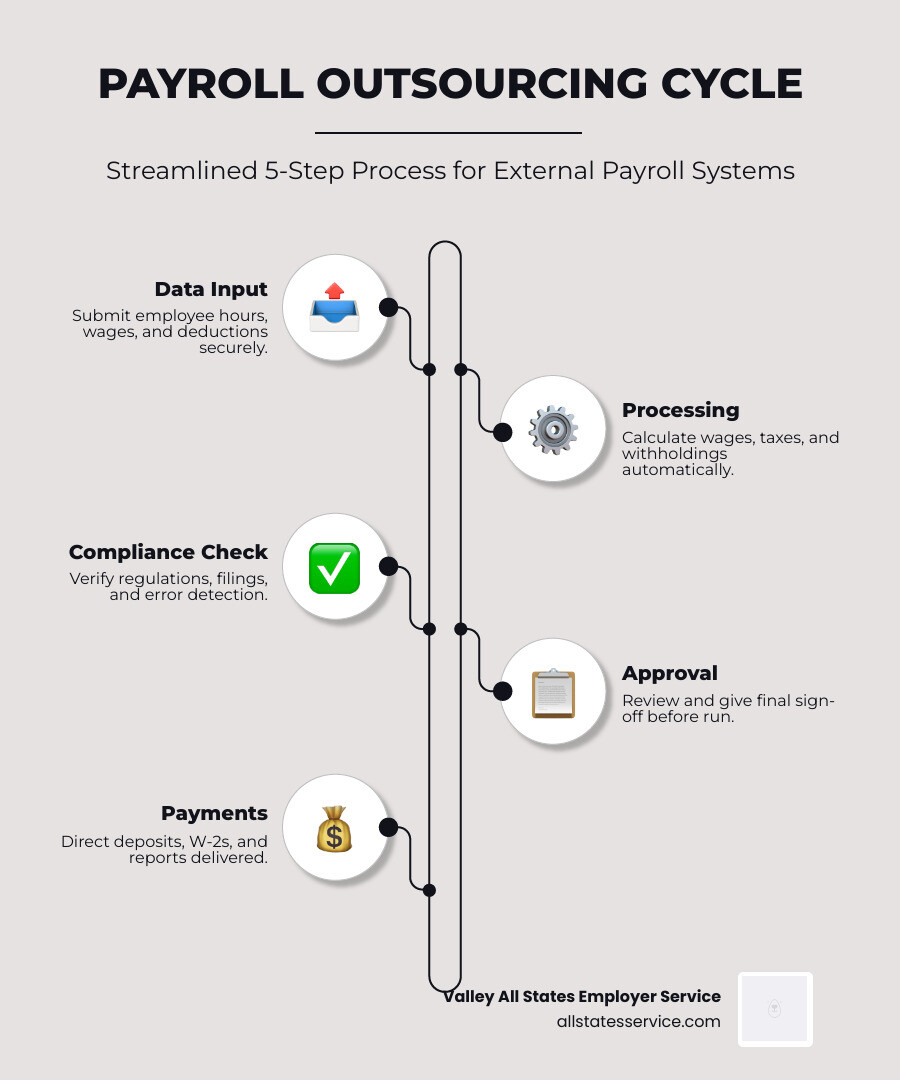
The process is much simpler than most people realize. First, we integrate your employee data into the provider’s platform. This includes everything from tax ID numbers to bank account details for direct deposits. Once the foundation is set, the workflow becomes largely automated.
Every pay period, your time and attendance data flows into the system. The external payroll system automatically calculates gross pay, withholds the correct federal, state, and local taxes, and accounts for voluntary deductions like health insurance or 401(k) contributions. For a deeper dive into these mechanics, check out The Complete Guide To Employee Payroll Solutions.
Common Services Included
What exactly are you getting when you move to an external model? Most full-service providers offer a comprehensive suite of features:
- Wage and Tax Calculations: Precise math for every employee, regardless of their pay type (salary, hourly, or commission).
- Direct Deposit and Paycards: Electronic distribution of funds, which is faster and more secure than paper checks.
- Tax Filing and Remittance: The provider calculates, withholds, and pays your payroll taxes to the appropriate agencies.
- Year-End Processing: Generating and distributing W-2 and 1099 forms to your workforce.
- Garnishment Management: Handling court-ordered withholdings like child support or tax levies, which can be legally complex.
- New Hire Reporting: Automatically notifying the state about new employees to comply with federal law.
- Employee Self-Service: Portals where staff can download their own pay stubs and tax forms without bothering the HR department.
Why Outsourcing Payroll is a Game Changer for Efficiency
Efficiency isn’t just about moving faster, it’s about moving smarter. When you implement an external payroll system, you are essentially buying back time and security. Statistics show that companies that outsource their payroll can cut operating costs by up to 18%. This happens because you no longer need to pay for expensive internal software licenses, dedicated payroll staff, or the “hidden cost” of manual errors.
Beyond the numbers, outsourcing provides a mental relief that is hard to quantify. When 57% of HR professionals report they are working beyond their capacity, removing the most repetitive and high-risk task from their plate can transform the office culture. It allows your team to focus on strategic growth rather than data entry. For more on this, see our Outsourced Hr Compliance Ultimate Guide.

Avoiding Costly IRS Penalties
We mentioned the $26.8 billion in IRS penalties earlier, and it’s worth repeating. Tax laws change constantly. In Maryland alone, local tax rates and withholding rules can shift annually. Keeping up with these changes in-house is a full-time job.
An external payroll system acts as your compliance shield. Providers employ teams of tax experts whose only job is to monitor regulatory changes in all 50 states. If a tax rate changes in Baltimore or a new filing requirement is introduced federally, the system is updated automatically. This proactive approach is why many businesses choose to outsource payroll before they lose their mind.
Reclaiming Your Workweek
Think about what you could do with an extra 11 hours every week. That is nearly 600 hours a year returned to your business. By using an external payroll system, you empower your employees to handle their own administrative needs.
If an employee needs a copy of a pay stub for a mortgage application, they don’t have to email you. They simply log into the mobile app and print it. If they move to a new address, they update it in the system themselves. These small “self-service” moments add up to massive time savings for management. If you are running an accounting firm or a high-volume business, you can unlock efficiency by letting technology handle the mundane tasks.
Comparing In-House Management vs. Outsourced Solutions
The “In-House vs. Outsourced” debate often comes down to a feeling of control. Some owners worry that if they don’t hit the “submit” button themselves, they won’t know what’s happening. However, modern external systems actually provide more visibility than traditional paper-based in-house methods.
| Feature | In-House Management | External Payroll System |
|---|---|---|
| Data Security | Dependent on office locks/local PCs | Bank-level encryption & off-site backups |
| Error Risk | High (Manual entry/Excel errors) | Low (Automated calculations & audits) |
| Cost Structure | High fixed costs (Staff/Software) | Variable (Pay-as-you-go per employee) |
| Compliance | Your responsibility to track laws | Provider’s responsibility to stay current |
| Accessibility | Limited to the office computer | 24/7 access via cloud and mobile |
While in-house management might feel like it offers more control, it often leads to “app-hopping” and data silos. You can read more about making this choice in The Small Business Owners Playbook.
Security and Data Privacy in an External Payroll System
Employee data is sensitive. Social Security numbers, bank details, and home addresses are prime targets for cybercriminals. A reputable external payroll system uses security measures that most small to mid-sized businesses simply cannot afford on their own.
Look for providers that are SOC-certified and use advanced encryption. High-end systems even use dedicated, non-outsourced servers to ensure that your data never leaves their direct control. These systems are monitored 24/7 for suspicious activity, providing a level of protection that far exceeds a password-protected spreadsheet on a desktop computer.
Scalability for Growing Teams
If your business is successful, it’s going to grow. That might mean hiring your first out-of-state employee or even expanding internationally. Managing payroll for a team in Maryland is one thing, but once you add employees in Virginia, Pennsylvania, or Florida, the tax complexity triples.
An external payroll system scales with you. It doesn’t matter if you have five employees or five hundred; the system handles the multi-state tax registrations and local filings seamlessly. For those looking at international teams, these systems are essential for navigating the maze of foreign labor laws and currencies.
Essential Features to Look for in a Provider
Not all providers are created equal. When you are shopping for an external payroll system, you aren’t just buying software; you are choosing a long-term business partner.

Pricing Factors for Your External Payroll System
Pricing can be tricky, so it’s important to look past the “headline” rate. Most businesses can expect to spend between $30 and $100 per person each month for outsourcing. However, the total cost is influenced by several factors:
- Base Fee: A flat monthly or per-payroll fee just to use the service.
- Per-Employee Fee: A cost for every person on your payroll.
- Frequency: Some providers charge more if you run payroll weekly versus bi-weekly.
- Add-on Services: Fees for benefits administration, time tracking, or specialized reporting.
- Hidden Fees: Watch out for “year-end” fees for W-2 printing or “setup fees” that aren’t disclosed upfront.
We always recommend looking for affordable payroll services that offer transparent, flat-rate pricing so you can budget accurately as you hire.
Integration with HR and Compliance Tools
Your payroll doesn’t exist in a vacuum. It needs to “talk” to your accounting software (like QuickBooks) and your time-tracking tools. A top-tier external payroll system will offer pre-built integrations that allow data to flow smoothly between these apps.
One of the most critical integrations for modern compliance is E-Verify. At Valley All States Employer Service, we specialize in this specific area. When your payroll system integrates with workforce eligibility verification, you ensure that every person getting a paycheck is legally authorized to work. This is a massive “power up” for employment agencies and growing businesses that need to stay audit-ready.
Frequently Asked Questions about Payroll Outsourcing
Is an external payroll system secure for sensitive data?
Yes, in fact, it is usually much more secure than in-house methods. Reputable providers use bank-level encryption, multi-factor authentication, and secure off-site servers. They also undergo regular third-party audits (like SOC 1 and SOC 2) to prove their security protocols are working.
How much control do I retain over my payroll?
You retain full control over the most important decisions. You decide the pay rates, the schedules, and who gets hired or fired. The external payroll system simply follows your instructions to handle the math and the filings. Most systems require your final “one-click” approval before any money actually moves.
When is the right time to switch to a provider?
If you are spending more than a few hours a month on payroll, or if you’ve recently received a tax penalty notice, the time is now. Other signs include expanding into new states, feeling that your HR team is over capacity, or struggling to keep up with new labor laws.
Final Thoughts
Making the move to an external payroll system is one of the most effective ways to modernize your business operations. It transforms a stressful, high-risk chore into a streamlined, automated process that runs in the background. By reclaiming those 11 hours a week, you can get back to the work that actually grows your company.
At Valley All States Employer Service, we understand that payroll is only one piece of the compliance puzzle. While your payroll provider handles the checks and taxes, we provide expert, impartial, and efficient E-Verify processing to ensure your workforce eligibility is always in order. Together, these tools minimize your administrative burden and protect your business from errors.
Ready to simplify your operations and secure your workforce? Explore our payroll outsourcing solutions and see how we can help you stay compliant while you focus on your mission. Contact our team today to learn more about our specialized E-Verify services.