
Why Getting I-9 Documents Right Matters for Your Business
What is acceptable I-9 documentation? In plain terms, these are the specific identity and work authorization documents that federal law allows you to accept when you complete Form I-9 for a new hire. Every employee must present either one document from List A (which proves both identity and work authorization) OR a combination of one document from List B (proving identity) plus one document from List C (proving work authorization).
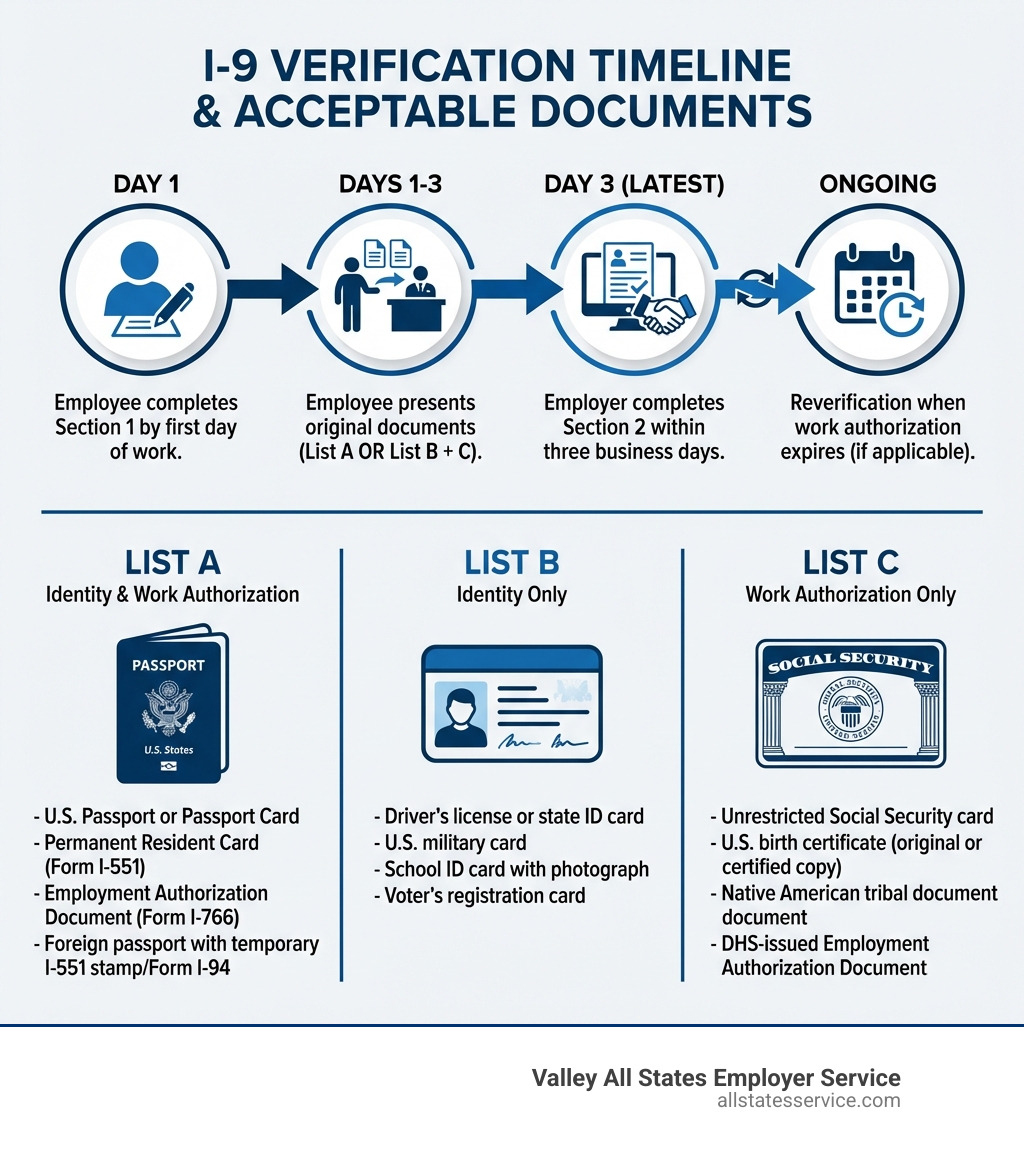
Here is the quick breakdown of what counts as acceptable I-9 documentation:
List A Documents (identity + work authorization):
- U.S. Passport or U.S. Passport Card
- Permanent Resident Card (Form I-551)
- Employment Authorization Document (Form I-766)
- Foreign passport with temporary I-551 stamp or Form I-94
List B Documents (identity only):
- Driver’s license or state ID card
- U.S. military card
- School ID card with photograph
- Voter’s registration card
List C Documents (work authorization only):
- Unrestricted Social Security card
- U.S. birth certificate (original or certified copy)
- Native American tribal document
- Employment authorization document issued by DHS
You may have been in this situation. A new employee starts on Monday, and a few days later you are holding their documents and asking yourself, “Is this really acceptable I-9 documentation? Can I sign off on this without creating a problem for my business?” One mistake on employment eligibility verification can lead to penalties that range from $573 to more than $20,000 per violation.
The positive side is that once you understand the three lists and a few simple rules, I-9 verification becomes very manageable. You do not need to be a document expert. You just need to know which documents are acceptable I-9 documentation, what they should look like, and what basic questions to ask.
This guide walks through everything in plain English, from the basic I-9 rules to special situations like receipts and automatic extensions. By the end, you will have a clear roadmap for almost every I-9 scenario you are likely to see in your workplace.
Similar topics to what is acceptable I-9 documentation:
The Three Lists of I-9 Documents Explained
The purpose of Form I-9 is simple: to verify the identity and employment authorization of individuals hired in the United States. This is a federal requirement, and using the right documents protects your business from avoidable fines and helps you maintain a compliant workforce. When you understand what is acceptable I-9 documentation, the process becomes a consistent, repeatable step in onboarding.
When it comes to what is acceptable I-9 documentation, the rules are structured around three lists: List A, List B, and List C. An employee must present either one document from List A OR a combination of one document from List B and one document from List C. This “A, B, C rule” is the foundation of I-9 compliance.
The employee gets to choose which documents they present from these lists. As employers, we cannot specify which documents an employee must provide. This is a crucial anti-discrimination measure. Our role is to examine the documents they choose and determine if they reasonably appear to be genuine and relate to the person presenting them.
Employees must present these original, unexpired documents within three business days of their first day of work for pay. If they start on a Monday, for example, they need to show us their documents by Thursday. If employment is for less than three business days, the documents must be presented no later than the first day of employment. Photocopies are generally prohibited, with the sole exception of a certified copy of a birth certificate.
You can find the official Lists of Acceptable Documents directly on the I-9 Form itself. Take a look at an example here to familiarize yourself.
List A: One and Done
List A documents are the simplest path to I-9 compliance. When an employee presents a document from List A, it establishes both their identity and their employment authorization. It is a “one and done” situation. We do not need to ask for any other documents. This streamlines the process significantly for both the employee and us.
Lists B and C: The Combination
If an employee does not have a List A document, they will need to provide one document from List B and one document from List C.
- List B documents establish identity only. These documents prove who the person is.
- List C documents establish employment authorization only. These documents prove the person is legally allowed to work in the U.S.
It is vital that they present both an unexpired List B document and an unexpired List C document together. One without the other is not sufficient under the rules for what is acceptable I-9 documentation.
List A: Documents That Establish Both Identity & Employment Authorization
These are the power players of I-9 documentation because they kill two birds with one stone, so to speak. When we see one of these, we know the employee has proven both who they are and that they can legally work.
Here are the specific documents accepted under List A:
- U.S. Passport or U.S. Passport Card: This is often the most straightforward document to present. It clearly identifies the individual as a U.S. citizen and confirms their right to work.
- Permanent Resident Card (Form I-551): Also known as a “Green Card,” this document signifies lawful permanent resident status, granting both identity and work authorization. It’s important to know that USCIS redesigns these cards periodically, but older designs remain valid until their expiration date.
- Employment Authorization Document (Form I-766): Often called an EAD card, this document is issued by the Department of Homeland Security (DHS) to non-citizens authorized to work in the U.S. Like the Permanent Resident Card, older versions are still valid.
- Foreign passport with a temporary I-551 stamp or printed notation on a machine-readable immigrant visa: This combination serves as temporary evidence of lawful permanent resident status.
- Foreign passport with Form I-94 or Form I-94A with an endorsement of nonimmigrant status: This applies to certain nonimmigrants (like H-1B, L-1, F-1 OPT students) who are authorized to work for specific employers. The Form I-94 must be unexpired, match the passport name, and clearly indicate work authorization.
- Passport from the Federated States of Micronesia (FSM) or the Republic of the Marshall Islands (RMI) with Form I-94/I-94A: These are special cases under the Compacts of Free Association, allowing citizens of these nations to work in the U.S.
- Form I-571, Refugee Travel Document: This document is issued to refugees and provides both identity and employment authorization.
It’s worth noting that some List A documents are actually a combination of two or more documents that together count as one List A document. Always ensure all parts of the combination are present and valid.
What is Acceptable I-9 Documentation from Lists B and C?
When an employee does not have a List A document, they will need to combine one document from List B to prove identity with one document from List C to prove employment authorization. This is one of the most common methods of verification, so having a clear picture of what is acceptable I-9 documentation in these lists is important for every hiring manager.
What is acceptable I-9 documentation for List B (Identity)?
List B documents are all about proving who the employee is. They do not say anything about work eligibility, so they always need to be paired with a List C document. All List B documents must be unexpired.

Here are the most common examples of what is acceptable I-9 documentation for List B:
- Driver’s license or ID card issued by a U.S. state or outlying possession: This is the most frequently presented List B document. It must include a photograph or identifying information such as name, date of birth, gender, height, eye color, and address.
- ID card issued by federal, state, or local government agencies: This could include non-driver ID cards, provided they contain the necessary identifying information and a photograph.
- School ID card with a photograph: Many students, especially those in high school or college, use this.
- Voter’s registration card: This document helps establish identity.
- U.S. military card or draft record: These documents are accepted for identity verification.
- Military dependent’s ID card: Also acceptable for identity verification.
- U.S. Coast Guard Merchant Mariner Card: This specialized ID is also on the list.
- Native American tribal document: These documents are issued by federally recognized Native American tribes.
- Driver’s license issued by a Canadian government authority: This is a specific exception for foreign driver’s licenses.
Special Considerations for Individuals Under 18:
For individuals under 18 years of age who are unable to present a standard List B document, there are alternative options that still count as acceptable I-9 documentation for identity:
- School record or report card
- Clinic, doctor, or hospital record
- Day-care or nursery school record
If an employer participates in E-Verify, and an employee presents a List B document, that document must include a photograph. This is an important distinction for E-Verify users.
What is acceptable I-9 documentation for List C (Employment Authorization)?
List C documents confirm that an employee is authorized to work in the U.S. They must always be presented with a List B document. Like all other documents, List C documents must be unexpired.
Here is what is acceptable I-9 documentation for List C:
- Unrestricted Social Security Account Number card: This is a very common List C document. However, there are crucial restrictions. We cannot accept Social Security cards that include any of the following notations:
- “NOT VALID FOR EMPLOYMENT”
- “VALID FOR WORK ONLY WITH INS AUTHORIZATION”
- “VALID FOR WORK ONLY WITH DHS AUTHORIZATION”
These notations mean the card is not valid for I-9 purposes. Also, laminated Social Security cards are generally not accepted.
- Original or certified copy of a birth certificate issued by a U.S. state, county, municipal authority, or outlying possession: These documents must bear an official seal. Puerto Rico birth certificates issued before July 1, 2010, are generally not acceptable due to fraud concerns.
- Certification of Report of Birth (Form FS-545 or Form DS-1350) issued by the U.S. Department of State: These certify U.S. citizenship for those born abroad.
- U.S. Citizen ID Card (Form I-197): This card is proof of U.S. citizenship.
- Identification Card for Use of Resident Citizen in the United States (Form I-179): Another form of identification for resident citizens.
- Employment authorization document issued by DHS: This is a broad category that includes various documents from the Department of Homeland Security that prove work authorization. Examples include:
- Form I-94 Arrival/Departure Record issued to asylees or work-authorized nonimmigrants, for example those with a refugee stamp or an “RE” notation
- Form I-327, Reentry Permit, if unexpired
- Form I-571, Refugee Travel Document, if unexpired
- Certificate of U.S. Citizenship (Form N-560 or N-561)
- Certificate of Naturalization (Form N-550 or N-570)
- Certain Forms I-797 for conditional residents, in combination with an expired Form I-551
- Native American tribal document: These documents can also establish employment authorization.
Employer Responsibilities: Examining Documents & Avoiding Discrimination
Our responsibilities as employers go beyond simply checking boxes. We must ensure the documents we examine meet federal standards for what is acceptable I-9 documentation while also upholding anti-discrimination laws.
The standard we operate under is that documents must “reasonably appear to be genuine and relate to the person presenting them.” We are not expected to be document fraud experts. If a document looks legitimate and appears to belong to the employee, we should accept it. If it does not, or if we suspect it is fraudulent, we should reject it and ask the employee for other acceptable documents. We cannot, however, ask for more or different documents than what is required, or discriminate based on perceived national origin or citizenship status.
A common area of confusion is handling expiration dates. All documents with an expiration date must be unexpired when presented. However, it is crucial to understand that documents with expiration dates do not automatically mean a person will lose work authorization when the card expires. We should not use a document’s expiration date to decide if an individual is qualified for a position, as this could lead to a violation of employment discrimination laws. For example, a Permanent Resident Card (Green Card) has an expiration date, but lawful permanent residents have continuous work authorization.
There are also instances of automatic extensions. For example, certain Employment Authorization Documents (EADs) may remain valid past their printed expiration date because of USCIS automatic extensions. It is important to stay informed about these extensions, which are typically announced through Federal Register notices. If an employee presents such a document, we should accept it and note the extension in the “Additional Information” field of Form I-9.
Reverification is a key part of our ongoing I-9 responsibilities. We must reverify an employee’s employment authorization when a List A or List C document with a temporary authorization date expires. However, reverification is not required for U.S. citizens, noncitizen nationals, or lawful permanent residents who presented a Permanent Resident Card (Form I-551), as their work authorization is continuous. Reverification never applies to List B identity documents.
To avoid discrimination, we must never specify which documents an employee must present. We present the Lists of Acceptable Documents and let the employee choose. For more comprehensive guidance, we can refer to USCIS guidance on acceptable documents.
The Receipt Rule: What to Do When Documents Are Lost, Stolen, or Damaged
Life happens. Sometimes, an employee’s documents are lost, stolen, or damaged. Fortunately, there is a “receipt rule” that allows for temporary acceptance of proof that a replacement document has been requested.
There are three types of acceptable receipts:
- A receipt for a replacement of a lost, stolen, or damaged List A, List B, or List C document.
- The arrival portion of Form I-94/I-94A with a temporary I-551 stamp and a photograph of the individual, which functions as a temporary List A document for lawful permanent residents.
- The arrival portion of Form I-94/I-94A with an “RE” (refugee) endorsement or a refugee stamp, which functions as a temporary List A document for refugees.
When an employee presents an acceptable receipt for a replacement document, they have a 90-day grace period from the date of hire, or reverification if that applies, to present the actual replacement document. We must then update their Form I-9 with the information from the new document.
It is important to remember two key restrictions:
- We cannot accept a receipt showing the employee has applied for an initial grant of employment authorization. The receipt rule only applies to replacements for existing authorization.
- We also cannot accept receipts if employment is for less than three business days. In such cases, the actual, unexpired documents must be presented on the first day of employment.
Managing receipts correctly is a core part of staying compliant with the rules around what is acceptable I-9 documentation. It offers some flexibility for employees while still ensuring we ultimately obtain proper documents.
Conclusion: Simplify Your I-9 and E-Verify Process
Navigating the rules around what is acceptable I-9 documentation might seem like a complex task at first, but it becomes very manageable with the right knowledge and a consistent checklist. You do not need to be an immigration attorney to protect your business, you just need a clear process that your team follows every time you hire.
Here are the core ideas to keep in mind:
- An employee chooses to present either one List A document, or one List B and one List C document.
- All documents must be original and unexpired, unless a specific automatic extension applies.
- You are not a document expert, accept documents that reasonably appear genuine and relate to the person.
- Never discriminate or specify which documents an employee must provide.
- Understand the rules for acceptable receipts and reverification.
I-9 compliance is more than just a legal obligation. It is part of building a lawful, fair, and reliable workforce. When you know what is acceptable I-9 documentation and you apply the rules the same way for every worker, you reduce risk and create a smoother onboarding experience.
For businesses that want to streamline employment verification and avoid I-9 and E-Verify headaches, expert services like those from Valley All States Employer Service can handle the complexities of E-Verify for you. Our team focuses on accurate, impartial, and efficient E-Verify processing, which reduces administrative burden and lowers the chance of costly mistakes.
Ready to take the guesswork out of I-9 verification and E-Verify? Get the ultimate guide to I-9 acceptable documents or contact our team today to learn how we can support your business.