
Why Verifying Your Identity Online is More Important Than Ever
Identity check online services are digital tools that confirm you are who you claim to be. They work by verifying your documents (like a driver’s license or passport), matching your face to your photo ID, and checking your personal details against trusted databases.
Quick Overview: How Online Identity Checks Work
- Submit Your Documents – Upload photos of your government-issued ID (passport, driver’s license, or state ID)
- Take a Selfie – Capture a live photo to match against your ID
- Verify Your Details – Enter personal information like your Social Security number
- Get Verified – Most checks complete in minutes, with results delivered instantly
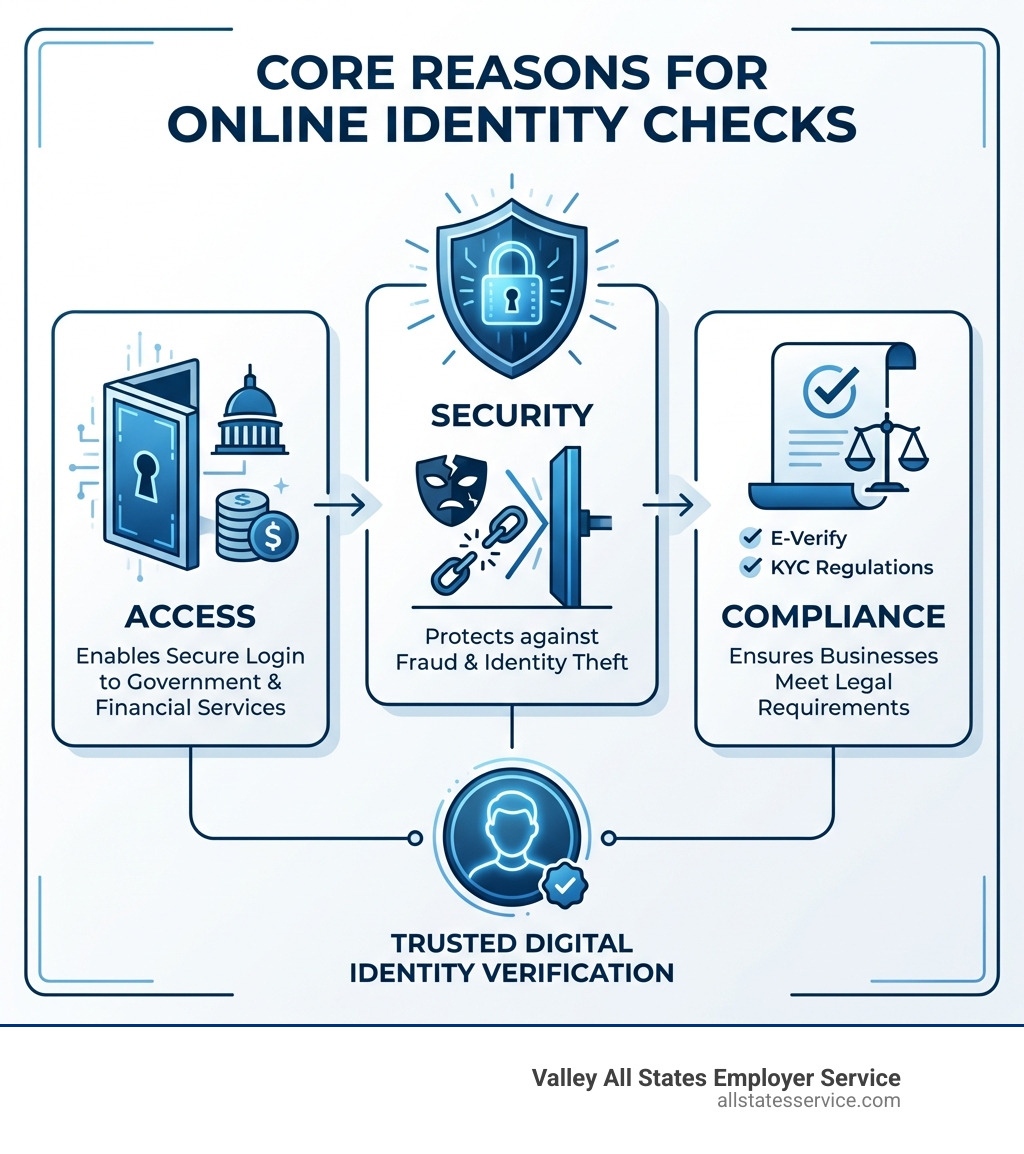
The digital age has transformed how we live and work. We bank online, access government services from our phones, and manage our entire professional lives through the internet. But this convenience comes with a cost.
Identity fraud is growing every year. According to UK government data, the number of identities being used to commit fraud continues to rise. Fraudsters create synthetic identities, steal personal information, and impersonate real people to access services, benefits, and sensitive data they’re not entitled to.
That’s why online identity verification has become essential. Whether you’re applying for a job, opening a bank account, or accessing government services through platforms like Login.gov or ID.me, you’ll need to prove you’re really you.
For employers, the stakes are even higher. Hiring the wrong person, or failing to properly verify an employee’s identity and work authorization, can lead to serious legal consequences. The IRS now uses ID.me to verify taxpayer identities. Businesses must comply with Form I-9 and E-Verify requirements. And platforms like Persona and iDenfy verify millions of users for companies worldwide.
The good news? Modern identity verification is faster, safer, and more accessible than ever. Services like iDenfy extract data from 3,500+ government documents in just 0.02 seconds. ID.me verifies identities in minutes. And these systems are built with robust security measures to protect your personal information.
The A-Z of an Identity Check Online: Methods and Steps
Understanding how an identity check online works can explain the process and help you steer it smoothly. We’ll walk you through the common methods and the steps involved.
Common Verification Methods Explained
Online identity verification relies on a combination of advanced technologies to ensure accuracy and security. Here are the primary methods you’ll encounter:
- Document Scanning: This is often the first step. You’ll be asked to upload images of your government-issued identification documents. Modern systems, like iDenfy, can extract data from over 3,500 active government-issued documents in as little as 0.02 seconds. This rapid data extraction allows for quick processing. These systems then compare your document against a vast and continuously updated library of authentic IDs, checking for signs of tampering or forgery. This secure ID authentication process often involves verifying documents against extensive databases.
- Biometric Verification: This method uses unique biological characteristics to confirm your identity.
- Liveness Detection: This technology ensures that the person presenting the ID is a live individual and not a spoof (like a photo or video). It often involves asking you to perform a simple action, such as turning your head or blinking, during a live video feed. This helps prevent fraudsters from using static images.
- Selfie Comparison: After scanning your document, you’ll typically be asked to take a selfie. The system then uses facial recognition technology to compare your live image against the photo on your ID document. This “face match” ensures the person completing the check is indeed the owner of the document. For instance, ID.me requires users to take a selfie with a smartphone or webcam as part of their verification process.
- Knowledge-Based Authentication (KBA): Sometimes, systems will ask you personal questions based on information only you would know. These questions are usually drawn from public or proprietary databases and can help further confirm your identity if other methods are inconclusive.
Your Step-by-Step Guide to a Successful Identity Check online
Completing an identity check online doesn’t have to be daunting. Follow these steps for a smooth experience:
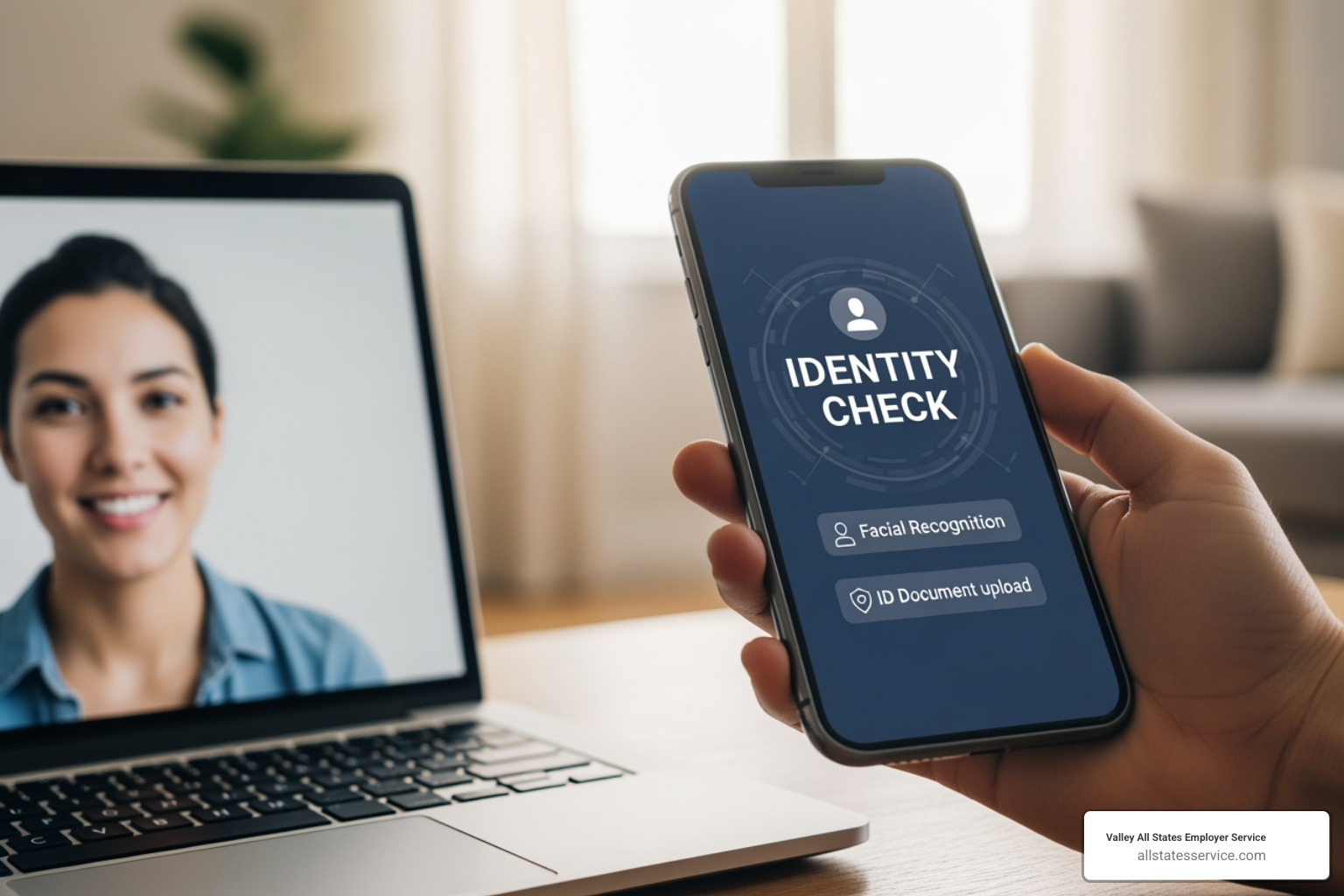
- Gather Your Documents: Before you begin, have your required identification documents ready. For services like Login.gov, you’ll need a U.S. Driver’s License, state ID, or passport book, along with your Social Security number and a U.S. phone number or mailing address.
- Take Clear Photos: When prompted, take high-quality, well-lit photos of your ID document. Ensure all corners are visible, the text is legible, and there’s no glare. Blurry or cut-off images are a common reason for delays.
- The Selfie Step: If required, prepare to take a live selfie. Follow the on-screen instructions carefully, ensuring your face is well-lit and centered. This is crucial for the biometric comparison.
- Entering Personal Data: Accurately enter your personal information, such as your Social Security number, name, and address. These details are cross-referenced with official records to confirm your identity. Login.gov, for example, enters your Social Security number to verify your personal information against records.
- Consent and Privacy: Reputable platforms will always ask for your consent before sharing your verified information with any partner agency. They adhere to high data protection standards. We always prioritize your privacy and security throughout this process.
For a detailed guide on verifying your identity, especially for government services, you can visit How to verify your identity.
Overcoming Common Verification Problems
Even with the best intentions, you might encounter a snag during your identity check online. Here are some common challenges and how to overcome them:
- Blurry Images: This is the most frequent issue. Ensure you have good lighting, a steady hand, and that your camera lens is clean. Retake photos until all text is sharp and clear.
- Expired Documents: Always use a valid, unexpired government-issued ID. Most online verification systems will reject expired documents.
- Name Mismatches: If your name on the document doesn’t exactly match the name you’re providing, it can cause a flag. This can happen due to recent name changes. Ensure consistency or be prepared to provide additional documentation if requested. For more on how identity checks relate to personal information, explore our insights on Social Security & Identity Checks.
- Poor Lighting: Insufficient or uneven lighting can lead to failed liveness detection or document scans. Find a well-lit area, ideally with natural, diffused light, to complete your verification.
- Connectivity Issues: A stable internet connection is vital for uploading documents and live video feeds. If your connection is spotty, try moving to an area with stronger Wi-Fi or cellular service.
Who’s Who in Identity Verification: From Government to Business
The landscape of online identity verification is diverse, with solutions custom for both public and private sectors. Let’s look at some key players.
Government and Public Sector Platforms
Government agencies are increasingly relying on robust identity check online systems to provide secure and convenient access to digital services.
- Login.gov: This is a secure government website designed to simplify access to various federal agency services with a single, trusted account. It requires users to verify their identity using a U.S. Driver’s license, state ID, or passport book, a Social Security number, and a U.S. phone number or mailing address. Login.gov emphasizes data security and privacy, asking for user consent before sharing verified information with partner agencies.
- IRS and ID.me Partnership: The Internal Revenue Service (IRS) has partnered with ID.me, a trusted technology provider, to improve the security of taxpayer access to online IRS tools. This means that to access services like your Online Account, Get Transcript Online, or the Child Tax Credit Update Portal, you’ll need to verify your identity through ID.me. This process involves providing a photo of an identity document (like a driver’s license, state ID, or passport) and taking a selfie. This initiative is part of the IRS’s Identity, Credential, and Access Management (ICAM) strategy, aimed at providing a mobile-friendly platform and an improved user experience. You can find more details at the ID.me IRS Help Site.
- Single Sign-On Benefits: Platforms like Login.gov and ID.me offer the significant advantage of single sign-on (SSO). This means you can use one verified identity to access multiple government services, reducing the need for numerous usernames and passwords, which in turn improves security and convenience. This approach tackles the challenge of current online login processes that lead to “more passwords, higher vulnerability, and increased risk.”
Leading Commercial Solutions
Beyond government, many private companies specialize in providing sophisticated identity check online solutions for businesses across various industries.
- Persona: Persona is a leader in identity verification, recognized in both the 2025 Gartner® Magic Quadrant™ and The Forrester Wave™ for Identity Verification Solutions. Their configurable platform adapts to diverse business needs, from identity verification to Know Your Customer (KYC), Anti-Money Laundering (AML), Know Your Business (KYB), and age assurance. Persona emphasizes a multi-layered approach to fraud prevention, even detecting AI-based face spoofs, and offers granular control over Personally Identifiable Information (PII) for regulatory compliance. Businesses trust Persona to verify millions of users each month with minimal friction.
- iDenfy: iDenfy prides itself on speed and cost-effectiveness. Trusted by over 1,000 businesses, they verify millions of users, claiming to be 3x faster and up to 70% lower in costs. Their system extracts data from documents in 0.02 seconds and offers 24/7 human supervision within 3 minutes for complex cases. iDenfy’s comprehensive approach includes checking against a library of 8,500+ government-issued IDs from 195 countries and using 3D liveness verification to combat fraud. They even optimize budgets by covering costs for certain declined verification attempts.
- Yoti: Yoti is another digital identity company that aims to make it safer for people to prove who they are. They offer a reusable digital ID app that minimizes data sharing with businesses, alongside identity verification, age verification, and e-signing services.
These commercial solutions are crucial for businesses to onboard customers securely, prevent fraud, and meet regulatory obligations efficiently.
Identity Checks for Employers: Ensuring a Compliant Workforce
For employers, especially in the United States, identity check online is not just about security, it’s about legal compliance. Understanding the different types of verification and the specific requirements is paramount.
The Difference Between IDV, KYC, and Employment Verification
While they all involve checking identities, these terms refer to distinct processes with different objectives:
- Identity Verification (IDV): This is the general process of confirming that an individual is who they claim to be. It’s foundational to all other identity-related checks.
- Know Your Customer (KYC) and Anti-Money Laundering (AML): These are regulatory requirements primarily for financial institutions and other regulated industries. KYC involves verifying the identity of clients to assess their suitability and potential risks of illegal intentions, like money laundering or terrorist financing. AML refers to the laws and regulations designed to stop these illicit financial activities.
- Know Your Business (KYB): Similar to KYC, KYB focuses on verifying the legitimacy and identity of a business entity. This includes checking company registration, ownership, and financial standing.
- Employment Verification: This specific type of identity check confirms an individual’s legal eligibility to work in a particular country. In the U.S., this primarily involves the Form I-9 and E-Verify process. These checks are vital for employers to avoid penalties and maintain a legal workforce. You can learn more about these requirements on our page about Employment Eligibility Checks.
E-Verify and Form I-9: The Gold Standard for U.S. Employers
For any employer in the United States, ensuring workforce eligibility is a non-negotiable legal requirement. This is where Form I-9 and E-Verify come into play.
- Form I-9 Requirements: The U.S. Citizenship and Immigration Services (USCIS) requires all employers to complete Form I-9 for every new hire, regardless of their citizenship status. This form verifies the identity and employment authorization of individuals hired for employment in the United States. Employees must present specific, unexpired documents from a list of acceptable documents to prove their identity and work authorization. Employers must physically examine these documents (though remote examination rules have evolved, especially for Maryland employers, which we’ll touch on later).
- E-Verify System Purpose: E-Verify is an internet-based system operated by USCIS that allows employers to electronically confirm the employment eligibility of their newly hired employees. It works by comparing information from an employee’s Form I-9 to data from U.S. Department of Homeland Security (DHS) and Social Security Administration (SSA) records. E-Verify is mandatory for some employers, such as federal contractors, and optional for others, though many states (including Maryland for certain sectors) may mandate it. If you’re wondering What is E-Verify?, we have a comprehensive guide to explain it.
- Remote I-9 Verification: The COVID-19 pandemic accelerated the need for remote hiring and, consequently, remote I-9 verification. While the physical presence requirement for document examination has traditionally been strict, recent guidance has allowed for more flexibility, including the use of authorized representatives or even live video interaction for document review under specific circumstances. For employers in Maryland and across the U.S., navigating remote I-9 verification requires careful attention to compliance.
- E-Verify vs. I-9: E-Verify and Form I-9 are distinct but complementary processes. Form I-9 is the initial paper or electronic record of an employee’s identity and work authorization documents. E-Verify is the electronic system that checks the information from Form I-9 against government databases. One doesn’t replace the other; they work together. We explain this in detail in our E-Verify vs I-9 Guide.
Choosing the Right Verification Partner for Your Business
Selecting an identity check online solution, especially for employment verification, is a critical decision for any business. We believe in finding the right partner to help you steer this complex landscape.
When evaluating a verification partner, consider these factors:
- Accuracy: The system must be highly accurate in verifying documents and identities to minimize errors that could lead to compliance issues or hiring delays.
- Efficiency: Automated processes that speed up onboarding without compromising security are invaluable. Look for solutions that integrate seamlessly with your existing HR systems.
- Compliance Expertise: The partner should have deep knowledge of federal and state-specific employment laws, including E-Verify and I-9 regulations. This expertise ensures your business remains compliant and avoids costly penalties.
- Cost-Effectiveness: While accuracy and compliance are paramount, the solution should also be economically viable, offering clear pricing models and demonstrating a return on investment through reduced administrative burden and fraud prevention.
For many businesses, particularly small to medium-sized enterprises, outsourcing these complex tasks to a specialized provider offers significant benefits. An expert, impartial, and efficient partner can minimize errors and administrative burden, allowing you to focus on your core business. This is where a trusted Background Verification Company can make a real difference, providing peace of mind and ensuring you’re always on the right side of the law.
The Future of Identity: Global Trends and New Technology
The world of identity check online is constantly evolving, driven by the need for greater security, convenience, and privacy. Let’s explore some of the trends and technologies shaping its future.
A Look at Global Regulations
While we focus on U.S. employment compliance, it’s worth noting that regulatory frameworks for online identity verification are developing globally. These regulations aim to standardize digital identity processes, ensure data protection, and build trust in online transactions. For example, some countries have detailed guidance on how to prove and verify someone’s identity for various services. These regulatory considerations highlight the universal importance of establishing robust and secure digital identities.
How Technology is Shaping the Future of the identity check online
Technology is at the forefront of innovation in identity verification, making processes more secure, efficient, and user-friendly.
- Artificial Intelligence (AI) and Machine Learning (ML): AI and ML are revolutionizing identity verification by enabling systems to analyze vast amounts of data, detect sophisticated fraud patterns, and perform biometric comparisons with incredible accuracy. These technologies are crucial in fighting advanced threats like deepfakes, where AI is used to create convincing but fake images or videos of individuals. Platforms like Persona actively work to detect AI-based face spoofs and other generative AI fraud, ensuring the person being verified is real.
- Blockchain and Self-Sovereign Identity: Blockchain technology holds promise for creating decentralized, secure, and user-controlled digital identities, often referred to as “self-sovereign identity.” Instead of relying on a central authority, individuals would control their own identity data, sharing only what’s necessary, when necessary, and with whom they choose. This could improve privacy and reduce the risk of large-scale data breaches.
- Mobile Driver’s Licenses (mDLs): The concept of a digital driver’s license stored securely on your smartphone is gaining traction. States like Maryland are at the forefront, with programs like the Maryland Mobile ID Program. These mobile IDs offer a convenient and secure way to prove your identity, potentially integrating directly with online verification systems. This technology leverages the security features of smartphones and could streamline many online identity checks in the future.
These technological advancements are continuously improving the accuracy, speed, and security of online identity verification, making it harder for fraudsters and easier for legitimate users.
Frequently Asked Questions about Online Identity Verification
We know you might have more questions about identity check online processes. Here are some of the most common ones we hear:
What documents do I need for an online identity check?
Typically, for an identity check online in the U.S., you’ll need:
- A valid U.S. Driver’s License or State ID.
- A valid U.S. Passport Book.
- Your Social Security Number (SSN).
- Sometimes, proof of your U.S. phone number or mailing address.
Always check the specific requirements of the service you are trying to access, as they can vary.
How long does online identity verification take?
The time it takes for an identity check online can vary depending on the platform and the complexity of the verification. Many automated systems can complete the initial check and data extraction in seconds. For example, iDenfy boasts data extraction in 0.02 seconds. Services like ID.me securely verify an individual’s identity in just minutes. However, if there are discrepancies or if human review is required, such as iDenfy’s 24/7 human supervision, it might take a few minutes longer, typically within 3 minutes for most cases.
Is it safe to upload my ID online?
Yes, when you use reputable and secure identity check online providers. These services employ strong encryption, adhere to strict data protection regulations (like GDPR or CCPA, where applicable, and federal privacy laws in the U.S.), and often operate on a consent-based model, meaning your data is only shared with your explicit permission. Platforms like Login.gov are secure government websites built with high data protection standards. Always ensure you are using a trusted service and look for indications of security, such as “https” in the website address and privacy policies. Your security is our priority.
Conclusion: Building a Secure Digital Future, One Verification at a Time
The need for a reliable identity check online is undeniable in our increasingly digital world. For individuals, it’s about securely accessing essential services, protecting against fraud, and maintaining peace of mind. For businesses, it’s about building trust with customers, preventing financial crime, and critically, ensuring compliance with complex regulations like those governing employment eligibility in the U.S.
We’ve seen how robust platforms like Login.gov, ID.me, Persona, and iDenfy are leading the charge, offering fast, secure, and compliant solutions. We’ve also highlighted the specific importance of processes like Form I-9 and E-Verify for U.S. employers, which are foundational to maintaining a legal workforce.
The future of identity verification, powered by AI, machine learning, and innovations like mobile IDs, promises even greater security and convenience. But with evolving technology comes the need for vigilance and expertise.
At Valley All States Employer Service, we understand these complexities. Our mission is to provide expert, impartial, and efficient E-Verify workforce eligibility verification, minimizing errors and administrative burden for our clients. Whether you’re a small business or a large corporation in Maryland or across the U.S., we are your trusted partner in ensuring compliance and building a secure digital future.
Ready to streamline your compliance and ensure accurate identity verification for your workforce? Explore our comprehensive Document Verification Service and let us help you steer the future of digital identity with confidence.