
The Hidden Costs of In-House Verification
Outsource employment verification is the practice of using a third-party service to confirm a candidate’s work history, education, and credentials instead of having your HR team handle these requests manually. It saves time, reduces errors, and helps businesses hire faster while maintaining compliance.
Key benefits when you outsource employment verification:
- Speed: Most verifications complete in 24-48 hours (some in minutes)
- Cost savings: Eliminate HR time spent on calls, emails, and paperwork
- Accuracy: Reduce human error and fraud risk (70% of people admit lying on resumes)
- Security: Encrypted data transmission with credentialed verifiers
- Compliance: Built-in adherence to FCRA and other regulations
- Scalability: Handle high-volume hiring without adding HR staff
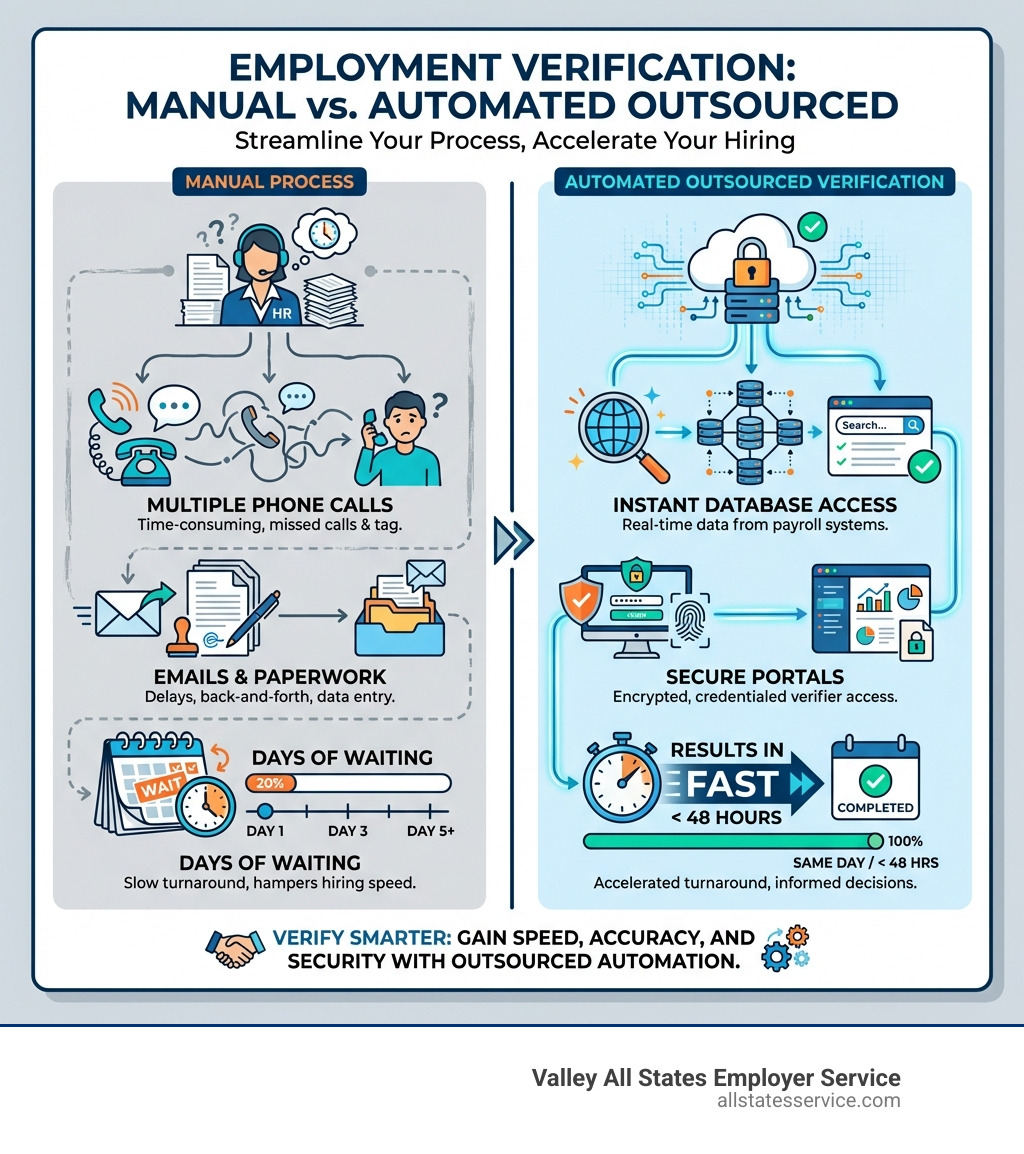
Here’s the reality most HR managers face: every verification request pulls your team away from strategic work. When a lender needs to confirm an employee’s income, or a new hire’s previous employer needs validation, someone on your team has to stop what they’re doing, dig through files, and respond. Multiply that by dozens or hundreds of requests per year, and you’re looking at serious time and money lost.
According to industry data, 37% of people admit they lie frequently on their resumes. That’s more than one in three candidates. Manual verification processes, where your HR team is already stretched thin, make it easier for those lies to slip through. A bad hire doesn’t just waste your time during onboarding. It creates financial risks, compliance headaches, and potential safety issues.
The good news? You don’t have to do this alone. Modern verification services handle the entire process for you, connecting directly to payroll systems and employer databases to provide instant, accurate results. Your team stays focused on hiring great people, while the verification happens automatically in the background.
Why is Employment Verification So Critical for Businesses?
Employment verification checks are more than just a formality; they are a cornerstone of responsible hiring and risk management for any business. We conduct these checks to gain additional insight into a candidate’s work history, ensuring we hire qualified individuals and mitigate various risks. It’s about building a strong, trustworthy team.
Mitigating Risk and Avoiding Negligent Hiring
Imagine hiring someone who misrepresented their past employment, only to find later they lacked critical skills or had a history of problematic behavior. This is where outsource employment verification becomes invaluable. By confirming a candidate’s previous positions, dates of employment, and even reasons for leaving, we protect our businesses from what’s known as negligent hiring. Negligent hiring can lead to significant legal liabilities, damage our company’s reputation, and create a less secure work environment for everyone.
The statistics are eye-opening: a significant number of individuals admit to fabricating information on their resumes. Resume Lab data indicates that 70% of people admitted to lying on their resume at least once, with 37% admitting they lie frequently. These numbers highlight the critical need for robust verification processes. By systematically checking employment history, we can uncover candidates who might not be who they claim to be, mitigating safety, compliance, and financial risks. For more on reducing these risks, explore our guide on Reduce HR Compliance Risk by Outsourcing.
The High Cost of a Bad Hire
The consequences of a bad hire extend far beyond the initial recruitment costs. A misstep in hiring can lead to:
- Financial risks: Costs associated with retraining, decreased productivity, and potential legal fees if the hire results in misconduct or poor performance.
- Safety risks: If an individual with a problematic work history or unverified credentials is hired for a sensitive role, it could jeopardize workplace safety.
- Compliance risks: Failure to verify employment adequately can expose us to regulatory penalties, especially in industries with strict hiring requirements.
- Damaged reputation: A series of bad hires can harm employee morale and public perception of our company.
Understanding these potential pitfalls underscores why a thorough employment verification process is not just an option, but a necessity. A comprehensive HR Compliance Risk Assessment can help identify areas where your business is vulnerable.
What Information is Typically Verified?
When we perform an employment verification check, we are typically looking to corroborate several key pieces of information a candidate provides. This helps us ensure accuracy and suitability for the role.
The types of information commonly verified include:
- Employer name: Confirming the companies a candidate claims to have worked for.
- Job titles: Verifying the roles held at previous organizations.
- Start and end dates: Ensuring the duration of employment aligns with the candidate’s stated history.
- Reason for leaving: Though often limited by employer policy, this can provide additional context.
- Education history: Confirming degrees, certifications, and attendance dates with educational institutions.
- Professional licenses and certifications: Validating any professional credentials required for the job, such as nursing licenses or financial certifications.
- Reference checks: Gaining insights into a candidate’s job-related traits and skills by speaking with former supervisors or colleagues.
For a deeper dive into confirming past work experiences, see our guide on Pre-Employment Work History Verification.
What is Outsource Employment Verification?
Simply put, outsource employment verification means entrusting the process of confirming a candidate’s employment history and credentials to a specialized third-party company. Instead of our internal HR team spending valuable time making phone calls, sending emails, and chasing down information, a dedicated service handles it all. This approach transforms a traditionally manual, time-consuming task into a streamlined, efficient process.
In-House vs. Outsourced Process
Traditionally, employment verification was handled entirely in-house. Our HR staff would directly contact previous employers, educational institutions, and licensing boards. While this approach offers direct control, it comes with significant drawbacks: it’s labor-intensive, prone to delays, and often inconsistent due to varying response times from different sources.
With outsource employment verification, we leverage the expertise and technology of a third-party provider. These providers often have vast databases of employment and income records, direct integrations with payroll and HRIS systems (like UKG, Dayforce, PeopleSoft, Workday, Paylocity, Infor), and established processes for contacting employers directly when data isn’t readily available. This shift allows us to move from a reactive, manual process to a proactive, automated one.
The Role of Technology
Technology is the backbone of effective outsource employment verification. Services like Truework, The Work Number, and First Advantage use intelligent automations, proprietary databases (such as First Advantage’s Verified!® database with over 120 million records), and API integrations to accelerate the verification process. This means that instead of waiting weeks, many verifications can be completed in minutes or within 24-48 hours. Secure, digital platforms allow for real-time integration, secure data exchange, and often provide free setup, training, and implementation.

This technological shift is precisely what allows us to verify smarter, not harder. For a complete understanding of this transition, refer to our Outsourced Employee Verification Complete Guide.
The Business Case to Outsource Employment Verification
The decision to outsource employment verification is a strategic one, offering compelling benefits that go beyond just saving time.
- Focus on core business functions: By offloading verification tasks, our HR teams can dedicate their efforts to strategic initiatives like talent development, employee engagement, and business growth, rather than administrative chores.
- Access to expertise: Third-party providers specialize in verification and background checks. They stay up-to-date with compliance regulations, possess extensive contact databases, and employ efficient methodologies that most in-house HR departments cannot match.
- Scaling hiring efforts: As our hiring needs fluctuate, an outsourced solution can easily scale up or down, handling high volumes of verifications without requiring us to hire additional HR staff or invest in new internal systems.
- Ensuring impartiality: An independent third party conducts verifications objectively, which can add credibility to the hiring process and help protect against claims of bias.
How Employment Verification Differs from a Full Background Check
While often used interchangeably, employment verification and a full background check are distinct services, though they are frequently part of a comprehensive pre-employment screening process.
- Employment Verification: This specifically focuses on confirming a candidate’s work history, job titles, dates of employment, education, and professional licenses or certifications. It corroborates the information provided on a resume or application.
- Full Background Check: This is a much broader process that can include employment verification, but also extends to:
- Criminal background checks: Searching for felony or misdemeanor convictions at various levels (county, state, federal).
- Identity services: Confirming a candidate’s identity through Social Security number traces, identity document checks, and address history.
- Due diligence: This can involve registry checks, media checks, civil record checks, and specialized record checks, particularly for executive roles or sensitive positions.
- Credit reports: Assessing financial responsibility, especially for roles involving financial management.
Companies like HireRight and First Advantage offer a suite of these services, helping us build a complete picture of a candidate. For a comprehensive overview of these broader services, check out our insights on Background Verification Company.
The Core Benefits When You Outsource Employment Verification
Choosing to outsource employment verification offers a cascade of advantages for businesses, leading to more efficient operations, reduced risks, and improved overall hiring quality. We’ve seen how these benefits transform hiring processes.
Relieve Administrative Burden and Reduce Costs
One of the most immediate benefits is the significant reduction in administrative burden on our HR teams. Manual verification involves countless hours spent on phone calls, emails, and paperwork. By outsourcing, we eliminate these tasks, freeing up our HR professionals to focus on strategic initiatives rather than reactive administrative work. This directly translates into cost savings by optimizing HR resources and reducing the need for additional headcount, even during periods of high recruitment. This administrative relief is a major win for any organization. For more on this, see our article on Administrative Burden Reduction.
Gaining Speed and Efficiency
In today’s competitive job market, speed is paramount. Candidates often have multiple offers, and delays in the hiring process can mean losing top talent. Outsource employment verification dramatically accelerates this process:
- Instant data access: Services like The Work Number provide employment records instantly, 24 hours a day, 7 days a week.
- Faster turnaround times: Most employees are verified within 24 hours through services like Truework. Our US employment verifications are often completed in under two days, significantly faster than traditional methods. Some platforms even boast results in less than one minute for present employment verification through current payroll providers.
- Streamlined HR processes: Automated systems mean less back-and-forth, fewer manual entries, and a smoother flow from application to onboarding.
This efficiency allows us to make quicker hiring decisions and onboard new employees faster, giving us a competitive edge. Learn more about how to Improve HR Efficiency.
Improving Accuracy and Reducing Fraud
With automated systems and specialized databases, the accuracy of verifications significantly improves. Human error is minimized, and data consistency is improved. This is crucial for combating resume fraud, which, as we’ve noted, is a widespread issue. By relying on verified data from official sources or directly from payroll systems, we gain a much more reliable picture of a candidate’s history.
Enhancing Security and Compliance
Data security and compliance are non-negotiable, especially when handling sensitive personal information. Outsourced verification services are built with these principles at their core:
- Secure data transmission: Data is exchanged between employers and verifiers through secure, encrypted platforms, mitigating exposure to unauthorized access.
- Credentialed verifiers: Access to employee data is typically restricted to contracted and credentialed verifiers who have a permissible purpose and employee consent for each request. This protects employee privacy.
- Employee consent and control: Employees often have portals to manage their data, grant consent for verifications, and see who has accessed their information, enhancing transparency and trust.
- FCRA compliance: Reputable third-party services operating in the United States are designed to comply with the Fair Credit Reporting Act (FCRA), ensuring that background checks and verifications are conducted legally and ethically.
By outsourcing, we ensure that our verification processes adhere to the highest standards of data security and regulatory compliance, including critical areas like I-9 compliance. For more details, explore More on I-9 Compliance.
How Does the Outsource Employment Verification Process Work?
The beauty of outsource employment verification lies in its automated and streamlined nature. While specific platforms may have unique features, the core process generally follows a similar path, leveraging technology to connect employers, employees, and verifiers.
Centralized Databases and Payroll System Integration
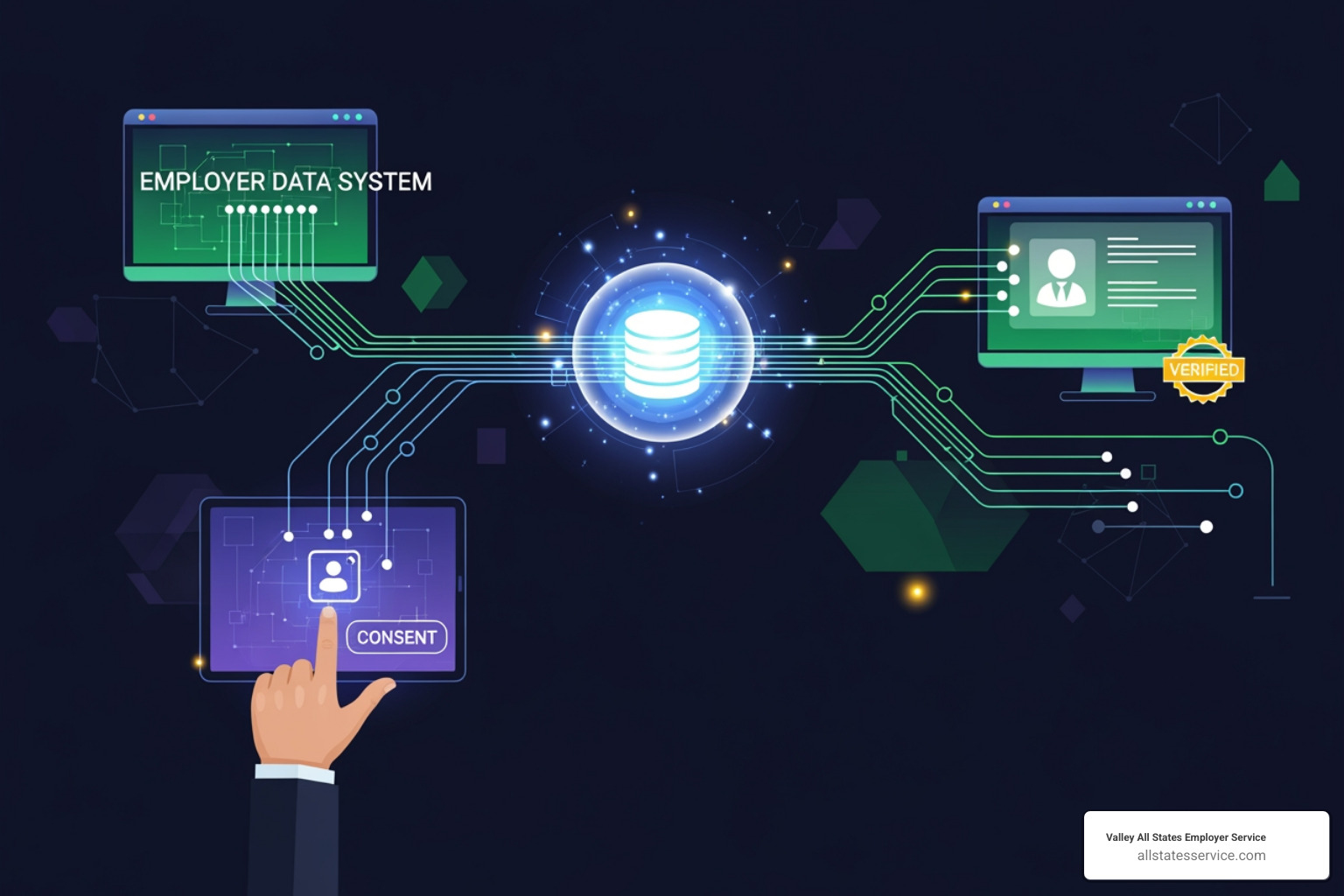
Many leading verification services, such as The Work Number and First Advantage, maintain vast, centralized databases of employment and income records. Employers contribute this data, often directly from their payroll systems, each payroll cycle. This means the information is always up-to-date and readily accessible.
The process often begins with:
- API integration: Verification providers offer real-time API integration with most payroll and HRIS systems, including popular platforms like UKG, Dayforce, PeopleSoft, Workday, and Paylocity. This allows for seamless, automated data transfer.
- Employer data contribution: Employers agree to securely transmit employment and income data to the verification service. This is typically done through secure feeds from their payroll or HR systems.
- Secure storage: The data is stored in highly secure, encrypted environments, accessible only through authorized channels.
When a verifier (e.g., a mortgage lender or a prospective employer) needs to confirm an individual’s employment or income, they submit a request through the service’s platform.
Verifier Portals and Employee Self-Service
The process is designed for ease of use for all parties:
- Verifier portals: Verifiers access secure online portals where they can submit requests, often requiring the employee’s consent and a permissible purpose (e.g., for a loan application). The system then matches the request against its database. If the data is available, the verification is often instantaneous. If not, the system intelligently routes the request for manual follow-up, ensuring a response.
- Employee self-service: Employees can often access their own data, generate salary keys or PINs (as with The Work Number, where a PIN might be the four-digit number denoting the month and day of birth), and grant consent for verifiers to access their information. This empowers employees with control over their personal data.
This integrated approach significantly reduces the manual workload for employers and speeds up critical decisions for verifiers.
A Look at Valley All States Employer Service’s Verification Solutions
At Valley All States Employer Service, we understand the complexities of employment verification, particularly in the landscape of workforce eligibility. Our approach focuses on expert, impartial, and efficient E-Verify processing, minimizing errors and administrative burden for our clients across the United States, including Maryland and Lutherville MD.
When you partner with us for outsource employment verification, we streamline your compliance needs. We act as your trusted agent for E-Verify, handling the submission of new hire data to ensure employment eligibility. Our platform integrates seamlessly with your onboarding process, allowing for quick and accurate checks against government databases. We ensure that every request is handled efficiently, maintaining strict adherence to federal E-Verify guidelines and reducing your risk of non-compliance. Our focus is on providing robust Workforce Verification Solutions that give you peace of mind.
The Role of the Employer, Employee, and Verifier
For a successful and compliant outsource employment verification process, each party plays a crucial role:
- Employer: Our primary role as employers is to accurately and promptly provide employee data to the chosen third-party verification service. This typically involves setting up secure data feeds from our payroll or HR systems. We ensure that the data is updated regularly, often each payroll cycle, so that verifiers always have access to current and accurate information.
- Employee: Employees are central to the process, as their consent is often required before any information can be released. They typically provide authorization to the verifier (e.g., a bank or landlord) and may also use self-service portals to generate access codes or review their own employment data report. This empowers them to manage who accesses their personal information.
- Verifier: The verifier (e.g., a lending institution, a new employer, or a government agency) initiates the request. They must have a “permissible purpose” for seeking the information, which is a legal requirement. Once authorized by the employee, the verifier accesses the data through the third-party service’s secure portal, receiving the necessary employment and income details to make informed decisions.
This collaborative framework ensures that verifications are not only fast and efficient but also secure and compliant with privacy regulations.
Frequently Asked Questions about Outsource Employment Verification
We often hear similar questions from businesses considering the move to outsource employment verification. Let’s address some of the most common ones.
What is the primary purpose of employment verification for Outsource employees?
The primary purpose of employment verification for any employee, including those from companies like Outsource (a professional services firm in Longwood, FL, with 101-1,000 employees), is to confirm their work history, validate credentials, and assess their eligibility for various applications. This could include:
- Confirming work history: Ensuring the accuracy of a candidate’s resume or job application.
- Validating credentials: Verifying educational degrees, professional licenses, and certifications.
- Assessing eligibility: For loans, mortgages, rental applications, or government benefits, where proof of income and stable employment is required.
- Fulfilling pre-employment screening: As part of a comprehensive background check to mitigate hiring risks.
Truework, for example, facilitates verification for Outsource employees by providing a simple, automated process where most employees are verified within 24 hours.
How long does an employment verification usually take?
The turnaround time for employment verification can vary, but outsourcing significantly speeds up the process compared to traditional manual methods.
- Instant verification: For employees whose data is already in a comprehensive database like The Work Number, employment records can be available instantly, 24 hours a day, 7 days a week.
- Within 24 hours: Many outsourced services, such as Truework, boast that most employees are verified within 24 hours.
- Under two days: Our US employment verifications are often completed in under two days. This can vary depending on whether direct contact with a former employer is needed and how quickly they respond.
The goal of outsourcing is always to provide faster, more reliable results, often reducing weeks of waiting to mere minutes or days.
How does Valley All States Employer Service get employee information?
At Valley All States Employer Service, we prioritize accuracy, security, and compliance in how we handle employee information for verification. For our E-Verify workforce eligibility verification services, we work directly with employers.
Here’s how it generally works:
- Employer data contribution: Our clients, the employers, securely provide us with the necessary new hire information required for E-Verify submissions. This data is typically integrated directly from their onboarding or HR systems.
- Secure processing: We then process this information through the federal E-Verify system, acting as an authorized employer agent. Our systems are designed to minimize errors and ensure accurate submissions.
- Compliance-focused: We adhere to strict data security protocols and E-Verify program requirements, ensuring that all information is handled confidentially and in compliance with federal regulations applicable across the United States, including Maryland and Lutherville MD.
This process ensures that your new hires are verified for employment eligibility efficiently and compliantly, minimizing the administrative burden on your team.
Conclusion: Streamline Your Hiring and Stay Compliant
The journey to building a strong, compliant, and efficient workforce doesn’t have to be fraught with administrative headaches and hiring risks. By embracing outsource employment verification, we empower our businesses to verify smarter, not harder. We’ve explored how outsourcing relieves administrative burdens, slashes costs, accelerates hiring timelines, boosts accuracy, fortifies data security, and ensures crucial compliance. These benefits are not just theoretical; they translate into tangible improvements for our HR operations and overall business success.
With the expertise of services like Valley All States Employer Service, specializing in efficient E-Verify processing for employers across the United States, including Maryland and Lutherville MD, you can transform your verification process. We ensure your workforce eligibility checks are impartial, precise, and compliant, allowing you to focus on what you do best: growing your business with confidence.
Ready to simplify compliance and gain a competitive edge in hiring? Streamline your compliance and verification processes today!