
Maryland employment law compliance: Master 5 Key Pillars
Why Maryland Employment Law Compliance Matters for Every Employer
Maryland employment law compliance requires employers to follow a complex web of state and local regulations. If you run a business in Maryland, you must steer specific rules that often go beyond federal requirements, with counties like Montgomery and Howard adding their own layers of regulation.
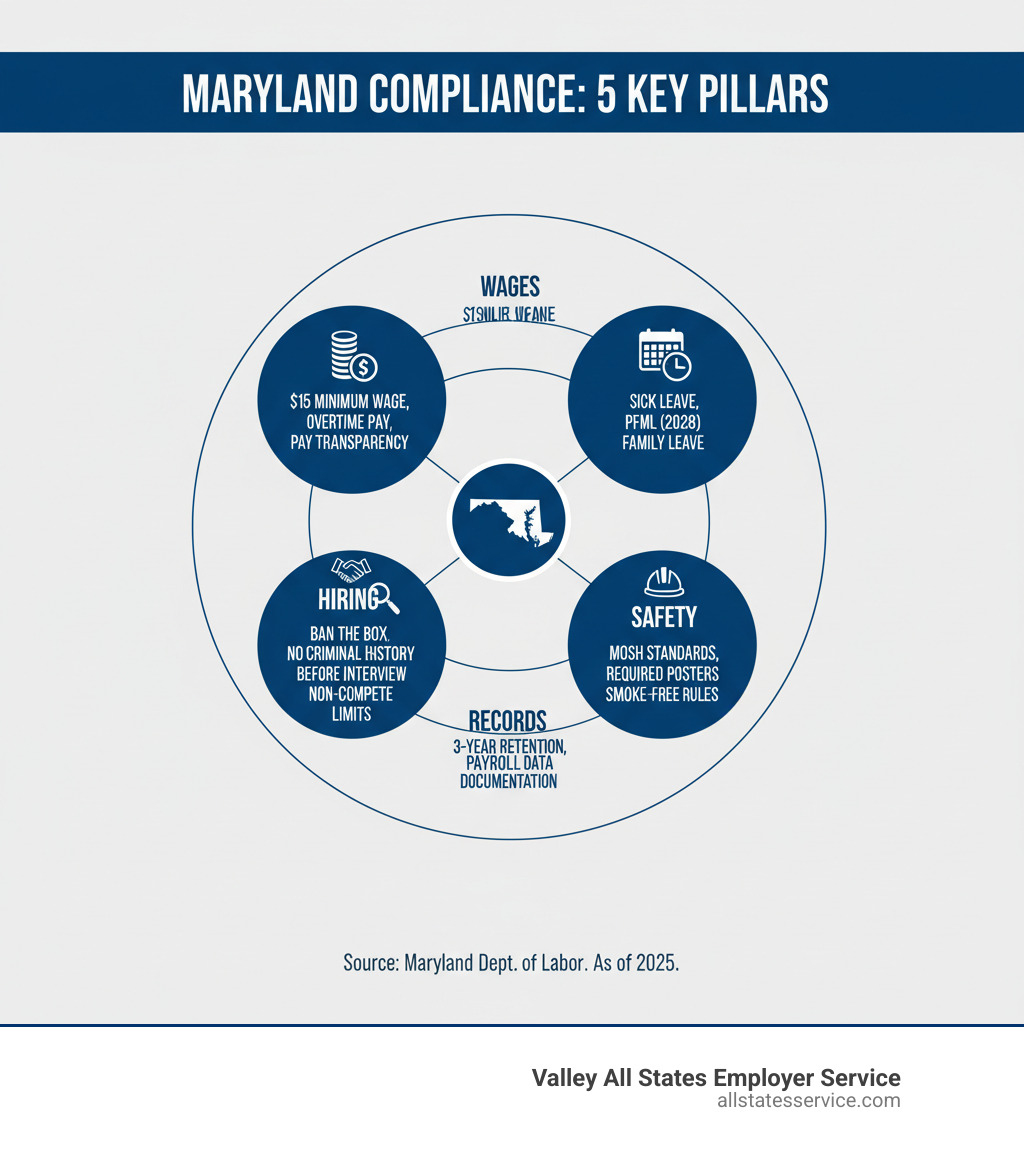
Here’s a glance at core compliance requirements:
- Minimum Wage: $15.00/hour statewide (higher in some counties)
- Paid Sick Leave: Required for employers with 15+ employees (up to 40 hours/year)
- Pay Transparency: Salary ranges must appear in job postings (effective October 2024)
- Ban the Box: No criminal history questions before the first interview (for firms with 15+ employees)
- Workers’ Comp: Mandatory insurance for all employees
- Record-Keeping: Payroll records must be kept for at least 3 years
- Final Pay: Due by the next regular payday after termination
As of January 1, 2024, Maryland’s minimum wage is $15.00 per hour for all employers. This is just one of many recent changes, including the Maryland Healthy Working Families Act (mandating sick leave) and new pay transparency laws.
Failure to comply can lead to fines, lawsuits, and enforcement actions from the Maryland Division of Labor and Industry or the Maryland Commission on Civil Rights. This guide breaks down everything you need to know to manage compliance effectively, from wage and hour rules to leave policies, hiring, and workplace safety.
Mastering Maryland’s Wage, Hour, and Pay Regulations
Getting payroll right is the foundation of Maryland employment law compliance. These rules shape how you compensate your team, from setting hourly rates to what you include in job postings.

Minimum Wage and Overtime
As of January 1, 2024, Maryland’s state minimum wage is $15.00 per hour for all employers. For tipped workers, the minimum cash wage is $3.63 per hour. If their tips don’t bring their total earnings to $15.00 per hour, you must make up the difference.
Maryland also allows counties to set higher minimum wages. Montgomery County and Howard County both have rates that exceed the state minimum.
In Montgomery County (as of July 1, 2023), the rate is $16.70/hour for employers with 51+ employees, $15.00/hour for 11-50 employees, and $14.50/hour for 10 or fewer employees. These rates adjust annually.
In Howard County (as of January 1, 2024), the rate is $15.00/hour for employers with 15+ employees. Smaller employers are on a schedule to reach $15.50/hour by January 1, 2026.
Overtime rules follow the federal standard: 1.5 times the regular pay rate for hours worked over 40 in a week. Leave hours do not count toward the 40-hour threshold. Exempt employees in executive, administrative, or professional roles who meet specific salary and duty tests are not entitled to overtime. Misclassifying employees can lead to serious violations.
For detailed guidance, see The Maryland Guide to Wage Payment and Employment Standards.
| Jurisdiction | Current Minimum Wage (as of Jan 1, 2024) | Notes |
|---|---|---|
| Maryland State | $15.00/hour | Applies to all employers, regardless of size. Tipped wage is $3.63/hour, with employers making up the difference if tips don’t reach state minimum. Under 18 paid at 85% of state minimum. |
| Montgomery Co. | $16.70/hour (Large Employers, 51+ employees) | As of July 1, 2023. Mid-sized (11-50 employees) $15.00/hour, Small (10 or fewer) $14.50/hour. Tipped wage $4.00/hour. Rates adjust annually based on CPI-W. |
| Howard Co. | $15.00/hour (15+ employees) | As of January 1, 2024. Employers with less than 15 employees will reach $15.50/hour by January 1, 2026. Howard County sets its own minimum wage, which generally increases with the Consumer Price Index for All Urban Consumers (CPI-U) for the Washington-Arlington-Alexandria, DC-MD-VA-WV metropolitan area. |
Pay Transparency, Final Pay, and Other Wage Rules
Maryland’s Wage Range Transparency Act (effective October 1, 2024) requires you to include a wage range and a general description of benefits in all job postings for roles performed at least partly in Maryland. This applies to both external and internal promotion opportunities.
When an employee leaves, final pay is due by the next regular payday. This includes all earned wages and commissions. Maryland law does not require you to pay out accrued PTO unless your company policy or employment agreement states you will. A clear, written PTO policy is essential.
Under the Equal Pay for Equal Work Act, you cannot prohibit employees from discussing their wages or pay employees of one sex or gender identity less than others for comparable work.
Child labor laws restrict the hours and types of jobs for minors under 18. Minors generally cannot work more than 12 combined school and work hours daily. You must obtain a Minor Work Permit for any employee under 18.
Maryland law does not require meal or rest breaks for adult employees. However, employees under 18 must get a 30-minute break for every 5 consecutive hours worked. Additionally, the Healthy Retail Employee Act requires certain retail employers (50+ employees) to provide paid breaks for shifts longer than 8 hours.
Navigating Leave, Benefits, and Retirement Mandates
Maryland employment law compliance covers employee leave, benefits, and retirement savings. Understanding these mandates is crucial for protecting your workforce and your business.

Sick, Family, and Medical Leave
Maryland’s leave laws include the Maryland Healthy Working Families Act (MHWFA) and the upcoming Paid Family and Medical Leave (PFML) program.
The MHWFA is Maryland’s sick leave law. Employees accrue one hour of leave for every 30 hours worked and can use it after their 106th day of employment.
- Employers with 15+ employees must provide paid sick and safe leave, up to 40 hours per year.
- Employers with fewer than 15 employees must provide unpaid leave.
Leave can be used for an employee’s or a family member’s illness, or for situations related to domestic violence (“safe leave”). Employees can carry over up to 40 hours of unused leave per year, with a maximum accrual of 64 hours. You must keep records of leave accrual and usage for at least three years.
Maryland is also implementing a Paid Family and Medical Leave (PFML) program. Contributions are set to begin on January 1, 2027, with benefits becoming available on January 1, 2028. This program will provide paid leave for reasons like an employee’s serious health condition, caring for a family member, or bonding with a new child. Unlike the federal FMLA, which is unpaid and applies only to larger employers, Maryland’s PFML will offer paid benefits to a broader range of workers. For more details, visit Maryland’s Paid Leave Portal.
Other required leaves include up to two hours of paid voting leave, unpaid family military leave for employees with deployed family members, and up to 60 days of unpaid organ donation leave.
Retirement, Workers’ Comp, and Other Benefits
Compliance also extends to retirement and insurance benefits.
The MarylandSaves program requires employers that do not offer a workplace retirement plan (like a 401k) to either register with MarylandSaves or certify an exemption. If you don’t offer a plan, you must enroll employees in this state-sponsored Roth IRA program with automatic payroll deductions. If you do offer a plan, you just need to certify your exemption.
Workers’ compensation insurance is mandatory for all Maryland employers, covering all employees, including part-time and temporary workers. This no-fault insurance covers medical expenses and lost wages for work-related injuries. You must obtain a policy from a state-approved private insurer and are prohibited from retaliating against employees who file claims.
For health insurance continuation, Maryland has state laws that supplement federal COBRA, often providing continuation rights for employees at smaller companies (fewer than 20 employees) not covered by federal law.
Hiring, Anti-Discrimination, and Employee Relations
How you hire and treat employees is a core part of Maryland employment law compliance. From job postings to workplace conduct, Maryland has clear expectations for employers.

Anti-Discrimination and Harassment
Maryland’s Fair Employment Practices Act (FEPA) offers protections that often go beyond federal law. Enforced by the Maryland Commission on Civil Rights (MCCR), FEPA prohibits employment decisions based on race, color, religion, sex, national origin, age, marital status, sexual orientation, gender identity, disability, genetic information, or ancestry. This covers all aspects of employment, from hiring to termination.
Employees who believe they’ve been discriminated against can file a complaint with the MCCR. Retaliating against an employee for reporting discrimination is strictly prohibited. For more details, see the Information on discrimination from the MCCR.
Harassment is also a form of discrimination. While Maryland does not mandate anti-harassment training for all employers, providing it is a best practice for creating a respectful workplace.
Maryland law also requires employers to provide reasonable accommodations for employees dealing with pregnancy, childbirth, or related conditions, unless doing so would cause an undue hardship. This could include light duty, adjusted schedules, or extra breaks.
Key Rules for Hiring and Maryland Employment Law Compliance
Maryland has specific rules that govern the hiring process.
Maryland’s ‘Ban the Box’ law prohibits employers with 15 or more employees from asking about a candidate’s criminal history before the first in-person interview. The goal is to allow candidates to be judged on their qualifications first. Some counties, like Prince George’s County, have even stricter rules.
Non-compete agreements are restricted. They cannot be enforced for employees earning $22.50 per hour or less (around $46,800 annually). This restriction also applies to certain healthcare workers and veterinarians earning $350,000 or less. The law aims to protect lower-wage workers from being trapped in their jobs.
Credit checks can only be used if an applicant’s credit history is directly related to a bona fide occupational qualification, such as for jobs with access to financial assets. They cannot be used as a general screening tool.
Drug and alcohol testing is permitted, but policies must be applied consistently and respect privacy and anti-discrimination laws. While employers can maintain a drug-free workplace and enforce policies against impairment, the legalization of recreational marijuana requires careful policy consideration.
Finally, Maryland is not a ‘Right-to-Work’ state. This means that in a unionized workplace, employees may be required to join a union or pay dues as a condition of employment.
Need help with federal hiring compliance? Learn more about our E-Verify services.
Workplace Safety, Notifications, and Maryland Employment Law Compliance
Creating a safe workplace is a legal requirement under Maryland employment law compliance. This includes adhering to safety standards, providing required notifications, and managing workforce changes correctly.

MOSH, Safety, and Required Postings
Maryland operates its own workplace safety program, the Maryland Occupational Safety and Health (MOSH) Act, which is a state plan approved by federal OSHA. This means employers must comply with both federal standards and any additional Maryland-specific regulations. The core duty is to provide a workplace free from recognized hazards, including providing necessary safety equipment and training. You can find more information on Maryland’s State OSHA Plan.
Maryland’s Clean Indoor Air Act prohibits smoking in nearly all indoor workplaces. You must maintain a smoke-free environment and post appropriate signage.
One of the most visible compliance tasks is displaying required labor law posters in a conspicuous place. These notices inform employees of their rights. Required posters include:
- Minimum Wage and Overtime
- Equal Pay for Equal Work
- Earned Sick and Safe Leave
- MOSH (Occupational Safety and Health)
- Workers’ Compensation
- Discrimination (Fair Employment Practices Act)
- Employment of Minors
- Pregnant Workers Fairness Act
Laws change, so posters must be kept current to avoid fines.
Record-Keeping and Mass Layoff Notifications
Good record-keeping is essential for Maryland employment law compliance. You must maintain payroll records for at least three years, including employee name, address, pay rate, hours worked, and deductions. These records are your proof of compliance in case of a wage and hour dispute.
For significant workforce reductions, Maryland’s Worker Adjustment and Retraining Notification (WARN) Act requires 60 days’ written notice to affected employees and government officials. This state law applies to employers with 50 or more employees and is triggered by a facility closing, relocation, or layoff affecting 25% of the workforce or 15 employees (whichever is greater) within a 30-day period.
Maryland’s WARN Act has lower thresholds than the federal WARN Act, so you may need to comply with the state version even if federal rules don’t apply. For more details, review the Maryland WARN Act Information.
Frequently Asked Questions about Maryland Compliance
Maryland employment law compliance can be complex. Here are answers to some common questions.
What is the final paycheck law in Maryland?
Final wages must be paid by the next regular payday after an employee’s termination. This includes all earned wages and commissions. Payout for unused vacation time is only required if your company policy or employment agreement promises it. A clear, written policy is crucial.
Are employers in Maryland required to provide breaks?
It depends on the employee’s age and industry:
- Adult employees (18+): Generally, no. Maryland law does not mandate meal or rest breaks for adults.
- Minors (under 18): Yes. A 30-minute break is required for every 5 consecutive hours worked.
- Retail workers: The Healthy Retail Employee Act requires certain retail employers (50+ employees) to provide paid breaks for shifts extending beyond 8 hours.
What is Maryland’s ‘Ban the Box’ law?
This law prohibits employers with 15 or more employees from asking about a job applicant’s criminal history on an initial application or before the first in-person interview. The goal is to have candidates evaluated on their qualifications first. Some local jurisdictions, like Prince George’s County, have stricter versions of this law.
Stay Ahead of Maryland’s Complex Labor Laws
Keeping up with Maryland employment law compliance is a continuous challenge. Regulations are constantly updated, and failure to adapt can lead to significant penalties. Staying compliant is about more than avoiding fines; it’s about building a fair and stable workplace.
Proactive compliance means regularly reviewing your policies on wages, leave, hiring, and safety. You must stay informed about changes from the state legislature in Annapolis and your local county government. A policy that was compliant last year might not be today due to new minimum wage rates or pay transparency rules.
Managing the details of the Maryland Healthy Working Families Act, preparing for the upcoming PFML program, adhering to ‘Ban the Box’ rules, and meeting MOSH safety standards requires constant vigilance. This can feel like a full-time job when you’re also trying to run your business.
That’s where expert assistance can be invaluable. At Valley All States Employer Service, we help Maryland employers steer these complex regulations with confidence. Our focus is on taking the administrative burden off your plate so you can focus on growing your business.
The Maryland employment landscape will continue to evolve, but with the right support, compliance can become a seamless part of your operations instead of a source of stress.
Ready to simplify your Maryland employment law compliance journey? Master Maryland employment law with our complete guide and find how we can support your needs.