
Why Biometric ID Checks Matter in Today’s Digital World
A biometric id check is a security process that verifies your identity by analyzing unique physical characteristics like your face, fingerprints, or iris patterns. Unlike passwords or ID cards, biometrics are permanently tied to you and nearly impossible to steal or forge.
Quick Answer: What You Need to Know About Biometric ID Checks
- What it is: A verification method using your unique biological traits (face, fingerprint, voice) to confirm identity
- How it works: Captures biometric data, analyzes it for authenticity, compares it to stored records, and confirms your identity
- Why it matters: Prevents identity theft, eliminates weak passwords, and enables secure remote verification
- Common uses: Employee onboarding, border control, banking access, government services, and secure payments
- Key benefit: Your biometric data cannot be forgotten, lost, or easily stolen like traditional credentials
With identity theft and fraudulent activities on the rise, businesses and government agencies are turning to biometric id check technology as a more reliable way to verify who you are. The massive volume of identity screenings processed globally each year reflects the growing demand for robust verification solutions.
Traditional methods like passwords and security questions have serious weaknesses. People forget passwords, reuse them across multiple accounts, or fall victim to phishing attacks. Physical ID cards can be stolen, forged, or used by impostors. Biometric verification solves these problems by using characteristics that are unique to each person and always available.
The biometric verification process typically involves capturing your biological data (like a facial scan or fingerprint), checking it for authenticity using liveness detection to prevent spoofing, and comparing it against a trusted source like an official ID document or stored template. Advanced systems can detect deepfakes, modified photos, and other fraud attempts that would fool traditional verification methods.
For HR managers handling employee onboarding, a biometric id check offers a faster, more secure alternative to manual document review. For government agencies processing immigration applications, they provide a way to confirm identity across borders. For consumers accessing online services, they eliminate the frustration of forgotten passwords while adding an extra layer of protection.
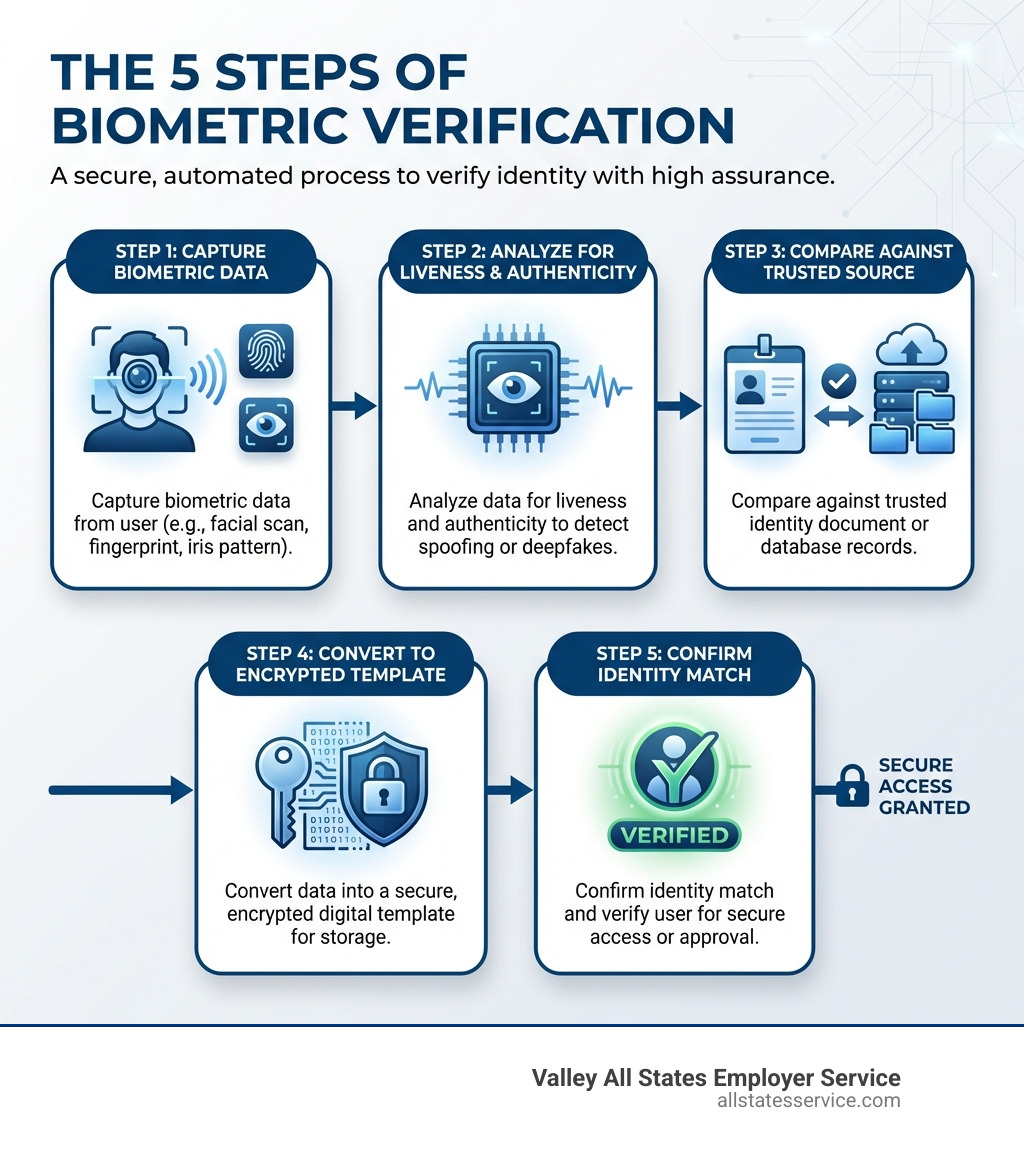
Biometric id check word guide:
The Core Components of a Biometric ID Check
When we talk about a biometric id check, we are looking at the measurement and analysis of unique physical and behavioral characteristics. The word biometrics itself comes from Greek, meaning “measurement on living beings.” These features are inseparable from you, which is why they are so powerful for security.
We can break these traits down into two main categories: physical and behavioral. Physical traits are what most of us think of first. These include your facial features, fingerprints, iris patterns, and even the shape of your ear or the patterns of your veins. These are often called passive biometrics because they are static features of your body.
Behavioral traits, on the other hand, are active biometrics. These involve the way you do things, such as your voice, your typing rhythm, or even your signature. While these can change slightly over time, they still provide a high level of accuracy when combined with other data.
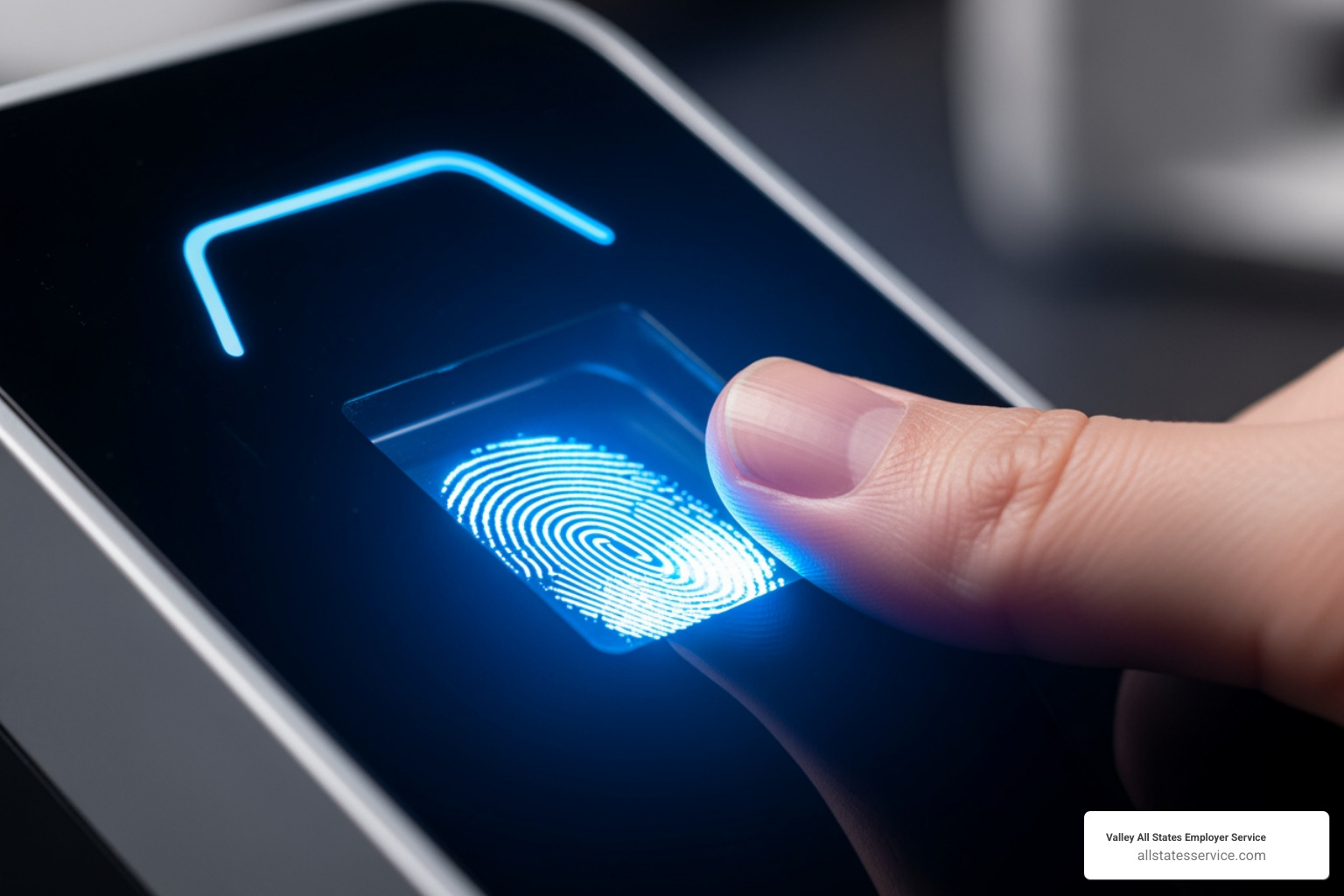
The identity document check is often the first step in this process. A system will scan a government-issued ID, like a driver’s license or passport, to pull the “anchor” image. Then, the biometric id check compares a live scan of the person to that anchor image. This ensures that the person holding the ID is the same person the ID was issued to.
The Department of Homeland Security (DHS) relies heavily on these components. According to their Biometrics standards, these systems must be both accurate and fast to handle the millions of people crossing borders or applying for benefits every year. For businesses in Maryland and across the U.S., using these same core components during hiring helps ensure that every new employee is exactly who they claim to be.
Why Biometric Verification Outperforms Traditional Methods
For years, we relied on “something you know” (like a password) or “something you have” (like a key card). The problem is that passwords are easy to forget and key cards are easy to lose. A biometric id check relies on “something you are,” which is much harder to compromise.
Let’s look at how these methods compare in a simple way:
| Feature | Passwords / PINs | Biometric Data |
|---|---|---|
| Security Level | Low to Medium (vulnerable to phishing) | High (unique to the individual) |
| User Experience | Frustrating (requires memorization) | Seamless (quick scan) |
| Portability | Can be stolen or shared | Inseparable from the user |
| Permanence | Can be changed if compromised | Constant throughout life |
| Reliability | Can be forgotten or lost | Always available |
One of the biggest advantages we see is the move toward password-less access. By using a biometric id check, we can eliminate the “forgot password” loop that wastes so much time for HR departments and IT help desks. Biometrics provide a superior basis for identification because physical characteristics are unchangeable and permanently assignable.
In the United States, traditional methods like social security identity checks are still important, but they have limits. A Social Security number is just a piece of data that can be stolen in a data breach. When you add a biometric layer, you ensure that even if a fraudster has a stolen SSN, they cannot pass the verification because they do not have the matching physical traits.
To ensure these systems are fair and accurate, they are tested against international standards. For example, ISO/IEC 19795-1:2021 provides the framework for testing the performance of biometric systems. This ensures that the technology works reliably across different lighting conditions and for people of all backgrounds.
How a Biometric ID Check Improves Onboarding
For businesses, especially those of us in the employment compliance industry, the onboarding process is where biometrics truly shine. When a new hire starts, we have a legal and ethical duty to verify their identity. This is where workforce eligibility verification comes into play.
In a remote-first world, you cannot always meet a candidate in person to look at their passport. A digital biometric id check allows the candidate to take a photo of their ID and then a “selfie.” The software performs a 1:1 match to confirm they are the same person. This remote identity verification is faster than traditional mail-in processes and much more secure than a simple video call.
This technology also helps us detect modified or stolen IDs. For example, if a fraudster tries to use a stolen driver’s license but replaces the photo, a high-quality biometric system will flag the inconsistencies in the document’s security features. This protects your business from the legal and financial risks associated with hiring unauthorized workers or victims of identity theft.
The Role of a Mobile Biometric ID Check
Most of us carry a powerful biometric scanner in our pockets every day. Modern smartphones are equipped with high-resolution cameras, infrared sensors, and secure enclaves that make a mobile biometric id check incredibly secure.
These devices use encryption to ensure that your raw biometric data, like a map of your face, never actually leaves the device. Instead, it is converted into a mathematical template. When you use an app for identity proofing, the app simply checks if the live scan matches the stored template.
Government services are increasingly using this mobile-first approach. For example, the Using your GOV.UK One Login system allows UK citizens to verify their identity via a smartphone app. While this is a UK example, the technology is identical to what we use in the U.S. for various state and federal digital services. It is convenient, low-cost for the user, and can be done from anywhere at any time.
For our clients at Valley All States Employer Service, this mobile capability means that new hire verification can happen before the employee even walks through the front door. It streamlines the entire “Day 1” experience, allowing the new team member to focus on training rather than paperwork.
Advanced Security: Liveness Detection and Fraud Prevention
As biometric technology gets better, so do the fraudsters. We have seen an increase in “presentation attacks,” where someone tries to fool a camera using a high-resolution photo, a video on a tablet, or even a realistic silicone mask. This is why liveness detection is a critical part of a modern biometric id check.
Liveness detection ensures that the biometric sample is coming from a real, present human being. Some systems use “active” liveness, where you might be asked to blink, smile, or turn your head. Others use “passive” liveness, which analyzes skin texture, depth, and micro-movements without requiring you to do anything.
One of the newest threats we face is the deepfake. These are AI-generated videos that can look and sound exactly like a real person. Advanced biometric systems now include deepfake prevention tools that look for digital artifacts or inconsistencies in how light reflects off the skin.
The ISO/IEC 30107-1:2023 standard specifically addresses these presentation attacks. By following these guidelines, a document verification service can provide a much higher level of assurance. These systems don’t just look at the face, they look for the “pulse” of life, ensuring that the identity belongs to the person who is actually standing in front of the camera.
Global Applications in Immigration and Government Services
Biometrics have become the gold standard for international travel and immigration. If you have traveled recently, you have likely seen this in action. The Canada Border Services Agency (CBSA) and the RCMP, for instance, use fingerprints and facial images to confirm the identity of travelers. This helps them identify known criminals and detect individuals using forged documents.
In the United Kingdom, the Post Office offers in-branch verification where they scan your photo ID and take a live photo to ensure a match. Similarly, New Zealand’s Identity Check service matches a user’s image to images held in secure government databases in real-time.
While these are international examples, the U.S. follows similar rigorous paths. The TSA PreCheck Touchless ID program is a great example of a biometric id check in the U.S. that allows travelers to move through security without showing a physical ID, using only facial recognition.
For employers, these global standards are important because they influence how we handle new hire verification. As government databases become more integrated with biometric data, the accuracy of our background checks and eligibility verifications continues to improve. This global “biometric web” makes it much harder for bad actors to move between countries or companies using stolen identities.
Frequently Asked Questions about Biometric Verification
Why is biometric data more secure than a password?
Biometric data is more secure because it is based on unique physical traits that cannot be easily guessed, shared, or forgotten. While a password can be stolen in a data breach or through a phishing email, your fingerprint or iris pattern stays with you. Furthermore, most biometric systems do not store your actual image, they store an encrypted digital template that is useless to a hacker even if they managed to steal it.
What is the difference between biometric identification and verification?
These terms are often used interchangeably, but they have different meanings. Biometric identification asks the question, “Who is this person?” It compares a sample against a large database to find a match (a 1-to-N check). Biometric verification asks, “Is this person who they say they are?” It compares a live sample against one specific trusted record, like the photo on an ID card (a 1-to-1 check).
How do businesses use biometric checkers for employees?
Businesses use biometric checkers for several reasons. The most common is identity verification during the hiring process to ensure the person being hired is the same person on the I-9 documents. We also see businesses use biometrics for secure access to sensitive areas or for attendance tracking. This prevents “buddy punching,” where one employee clocks in for another, and ensures that only authorized personnel can access secure data or physical locations.
Conclusion
The transition to biometric technology is not just a trend, it is a necessary response to a world where digital fraud is becoming more sophisticated. By using a biometric id check, we move away from the vulnerabilities of passwords and physical documents toward a future where your identity is truly your own.
At Valley All States Employer Service, we understand how overwhelming compliance can feel. Whether you are navigating the complexities of E-Verify or looking for a reliable document verification service, we are here to help. Our goal is to provide expert, impartial, and efficient processing that minimizes your administrative burden and keeps your business secure.
By integrating biometric verification into your workforce eligibility processes, you are not just checking a box for compliance, you are building a foundation of trust. You can be confident that your team is who they say they are, allowing you to focus on growing your business while we handle the technical details of identity and eligibility.
Ready to simplify your hiring compliance and accept the future of identity? Let us help you streamline your E-Verify and onboarding processes today. We make the complex simple, so you can get back to what you do best.