
Everything You Need to Know About I-9 Documentation Verification
Why Accurate I-9 Documentation Verification Matters for Your Business
I-9 documentation verification is the legal process employers must use to confirm every new hire’s identity and authorization to work in the United States. Under federal law, all U.S. employers must complete Form I-9 for each employee, examine specific documents, and retain records for government inspection.
Here’s what you need to know right now:
Quick Reference: I-9 Documentation Verification Essentials
| Requirement | What You Must Do | Deadline |
|---|---|---|
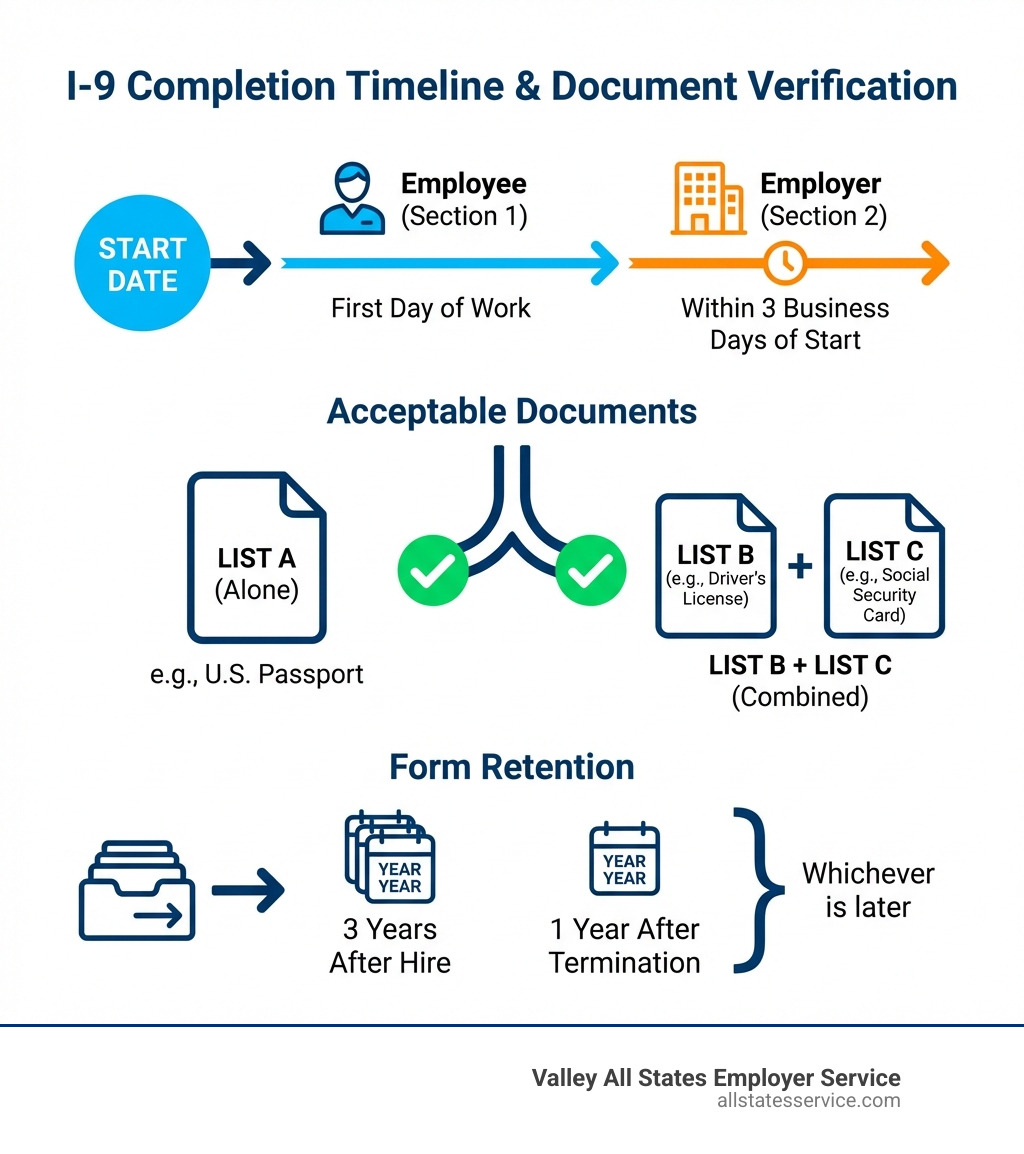
| Employee completes Section 1 | Provide personal information and attest to work authorization | No later than first day of work |
| Employer completes Section 2 | Examine original documents and verify information | Within 3 business days of start date |
| Document options | Accept List A or List B + List C | At employee’s choice |
| Form retention | Keep on file (not with USCIS) | 3 years after hire or 1 year after termination (whichever is later) |
The Form I-9 might seem like just another onboarding form, but it plays a crucial legal role in verifying your employees’ right to work in the United States. Failing to properly complete this form risks violating section 274A of the Immigration and Nationality Act and may subject your business to significant civil money penalties.
For busy HR managers, the challenge isn’t just understanding what documents to accept. It’s also knowing when to complete each section, how to verify documents meet the “reasonableness standard,” and what to do when employees work remotely or present receipts instead of permanent documents.
This guide breaks down everything you need to know about I-9 documentation verification. We’ll walk through the three lists of acceptable documents, explain remote verification procedures, share compliance best practices, and answer the most common questions employers face during the hiring process.
I 9 documentation verification terms you need:
The Basics of I-9 Documentation Verification
At its heart, the Form I-9 is about one thing: ensuring that everyone working in the U.S. has the legal right to do so. Whether you are a small startup in Lutherville or a large enterprise with offices across Maryland, the rules remain the same. Every single person you hire for pay must complete this form.
The process is divided into sections with strict timelines. What is an I9? Essentially, it is the federal government’s way of holding employers accountable for their workforce’s eligibility. According to Employment Eligibility Verification | USCIS, you do not file this form with the government. Instead, you keep it in your own files, ready for an auditor to knock on your door.
Who must complete the form?
If you are hiring someone to perform labor or services in return for wages or other remuneration, they are a new hire. This includes U.S. citizens, noncitizen nationals, lawful permanent residents, and noncitizens authorized to work. What is I-9 Form? It is a mandatory document for all employees hired after November 6, 1986. Even if you know your new hire is a lifelong neighbor from down the street, the law says you must verify their documents.
Deadlines you cannot miss
Timing is everything in compliance. We often see businesses get into trouble simply because they let the paperwork slide for a week. Our I-9 Verification Requirements Guide emphasizes two critical milestones:
- Section 1: The employee must complete this no later than their first day of employment for pay. They can even do it before they start, provided they have already accepted a job offer.
- Section 2: You, the employer, must complete this within three business days of the employee’s first day of work. For example, if they start on a Monday, you must have Section 2 finished by Thursday.
Understanding the Three Lists of Acceptable Documents
One of the most common mistakes we see is an employer telling an employee exactly which documents to bring. That is a big no-no! To stay compliant, you must provide the employee with the official “Lists of Acceptable Documents” and let them choose which ones to present.
The documents are categorized into three lists. For a deep dive, check out our I-9 Acceptable Documents Ultimate Guide. You can also find the full official breakdown at 13.0 Acceptable Documents for Verifying Employment Authorization and Identity | USCIS.
List A: Establishing Identity and I 9 Documentation Verification
List A documents are the “golden tickets” of the I-9 world because they establish both identity and employment authorization all by themselves. If an employee shows you one valid List A document, the i 9 documentation verification is done. Common examples include:
- A U.S. Passport or Passport Card.
- A Permanent Resident Card (often called a Green Card).
- An Employment Authorization Document (EAD) that contains a photograph.
For more details on these high-level documents, see our Federal I9 Document Complete Guide.
Combining List B and List C for I 9 Documentation Verification
If the employee does not have a List A document, they must provide a combination of one document from List B (to prove who they are) and one document from List C (to prove they are allowed to work).
- List B (Identity): Usually a State-issued driver’s license or an ID card with a photo. For minors, this could even be a school record or report card.
- List C (Employment Authorization): Most commonly an unrestricted Social Security card or a certified birth certificate.
If you participate in E-Verify, any List B document presented must contain a photograph. You can learn more about these pairings in our guide on I-9 Section 2 Acceptable Documents.
Navigating Remote and Virtual Verification Procedures
In the modern workplace, you might hire someone who never actually steps foot in your Maryland office. So, how do you handle i 9 documentation verification when you cannot physically touch the documents?
Historically, the law required physical presence. However, things have changed. What is Remote I-9 Verification? It is a way to handle the process for off-site staff. We offer specialized Remote I-9 Services to help bridge this gap safely.
Requirements for the alternative procedure
If you are an E-Verify participant in good standing, you may be eligible to use the “alternative procedure” for remote examination. This is not just a simple FaceTime call; there are specific steps you must follow:
- The employee must transmit a clear copy of the front and back of their documents to you.
- You must conduct a live video interaction with the employee while they hold up the original documents to ensure they match the copies.
- You must check the box on the Form I-9 indicating that you used the alternative procedure.
- You must retain clear copies of all documents examined.
More details can be found at USCIS I-9 Remote Verification.
Managing remote authorized representatives
If you do not use the virtual alternative procedure, you can designate an “authorized representative” to act on your behalf. This person can be anyone, but many businesses use a professional notary network to ensure the job is done right. Just remember: you are still legally responsible for any mistakes your representative makes!
Best Practices for Compliance and Document Review
When you are verifying I-9 documents, you are not expected to be a forensic handwriting expert or a CIA agent. The government uses a “reasonableness” standard. This means the documents must reasonably appear to be genuine and relate to the person presenting them.
If a document looks like it was printed on a home inkjet printer with blurry edges, it might not be reasonable to accept it. For more on this, visit Examining Documents.
Avoiding discriminatory practices
This is where many well-meaning employers trip up. You cannot ask for “more” or “different” documents than what is required. If an employee provides a valid Passport, you cannot ask to see their Social Security card “just to be sure.” This is called “document abuse” and can lead to heavy fines. Our Navigating I-9: A Comprehensive Guide to Acceptable Documents explains how to stay on the right side of the law by letting the employee choose.
Proper document retention and storage
Once the form is filled out, where does it go? Not to the government! You must store it securely. The rule of thumb is the “3-year/1-year” rule: retain the form for three years after the date of hire, or one year after employment is terminated, whichever is later. We recommend keeping I-9s in a separate folder from general personnel files to make I-9 Form Processing easier during an audit.
Frequently Asked Questions About I-9 Verification
Even with a guide, questions always pop up. It is a complex topic! You can always refer to our Form I9 Ultimate Guide for a deep dive into the “what-ifs.”
Are photocopies of documents acceptable?
With very few exceptions, the answer is no. You must examine the original document. The only common exception is a certified copy of a birth certificate. You cannot accept a photocopy of a passport or a driver’s license that the employee shows you on their phone. For more details, see our page on I-9 Document Review.
When is a receipt acceptable for verification?
Sometimes an employee has lost their wallet or their document has been stolen. In these cases, you can accept a “receipt.” According to this page of the U.S. Citizenship and Immigration Services website, a receipt for a replacement document is valid for 90 days. After that, the employee must show you the actual original document.
What happens if an employer fails to comply?
The consequences are no joke. Under INA Section 274A, failing to properly complete or retain Form I-9 can result in civil fines ranging from a few hundred to several thousand dollars per form. If the government finds a pattern of knowingly hiring unauthorized workers, criminal penalties can even come into play. Check our I-9 Eligibility Documents Guide for more on the risks of non-compliance.
Final Thoughts on Staying Compliant
Managing i 9 documentation verification is a full-time job in itself. Between tracking expiration dates, updating forms to the latest version (the current edition expires in 2027!), and ensuring remote hires are handled correctly, it is easy for things to fall through the cracks.
At Valley All States Employer Service, we specialize in taking that burden off your shoulders. We provide expert, impartial, and efficient E-Verify processing that minimizes errors and keeps your business safe. By outsourcing your workforce eligibility verification to us, you can focus on growing your business while we handle the fine print of federal compliance.
Ready to simplify your hiring process and protect your business from costly errors? Let us help you master e-verify-i-9-compliance today. Reach out to our team to see how we can streamline your onboarding and give you peace of mind.