
Why HR Outsourcing Matters More Than Ever
Employee outsourcing services are third-party solutions that handle some or all of your human resources functions, from payroll and benefits to compliance and recruitment. Companies use them to save time, reduce costs, access specialized expertise, and focus on core business activities instead of administrative HR tasks.
Quick Answer: What Are Employee Outsourcing Services?
- Payroll Processing – Managing wages, taxes, and deposits
- Benefits Administration – Handling enrollment, claims, and compliance
- Compliance Management – Staying current with employment laws and regulations
- Recruitment & Onboarding – Finding talent and getting them job-ready
- HR Consulting – Strategic guidance from experienced professionals
- Technology Access – Advanced HRIS platforms without the investment
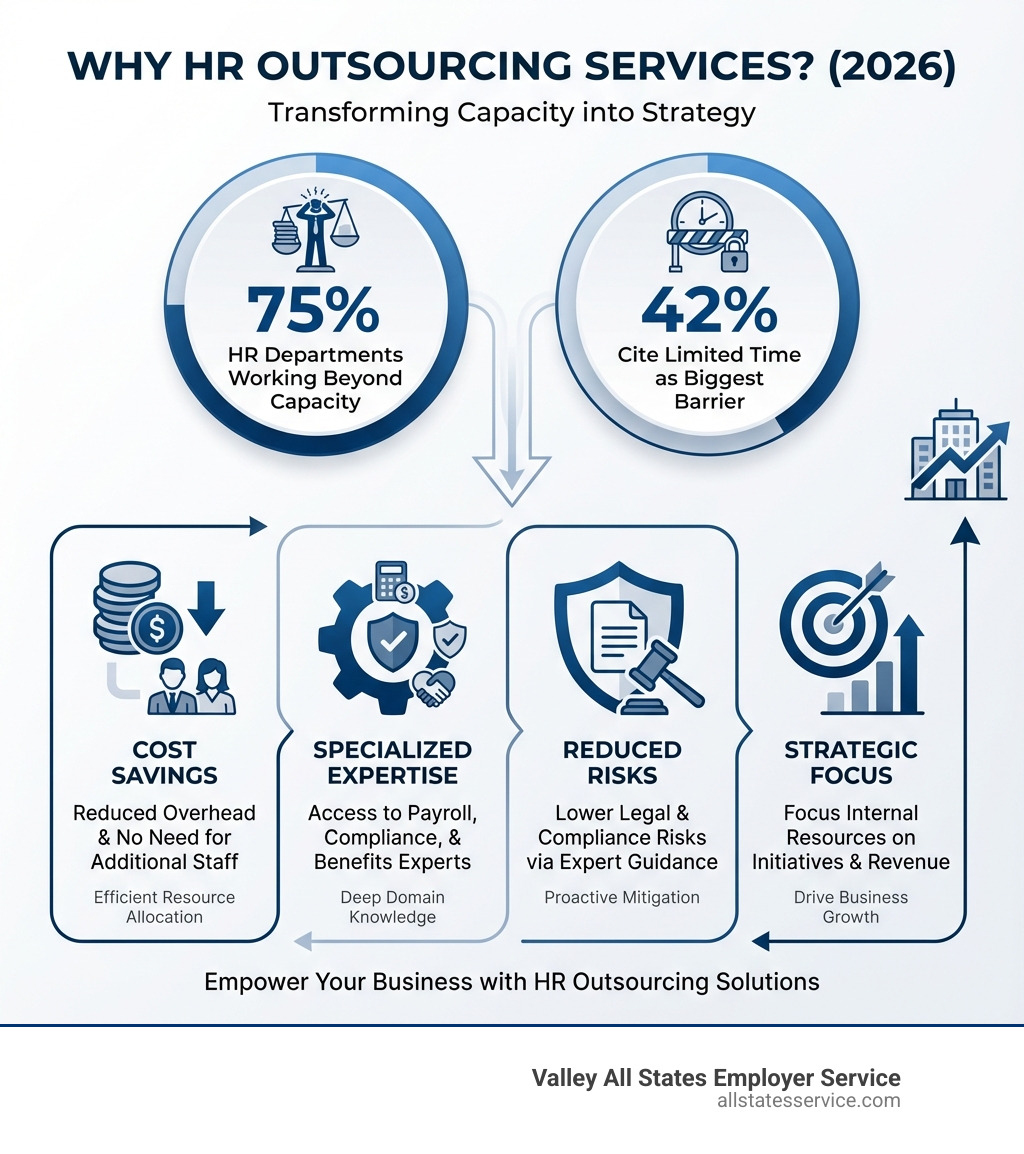
If you’re an HR manager juggling endless compliance requirements, drowning in paperwork, and struggling to keep up with changing regulations, you’re alone. Nearly 75% of HR professionals feel their department is working beyond capacity, stretched too thin to handle everything on their plate. Another 42% say limited time and dedicated personnel are the biggest barriers to achieving their organizational priorities.
The reality is simple: HR is complex, costly, and constantly changing. Resources are tight, pressure is high, and the risk of non-compliance can be severe. Whether it’s navigating E-Verify requirements, managing international payroll, or simply processing benefits for a growing team, the administrative burden keeps pulling you away from strategic work that actually drives business growth.
That’s where employee outsourcing services come in. Instead of trying to be an expert in everything, you can partner with specialists who live and breathe specific HR functions. This isn’t about losing control or replacing your team. It’s about gaining capacity, reducing risk, and freeing up your time to focus on building a better workplace culture and supporting your company’s strategic goals.
Why Do Companies Choose to Outsource HR?
We often find ourselves asking why more and more companies are turning to employee outsourcing services. The reasons are compelling and rooted in the desire to optimize operations, manage costs, and stay competitive in a dynamic business landscape. When our internal HR departments are constantly working beyond capacity, it is clear something needs to change.
Many businesses, especially small to medium-sized businesses (SMBs) in the United States, find themselves overwhelmed by the sheer volume and complexity of HR tasks. From managing employee benefits to ensuring compliance with ever-changing state and federal regulations, the administrative burden can be immense. For instance, keeping up with evolving labor rules can feel a lot like tracking every update on the Fair Labor Standards Act, which is no small task.
This is where outsourcing becomes not just a convenience, but a strategic necessity.
Gaining a Competitive Edge
For many companies, the decision to use employee outsourcing services is about more than just cutting costs, it is about gaining a significant competitive edge. When we offload routine yet critical HR functions, our internal teams can shift their focus from administrative minutiae to strategic initiatives that drive growth and innovation.
This strategic focus allows our businesses to concentrate on revenue generation and core competencies. Instead of spending valuable time on payroll processing or benefits administration, our leaders can dedicate their energy to product development, market expansion, or improving customer relationships. This agility is crucial in today’s market. Leveraging expert knowledge from outsourcing partners also ensures we are implementing best practices, keeping us ahead of the curve.
Solving Capacity and Skill Gaps
Think about it, can your in-house team truly be experts in every single facet of HR, from E-Verify compliance in Maryland to benefits administration across multiple states? Probably not. This is where employee outsourcing services shine, providing immediate solutions for capacity and skill gaps.
Outsourcing provides access to a vast talent pool and specialized expertise that would be too costly or difficult to cultivate internally. This is particularly true for complex areas like compliance, where staying abreast of all federal and state laws, like those in Lutherville, MD, can be a full-time job. Tasks that would take weeks internally can often be completed in days by expert partners. This efficiency, coupled with access to advanced HR technology that individual businesses might not afford, makes outsourcing an attractive option. Some providers even offer fractional HR support, allowing businesses to tap into expert resources only when needed, without the overhead of a full-time hire.
The Pros and Cons of Outsourcing Employees
Weighing the decision to outsource involves looking at both the significant advantages and the potential challenges. Understanding this balance is key to making the right choice for your company. Just like any strategic business move, there are two sides to the coin when it comes to employee outsourcing services. Let’s explore them.
- Reduced operating costs
- Improved compliance
- Access to better benefits
- Scalability
- Improved accuracy
- Focus on critical work
Major Benefits (Pros)
The benefits of using employee outsourcing services directly impact your bottom line and efficiency. A primary advantage is cost control, as outsourcing reduces expenses tied to salaries, benefits, and training, freeing up capital for core business areas. It also brings a significant reduction in administrative burden, as experts handle time-consuming tasks like payroll and tax filings. This allows your internal team to focus on strategic work.
You also gain expert guidance from specialists familiar with the latest employment laws, like federal E-Verify mandates, which minimizes legal risks. These services often provide access to advanced HR technology and can lead to an improved employee experience by offering better benefits packages, helping you attract and retain top talent.
Potential Drawbacks (Cons)
It’s also important to acknowledge potential drawbacks. A primary concern is a perceived loss of direct control over HR functions, though a good partner mitigates this with clear service level agreements (SLAs). Communication challenges can arise, so establishing clear channels is vital.
Entrusting sensitive employee data to a third party also raises data security concerns, requiring thorough vetting of the provider’s security protocols. Other potential issues include hidden costs in unclear contracts or an impact on in-house morale. Choosing the wrong partner can create more problems than it solves, which highlights the importance of a careful selection process.
Models and Services: What Can You Actually Outsource?
HR outsourcing isn’t a one-size-fits-all solution. It ranges from handing off a single task to a comprehensive partnership. The model you choose depends entirely on your business needs, size, and long-term goals. We see a spectrum of employee outsourcing services designed to fit various organizational structures and requirements.
| Aspect | In-House HR | PEO/HRO (Co-Employment) | EOR (Employer of Record) |
|---|---|---|---|
| Cost | High fixed overhead, recruitment costs | Variable, often per-employee fee, economies of scale | Variable, often per-employee fee, includes global compliance |
| Control | Full direct control, high management burden | Shared control, guidance from PEO, reduced burden | High control over daily tasks, legal employer is EOR |
| Liability | Full legal and compliance liability | Shared liability, PEO handles compliance risk | EOR assumes full legal and compliance liability |
| Scope | All HR functions, internally managed | Comprehensive HR, payroll, benefits, compliance | Global payroll, benefits, compliance for international hires |
What are the main types of employee outsourcing services?
Understanding the different models of employee outsourcing services is crucial for selecting the right fit for your business in the United States. We often work with clients who benefit from various approaches:
-
Professional Employer Organization (PEO): A PEO uses a co-employment model. Your business retains day-to-day control, while the PEO handles payroll, benefits, and HR compliance, sharing some employer liability. This is a popular choice for U.S. SMBs looking to offer better benefits and reduce administrative tasks.
-
Human Resources Outsourcing (HRO): This is a flexible model where you hire a third party to manage specific HR functions (like payroll) or your entire HR department. It does not involve co-employment, and you typically retain full employer liability.
-
Employer of Record (EOR): An EOR is mainly for international hiring. The EOR becomes the legal employer for your staff in another country, handling all local legal, tax, and HR duties. This allows you to hire globally without setting up a foreign entity.
-
Business Process Outsourcing (BPO): This involves outsourcing specific, non-core business processes. For HR, this can include payroll processing or recruitment to streamline functions for efficiency.
-
Shared Services: This model, typically for larger organizations, centralizes HR functions internally to standardize processes and increase efficiency, often using shared technology.
Specific HR Functions You Can Outsource
The beauty of employee outsourcing services lies in their flexibility. We can choose to outsource a single, problematic function or a comprehensive suite of services. Here are some of the key HR functions we commonly see outsourced:
- Payroll and tax administration: Ensures accurate and timely payroll, including deductions, deposits, and compliance with federal and state tax laws.
- Benefits administration: Manages health insurance, retirement plans, and leave, ensuring compliance with rules like ERISA and ACA.
- Talent acquisition and recruitment: Streamlines hiring, from job posting and candidate sourcing to screening and background checks.
- Onboarding and offboarding: Ensures a smooth and compliant process for employees joining or leaving the company, which is crucial for retention and mitigating legal risks.
- Compliance management: Outsourcing helps you stay current with complex federal and state laws (like FLSA, FMLA, and E-Verify requirements), mitigating legal risks and ensuring adherence to all regulations.
- Employee relations: Provides objective guidance for managing employee grievances, disciplinary actions, and conflict resolution.
- Time and attendance tracking: Ensures accurate record-keeping for employee hours and overtime, maintaining compliance with wage laws.
- Workers’ compensation: Helps manage claims, safety programs, and insurance, reducing administrative load.
- Performance management: The administrative aspects of performance reviews, such as system setup and record-keeping, can be outsourced.
Choosing the Right Partner for Your Employee Outsourcing Services
Selecting a provider is the most critical step. The right partner acts as an extension of your team, while the wrong one can create more problems than it solves. Due diligence is essential, especially when considering employee outsourcing services for your business in the United States. We understand that this decision can feel daunting, but with the right approach, you can find a partner that truly empowers your business.
Key Considerations for Selecting a Provider
When we look for a partner to provide employee outsourcing services, we emphasize a few core considerations to ensure a successful, long-term relationship:
- Needs assessment: Before anything else, conduct a thorough self-assessment. What are your pain points? Which HR functions are consuming too much time or causing compliance headaches? Clearly defining your needs will guide your search.
- Industry experience: Look for providers with a proven track record and deep understanding of your industry and its unique challenges.
- Technology integration: Seamless integration with your existing systems is vital. Does the provider offer advanced HR technology that can streamline processes and improve data management?
- Scalability: Your business will grow. Ensure your outsourcing partner can scale their services to meet your evolving needs.
- Client reviews and references: Check online reviews, request case studies, and speak with current clients to gauge service quality and reliability.
- Service Level Agreements (SLAs): A clear SLA outlines expectations for service delivery, including response times and performance metrics, ensuring accountability.
- Transparent pricing: Understand the cost structure upfront. Are there any hidden costs? Transparency is key to avoiding budget surprises.
If you are exploring locations for international teams, independent resources on regions like Eastern Europe outsourcing destinations can help you better understand time zones, talent pools, and general business climates.
Navigating International Outsourcing Risks
For US companies considering international expansion, it is crucial to understand the unique risks. Global outsourcing requires navigating complex and varied local labor laws, tax compliance, and data privacy regulations like the General Data Protection Regulation. You must also consider intellectual property (IP) protection, cultural nuances, and time zone differences. Due to these complexities, seeking advice from experts in international employment law is highly recommended when hiring globally.
Cost implications of employee outsourcing services
Understanding the financial aspect is key. Common pricing models include a per-employee-per-month (PEPM) fee, project-based fees for one-off tasks, or a retainer model for ongoing expert access.
When comparing costs, look beyond the sticker price and consider the Return on Investment (ROI). Factor in savings from reduced administrative time, avoided compliance penalties, and the ability to focus on revenue-generating activities. The total cost of an in-house HR department includes salaries, benefits, software, and training. When you account for everything, employee outsourcing services often prove to be a more cost-effective solution.
Frequently Asked Questions about HR Outsourcing
We hear a lot of great questions about employee outsourcing services, and we’re here to provide clear answers. Let’s tackle some of the most common inquiries.
What is the difference between a PEO and an EOR?
The distinction is crucial. A Professional Employer Organization (PEO) enters a co-employment relationship with your company for domestic employees. You retain day-to-day control, while the PEO handles HR tasks like payroll and benefits, sharing some employer liability. This is common within the United States.
An Employer of Record (EOR) becomes the legal employer for your staff in another country. The EOR handles all legal, tax, and HR duties for your international hires, allowing you to expand globally without setting up a foreign entity. In short, a PEO is a domestic partner, while an EOR is a global solution.
How does outsourcing HR compare to an in-house department?
Outsourcing often provides significant cost savings compared to the high overhead of an in-house team (salaries, benefits, training). It also offers access to a broader range of specialized expertise and better technology than a small business can typically afford.
An in-house department provides more direct control and deeper integration with your company culture. However, it comes with higher costs and potentially limited expertise in complex areas like compliance, which increases risk. Outsourcing allows your team to focus on strategic work instead of administrative tasks.
What are the biggest risks of outsourcing employees?
The biggest risks include a perceived loss of control over HR processes, potential data security breaches with sensitive employee information, and communication gaps with your provider. A critical risk is ensuring your partner complies with all labor laws, as your company can still be held liable for mistakes in areas like payroll or E-Verify processing.
You can mitigate these risks through a thorough vetting process, clear service level agreements (SLAs), and a strong contract that outlines responsibilities and data protection measures.
From Burden to Benefit: Making Outsourcing Work for You

Shifting HR responsibilities to an external partner can free up invaluable resources, reduce compliance headaches, and empower your business to focus on what it does best. From payroll to complex legal requirements, employee outsourcing services provide a scalable path to efficiency and strategic growth.
For specialized, high-stakes tasks like workforce eligibility, partnering with an expert is crucial. For example, a dedicated service like Valley All States Employer Service can handle the complexities of E-Verify, ensuring your business remains compliant with federal hiring laws impartially and efficiently. We understand the nuances of E-Verify requirements across all US states, minimizing errors and administrative burden for our clients. By strategically choosing what and how to outsource, you can build a more resilient and successful organization that thrives on efficiency and expert support.
Ready to streamline your HR and compliance? Explore our services to see how we can help.