
E-Verify service United States: Secure Hiring 2025
Understanding the E-Verify Service United States
The E-Verify service United States is a web-based system from the Department of Homeland Security (DHS) and Social Security Administration (SSA) that lets employers confirm an employee’s eligibility to work in the U.S. While voluntary for most, it’s mandatory for federal contractors and in many states.
Quick Facts About E-Verify:
- What it does: Compares Form I-9 information against government databases
- Who runs it: DHS in partnership with SSA
- Usage: Over 700,000 employers use the system (as of 2018)
- Accuracy rate: 98.88% of applicants are approved to work
- Cost: Free for employers to use directly
- Timeline: Results typically provided within seconds
For HR managers, understanding E-Verify can feel overwhelming. The system affects millions of new hires annually, with over 48 million cases processed as of May 2023.
The stakes are high. Mistakes can lead to penalties, legal issues, or discrimination claims. Getting it right streamlines your hiring process and ensures federal compliance.
This guide breaks down the E-Verify system, covering who must use it, how it works, and how to handle issues when they arise.
What is E-Verify and How Does It Work?
E-Verify is your digital compliance partner. This E-Verify service United States system connects your hiring paperwork to federal government databases to quickly confirm if a new hire is legally allowed to work here.
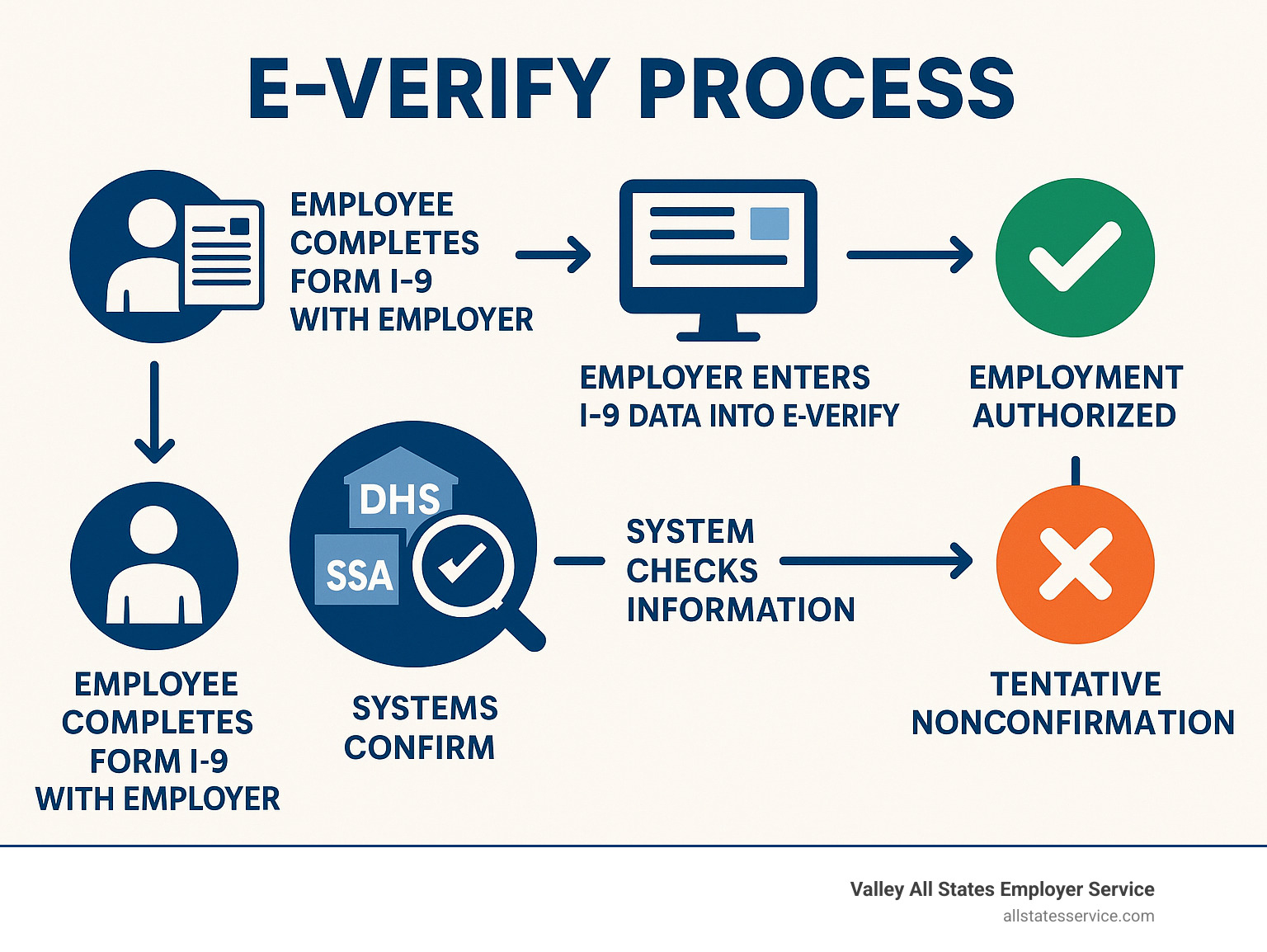
This web-based system is a partnership between the Department of Homeland Security (DHS) and the Social Security Administration (SSA). You enter your new employee’s Form I-9 information into E-Verify, which then performs a government records check against federal databases.
Usually, you get an Employment Authorized result in seconds. Sometimes, the system returns a Tentative Nonconfirmation (TNC), which means a discrepancy needs to be resolved. A TNC is not necessarily bad news, it just means the system needs a human touch to resolve any discrepancies.
Want to explore the system yourself? You can learn more about the E-Verify program directly from the source. We also have more info about E-Verify and I-9 compliance that breaks down how these two requirements work together.
The E-Verify Process
The E-Verify process is simple and becomes routine. The key is timing: you can only use E-Verify after a new hire accepts the job offer and completes their Form I-9.
Here’s how the process unfolds:
-
Employer completes Form I-9 with new hire – Your new employee shows you their documents, and you verify them in person (or through approved remote methods).
-
Employer creates a case in E-Verify – You log into the system and enter the information from the completed I-9, including name, date of birth, and document details.
-
E-Verify compares data to DHS and SSA records – The system cross-references the information against government databases for verification.
-
Employer receives a result in seconds – You get either a confirmation or a notice that something needs to be resolved.
The entire process typically takes just a few minutes but provides lasting peace of mind.
A Brief History of E-Verify
E-Verify began as the Basic Pilot Program, created by the 1996 Illegal Immigration Reform and Immigrant Responsibility Act. It was a much smaller, simpler version of today’s system.
Initially a voluntary experiment with basic technology, the program evolved to a web-based system to handle millions of verifications as technology and needs grew.
The federal government recognized its value, expanding mandates for its use. The small pilot project became an essential verification tool. While the system has changed, its core mission of helping employers build legal, compliant workforces remains.
Who Must Use the E-Verify Service United States?
Many HR managers ask, “Do I need to use E-Verify?” The answer is complex. While the E-Verify service United States is free and available to any employer, participation isn’t always optional.
Your requirement to use E-Verify depends on your employer type, work, and location. Mistakes can lead to hefty fines, loss of your business license, or other legal consequences.
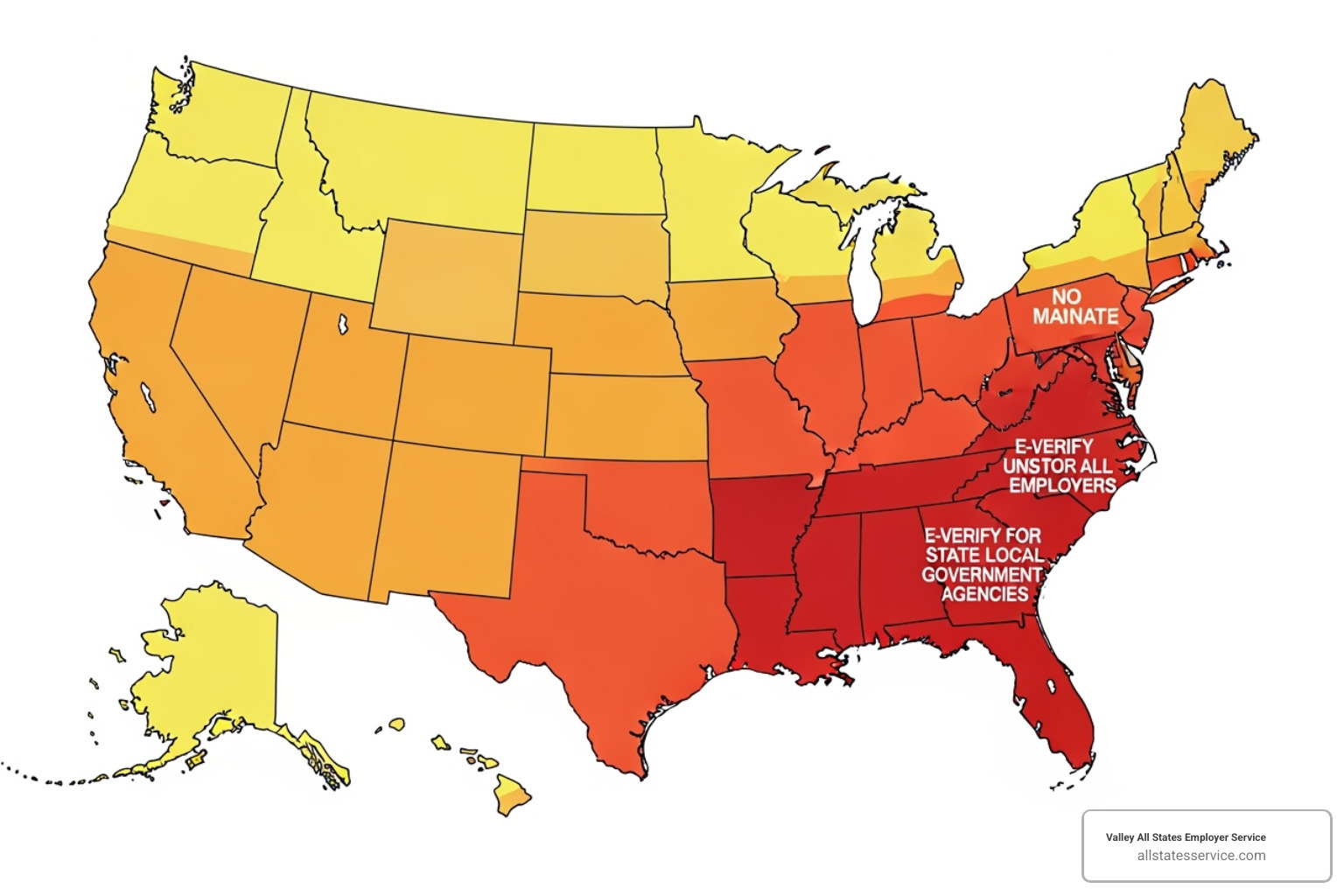
The landscape is complicated, with requirements from both federal mandates and state-specific laws. Rules vary by state and employer type. For a comprehensive look, check out our guide on what employers are required to use E-Verify.
Federal E-Verify Mandates
The federal government is clear: doing business with them often means using E-Verify. The main federal mandate affects federal contractors and subcontractors with the Federal Acquisition Regulation (FAR) E-Verify clause in their contracts.
If your contract has the FAR clause, you must use E-Verify for all new hires, not just those on the federal contract. You may also need to verify existing employees working on federal contracts. Federal government agencies have been required to use E-Verify since 2007.
Additionally, if you’re hiring someone on an F-1 visa seeking a 24-month STEM Optional Practical Training (OPT) extension, your company must participate in E-Verify. You can learn more in our Federal E-Verify Rules resource.
State-Specific Requirements
While federal mandates are specific, many states have created their own E-Verify laws, resulting in a complex patchwork of requirements. You can review an overview of E-Verify policies at the state level for details.
Some states, like Arizona and Alabama, have comprehensive mandates requiring most employers to use E-Verify. Many others, including Colorado, Florida, Georgia, Indiana, Mississippi, Missouri, North Carolina, South Carolina, Tennessee, and Utah, have requirements that might apply to public employers or government contractors.
Requirements can be nuanced. North Carolina, for example, has phased-in requirements based on company size. Some cities and counties also impose their own rules.
Penalties for non-compliance are severe, including fines, loss of business licenses, and contract termination. Understanding your specific obligations is essential for keeping your business running legally.
The E-Verify Onboarding Process: A Step-by-Step Guide
Getting E-Verify right during onboarding creates a smooth, compliant process that protects your business and new employees. It works hand-in-hand with Form I-9 completion. For a comprehensive walkthrough, check out our detailed guide on the E-Verify Onboarding Process.

Step 1: Accurately Complete Form I-9
Everything starts with a properly completed Form I-9, which is required to use the E-Verify service United States. The I-9 is your legal foundation, documenting an employee’s identity and work authorization.
Timing is critical. Employee Section 1 must be completed by the employee’s first day of work. For Employer Section 2, you have three business days from the start date to examine their original, unexpired documents and ensure they appear genuine. With more distributed workforces, it’s important to stay current on the latest remote verification rules.
Accuracy is everything, as errors can trigger issues. When in doubt, consult the official USCIS I-9 Central website for guidance.
Step 2: Create an E-Verify Case
Once the Form I-9 is complete, you must create an E-Verify case no later than the third business day after the employee starts work. This three-day rule is not flexible.
Entering employee information requires careful attention to detail. You’ll input data exactly as it appears on the Form I-9. The Photo matching tool adds another verification layer for certain documents, like U.S. passports, by comparing the document photo to government database photos.
The system guides you through the case creation process, and you’ll usually have an answer in seconds.
Step 3: Handle E-Verify Results
E-Verify delivers one of two initial results. How you handle each is critical.
An Employment Authorized result means the employee’s information matches government records. You just need to record the E-Verify case number on their Form I-9 or keep a copy of the case details.
A Tentative Nonconfirmation (TNC) requires careful handling. It doesn’t mean the employee isn’t authorized to work, but that there’s a discrepancy. You must promptly notify your employee with the official TNC notice. The employee then chooses whether to contest it.
If they contest, they have eight federal government work days to contact the appropriate agency (SSA or DHS). During this time, you cannot take any adverse action against the employee; they have the right to continue working. A Final Nonconfirmation only occurs if the employee doesn’t contest or the issue can’t be resolved. For detailed guidance, reference the official resource on Resolving a Tentative Nonconfirmation.
Understanding employee rights is about more than compliance; it’s about fairness. A well-handled TNC process protects your business and your employee.
Benefits, Criticisms, and the Future of E-Verify
The E-Verify service United States is central to debates on employment verification, privacy, and immigration. It offers advantages for workforce integrity but also faces legitimate concerns about its future.
Benefits for Employers and Employees
For employers, E-Verify provides peace of mind through legal safe harbor protection. If you follow procedures correctly, you’re protected from penalties for unknowingly hiring someone without work authorization. The system is also fast, with 98.88% of applicants approved to work, often in seconds.
| For Employers | For Employees |
|---|---|
| Legal safe harbor from penalties | Identity theft protection through myE-Verify tools |
| Reduced errors with digital verification | Faster verification process |
| Digital records for easier compliance | Free myE-Verify account for case tracking |
Employees also benefit. Tools like myE-Verify allow workers to lock their Social Security Number to prevent fraud, track their cases, and resolve issues directly.
Modern E-Verify Tools: myE-Verify and E-Verify+
The system is evolving with employee-focused tools. myE-Verify gives workers control over their verification. Through this free portal, employees can view case history, track cases, and self-lock their SSN to prevent identity fraud. Workers can visit the official myE-Verify portal for more information.
E-Verify+ is the next generation, aiming for better Form I-9 integration and more employee control to streamline the entire process.
Criticisms and Concerns about the E-Verify service United States
E-Verify faces serious criticism, primarily concerning database errors. While the error rate is small, mistakes can devastate individual workers. The Immigration Forum’s fact sheet on E-Verify accuracy and issues highlights these concerns.
Discrimination remains a persistent worry, as some employers might misuse the system. Privacy advocates also worry about data security and potential expansion into a national ID system. Finally, small businesses can struggle with the administrative burden of training and TNC resolution.
Latest Updates to the E-Verify service United States
E-Verify stays current with policy and technology. Recent updates include new reporting tools for specific cases like parole terminations. You can watch a video on the new reporting tool to see it in action.
The system now requires Login.gov integration for improved security. Policy updates for specific populations, like Afghan and Ukrainian parolees or those with Temporary Protected Status (TPS), also happen regularly. Free government webinars help employers and employees stay current.
Frequently Asked Questions about E-Verify
Navigating the E-Verify service United States can be complex. It’s normal for employers to have questions, as verification involves federal law, employee rights, and business operations. Let’s tackle some common concerns.
What is the difference between Form I-9 and E-Verify?
This is a common question. Think of Form I-9 as the foundation. Every U.S. employer must complete this form for every new hire to document their identity and work authorization.
E-Verify is the digital double-check. It uses the information from Form I-9 to confirm that authorization against government databases. E-Verify supplements the I-9, it does not replace it. While Form I-9 is mandatory for all employers, E-Verify is only required for certain employers, like federal contractors or those in specific states.
Can I use E-Verify to check current employees?
The short answer is no. E-Verify is for new hires only. It cannot be used to pre-screen applicants or to check existing employees, except in very specific situations. These exceptions include certain federal contractors with the FAR E-Verify clause or employers undergoing a government audit.
E-Verify is not used for reverifying employees when their work authorization expires; that process is handled through Form I-9. The safest approach is to use E-Verify for new hires only unless a specific legal requirement states otherwise.
What are an employer’s responsibilities during a TNC?
Don’t panic if E-Verify returns a Tentative Nonconfirmation (TNC). A TNC doesn’t mean your employee lacks work authorization; it just indicates a mismatch that needs resolution.
Your most important responsibility is to do nothing adverse. You cannot fire, suspend, or take any negative action against an employee because of a TNC. You must notify the employee immediately with the official TNC notice, which explains their right to contest it. The employee has eight federal government work days to contact the appropriate agency (SSA or DHS) to fix the problem.
During this process, the employee keeps working. Your job is to provide information, document their decision, and remain neutral. Following these steps protects both you and your employee.
Simplify Your Compliance with an E-Verify Agent
Managing the E-Verify service United States is complex. Juggling federal and state mandates, Form I-9 rules, and TNCs is a challenge for any HR professional. It’s easy to second-guess data entry or worry about missing the three-day deadline. The stakes are high, and a single mistake can lead to penalties or legal claims.
This is where partnering with an E-Verify Employer Agent changes everything.
At Valley All States Employer Service, we understand these challenges. As experts in employment compliance and HR services, our team has handled every type of E-Verify case and TNC scenario. We offer expert, impartial, and efficient E-Verify processing that takes the burden off your shoulders.
Think of us as your compliance safety net. While you focus on building your team, we handle the technical verification work with precision. Our trained specialists prevent common errors, ensure timely case submission, and guide you through the TNC process, protecting both your company and your employees’ rights.
The peace of mind is invaluable. No more wondering if you’ve done everything correctly or scrambling to understand new policy updates. We stay on top of the latest E-Verify developments so you don’t have to.
Ready to transform your hiring process from stressful to streamlined? Learn more about our E-Verify Employer Agent Service and find out how we can simplify your compliance journey.
Your business deserves to run smoothly, and your new hires deserve a professional, error-free verification experience. Explore our expert E-Verify services today.