
Why the I-9 Process for Rehires Causes So Much Confusion
The I-9 process for rehires trips up even experienced HR managers. You’re bringing back a former employee, which feels routine, but suddenly you’re facing questions about old forms, Supplement B, three-year rules, and whether you need to start from scratch. Get it wrong, and you’re looking at penalties ranging from hundreds to thousands of dollars per violation.
Quick Answer: Your Two Main Options
When rehiring someone, you have two paths:
- Use Supplement B (if rehiring within 3 years of their original I-9 and the form is still current)
- Complete a new Form I-9 (if it’s been more than 3 years, or you prefer a fresh start)
The 3-Year Rule Determines Everything:
- Within 3 years: You may use Supplement B of the original I-9 OR start fresh with a new form
- After 3 years: You must complete a brand new Form I-9
Here’s what makes this confusing: continuing employment, expired documents, old form versions, E-Verify requirements, and the difference between reverification and rehire all create decision points that aren’t always clear.
The research shows that most employers don’t realize they have options when rehiring within three years. Many complete unnecessary new forms, while others incorrectly use old I-9s when they should start over. Both mistakes create compliance risks during an ICE audit.
This guide walks you through every decision point in the rehire process. You’ll learn exactly when to use Supplement B, how to fill it out correctly, what to do about E-Verify, and how to avoid the most common penalties. We’ll cover name changes, expired work authorization, mergers and acquisitions, and the critical difference between reverification and rehire.
The First Big Decision: New Form I-9 or Supplement B?
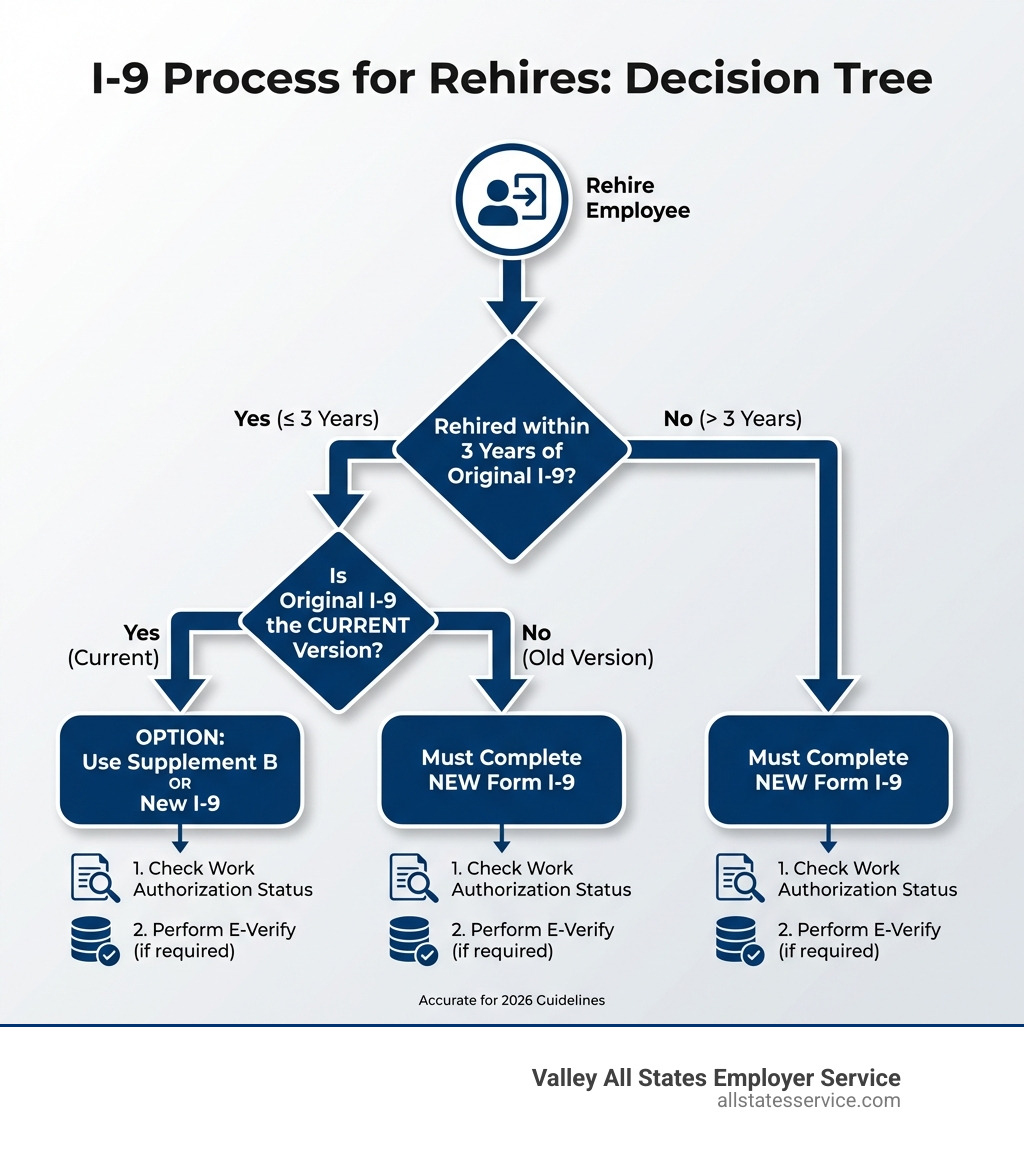
When a familiar face returns to your team, it’s easy to assume the paperwork will be straightforward. However, the I-9 process for rehires requires careful consideration. The first pivotal decision you’ll make is whether to complete a brand new Form I-9 or to use Supplement B (formerly Section 3) of the employee’s original Form I-9. This choice largely hinges on how much time has passed since their last employment and the status of their previous Form I-9.
Our goal is to help you maintain compliance without unnecessary administrative burden. Let’s explore the options. To truly understand the foundation of this process, it helps to know What is an I-9? and its core purpose.
When to Use Supplement B for a Rehire
You have the flexibility to use Supplement B for a rehired employee if they are returning to your company within three years from the date you originally completed their previous Form I-9. This can be a real time-saver, but there are a few conditions to consider:
- Within 3 years of original I-9: This is the golden rule. If the rehire date falls within this three-year window, Supplement B is an option.
- Employee still work-authorized: You must verify that the employee is still authorized to work in the United States.
- Original form is a current version: If the original Form I-9 is an older, no longer valid version, you’ll need to use Supplement B from a current Form I-9. We’ll dive into this more shortly, but it’s important to be aware of I-9 Form Updates to ensure you are always using the correct version.
- No expired documents requiring reverification: If their previous employment authorization document has expired, you’ll need to reverify their authorization using a new document.
Choosing Supplement B can streamline the I-9 process for rehires, but it’s crucial to ensure all conditions are met to avoid compliance issues.
When a New Form I-9 is Mandatory
While Supplement B offers convenience, there are clear circumstances when a new Form I-9 is not just an option, but a requirement.
- Rehire is after 3 years: This is non-negotiable. If more than three years have passed since the original Form I-9 was completed, you must treat the individual as a new hire and complete a brand new Form I-9.
- Original I-9 is an old version: If you’re rehiring an employee within the three-year window, but their previous Form I-9 is an outdated version, you cannot simply update it. You must either complete a new Form I-9 or use Supplement B from the current version of the form and attach it to the old one. For many, completing a new Form I-9 is often the simplest and most compliant approach in this scenario.
- All Supplement B blocks are full: Supplement B provides multiple blocks for reverification and rehire. If all these blocks have already been used for previous rehires or reverifications, you’ll need a new Form I-9.
- Employer preference for a clean record: Even if you qualify to use Supplement B, you always have the option to complete a new Form I-9. Some employers prefer this for clarity, especially if the original form has many annotations or corrections. It provides a clean slate, similar to handling New Hire Paperwork I-9 for any new employee.
What Counts as “Continuing Employment”?
Sometimes, an employee’s break in service isn’t a true “rehire” but rather a continuation of employment. This is a critical distinction in the I-9 process for rehires, as it means a new Form I-9 or Supplement B update might not be necessary at all. The key factor is whether the employee had a “reasonable expectation of employment at all times” during their absence.
Here are situations typically considered continuing employment, as detailed in the USCIS Handbook for Employers:
- Approved leave of absence: This includes situations like medical leave, family leave, or other employer-approved breaks.
- Temporary layoffs: If an employee is temporarily laid off due to lack of work and there’s an expectation of recall, their employment may be considered continuous.
- Seasonal work: Employees who return seasonally, like agricultural workers or summer camp staff, often fall under this category.
- Promotions or transfers: Moving to a different position or department within the same company is continuous employment.
- Strikes or other union-initiated work stoppages.
- Reinstatement after disciplinary suspension.
- Continuing employment with a related, successor, or reorganized employer.
To determine if a reasonable expectation of employment existed, consider factors like: the regularity of employment, compliance with absence policies, the employer’s recall history, position availability, benefits sought during absence, financial condition, and communication regarding return. For more detailed guidance, refer to Rules for Continuing Employment and Other Special Rules.
A How-To Guide for Completing Supplement B
If you’ve determined that using Supplement B is the right path for your rehired employee, let’s walk through the steps to complete it accurately. This section is all about precision and ensuring every detail is correct.

Supplement B, Reverification and Rehire, is designed to capture updates to an employee’s work authorization or rehire status without requiring a completely new Form I-9. It’s often found on the last page of the current Form I-9. Section 2 of the Form I-9 is where the initial document verification occurs, so any changes or rehires will be updated in Supplement B, referencing that original information. Our I-9 Section 2 Complete Guide can provide context on the initial verification.
For a Rehire with Current Work Authorization
When rehiring an employee who is still authorized to work and their documents have not expired, the process for completing Supplement B is quite straightforward. We’re essentially just noting their return.
You must enter the following information in Supplement B:
- Employee’s full name: Write the employee’s full name as it appeared on their original Form I-9.
- New name (if applicable): If the employee has legally changed their name since their last employment, enter the new name in the designated field.
- Rehire date: Crucially, enter the employee’s new rehire date. This marks their official return to your payroll.
- Employer signature and date: You, or your authorized representative, must sign and date the completed block.
It’s that simple. You’re confirming their identity and authorization haven’t changed, just their employment status with your company. For a visual reference, you can find more details on Completing Supplement B, Reverification and Rehires … – USCIS.
For a Rehire Whose Work Authorization Expired
This scenario combines the rehire process with reverification, which means you’ll need to do a bit more than just record a rehire date. If the employee’s previous employment authorization has expired, they must present new, unexpired documentation.
Here’s what you need to do:
- Combined rehire and reverification: The employee must provide an unexpired document from either List A or List C to prove their current work authorization.
- Employee’s full name: As with other rehires, enter the employee’s full name from their original Form I-9, and any new name if applicable.
- Rehire date: Enter the rehire date.
- New List A or List C document details: In the reverification section of Supplement B, record the:
- Document title (e.g., Employment Authorization Document, Permanent Resident Card).
- Document number.
- Expiration date of the new document.
- Employer signature: Sign and date the completed block.
This ensures that even though they are a rehire, their current employment eligibility is properly documented. If you’re dealing with expired documents, our Expired I-9 Documents Complete Guide offers further insights.
Handling Name Changes and Other Updates
What if an employee’s personal information has changed since their last Form I-9, or even during their current employment? This is another area where Supplement B comes in handy, though it’s important to understand the nuances.
- Legal name change documentation: While not strictly required by law to update Form I-9 for a name change, it’s a best practice to keep records accurate. If an employee legally changes their name, you can ask for documentation linking the new name to the old identity (like a marriage certificate or court order) and keep it with the Form I-9.
- Recording the new name in Supplement B: You can note the new name in the “New Name” field in Supplement B. This helps maintain consistency in your records. Our I-9 Form Completion guide has more information on best practices for accurate data entry.
- Substantial identity changes (name, DOB, SSN): If an employee’s name, date of birth, or Social Security number substantially differs from previously provided information, and they cannot provide evidence linking the new information to the old identity, you should proceed with caution.
- When a new I-9 is required for identity discrepancies: In cases of substantial, unlinked identity discrepancies, the USCIS recommends completing a new Form I-9. You should write the original hire date in Section 2 of the new form and attach it to the previously completed one. This helps ensure you are reasonably assured of the employee’s identity and work authorization.
The E-Verify Connection: Your Digital Compliance Step
The I-9 process for rehires often involves E-Verify. E-Verify is an internet-based system that compares information from an employee’s Form I-9 to data from U.S. Department of Homeland Security (DHS) and Social Security Administration (SSA) records to confirm employment eligibility. Understanding how E-Verify integrates with rehires is crucial for compliance. Our I-9 E-Verify Ultimate Guide can offer a comprehensive overview.
Rehire with a Previous “Employment Authorized” E-Verify Case
This is the most favorable scenario when rehiring an employee who was previously E-Verified. If you rehire a former employee within three years of the initial execution of their previous Form I-9, and you created an E-Verify case that resulted in “employment authorized,” you have options:
- Within 3 years: You may rely on the information from the employee’s previous Form I-9.
- No new case needed: If the previous E-Verify case received an “employment authorized” result, and the Form I-9 has no expired documents that require reverification (like a U.S. passport, Permanent Resident Card, or List B document), you simply write the employee’s rehire date in Supplement B of the existing Form I-9. You do not need to create a new case in E-Verify.
- Update Supplement B only: Even if some documents, like a List A or C document that does trigger reverification, have expired, you would update Supplement B with the new document information and the rehire date. Still, no new E-Verify case is required in this specific scenario.
- Option to complete a new Form I-9 and create a new E-Verify case: You always have the option to treat the rehire as a new hire. This means completing a new Form I-9 and creating a new E-Verify case, even if you could have used the old one. This might be preferable for some employers for consistency or simpler record-keeping.
Rehire with No Previous E-Verify Case (or a Negative Result)
This situation requires a more proactive approach. If you rehire a former employee within three years of their previous Form I-9, but one of the following applies, you must act:
- Did not create an E-Verify case previously: Perhaps E-Verify wasn’t mandatory for your company at that time, or you simply didn’t run a case.
- Received a non-employment authorized result: The previous E-Verify case did not confirm employment authorization.
In either of these situations, you must:
- Complete a new Form I-9: The employee will need to complete a brand new Form I-9.
- Create a new case in E-Verify: You must create a new case in E-Verify within three business days of the rehire date. This ensures their current employment eligibility is properly verified through the system.
For a smooth process, understanding E-Verify Employer Requirements is key. If you’re new to the system, our E-Verify Registration Process can guide you through getting started.
What About Federal Contractors?
Federal contractors operate under additional scrutiny and specific rules regarding E-Verify. If your company is a federal contractor with the FAR E-Verify clause, you are subject to special requirements for verifying existing employees, not just new hires. This extends to rehires as well.
- FAR E-Verify clause: This clause mandates that federal contractors use E-Verify for all new hires and, in some instances, for existing employees assigned to federal contracts.
- Special rules for existing and rehired employees: These rules can be complex and may require E-Verify cases for employees who might not otherwise need them. It’s crucial for federal contractors to consult the specific guidance.
For comprehensive information custom to federal contractors, we recommend reviewing the E-Verify Supplemental Guide for Federal Contractors at e-verify.gov. Staying informed is your best defense against non-compliance.
Mastering the Complete I-9 Process for Rehires and Beyond
Navigating the I-9 process for rehires is just one piece of the larger puzzle of employment eligibility verification. To truly master compliance, we need to understand how rehires fit into the broader landscape of I-9 management, including reverification, retention, and special scenarios like mergers and acquisitions.

Understanding Reverification vs. the I-9 process for rehires
It’s easy to confuse “reverification” with the I-9 process for rehires, but they are distinct concepts with different triggers.
- Reverification for current employees with expiring documents: Reverification applies to current employees whose employment authorization or documentation of employment authorization has an expiration date. When that date approaches, you must reverify their authorization by having them present new, unexpired documents from List A or List C. This is a mandatory step to ensure continuous work authorization. For more details, see 6.1 Reverifying Employment Authorization for Current Employees.
- Rehire for returning employees after termination: A rehire, on the other hand, occurs when an employee who was previously terminated returns to work for your company. The decision to use Supplement B or a new Form I-9 depends on the three-year rule and the status of their previous I-9.
Crucially, some employees do not require reverification:
- U.S. citizens: Their employment authorization does not expire.
- Noncitizen nationals: Similar to U.S. citizens, their status is permanent.
- Lawful Permanent Residents (LPRs) who presented a Form I-551 (Permanent Resident Card): While the card itself may have an expiration date, their status as an LPR does not. You do not reverify the status, only the document if it was used for reverification. Also, List B documents (identity only) are never subject to reverification.
Retention Rules and Avoiding Penalties in the I-9 process for rehires
Proper retention of Form I-9s is as critical as their accurate completion. Failure to follow retention rules, or any other aspect of the I-9 process for rehires, can lead to significant penalties.
- The 3-year/1-year rule for I-9 retention: Employers must retain completed Forms I-9 for either three years after the date of hire or one year after the date the employee’s employment ends, whichever date is later. This applies to both original Forms I-9 and any Supplement B updates. Our I-9 Record Keeping guide can help you set up a robust system.
- Storing I-9s separately from personnel files: It’s a best practice, and often recommended, to store Forms I-9 separately from general personnel files. This helps maintain privacy and ensures easy access if an audit occurs.
- Potential fines for non-compliance: Non-compliance with Form I-9 requirements can result in severe financial penalties. For technical or substantive violations, fines can range from $230 to $2,292 per violation. For knowingly hiring or continuing to employ unauthorized individuals, penalties can be much higher, ranging from $573 to $20,130 per violation. These penalties underscore the importance of getting the I-9 process for rehires right every time. To understand the full scope, refer to I-9 Compliance Penalties.
I-9 Rules for Mergers and Acquisitions
Mergers and acquisitions (M&A) present unique challenges for I-9 compliance, including how to handle the I-9 process for rehires if employees from the acquired company are considered “rehires” by the new entity. Employers have two main options:
- Option A: Treat all acquired employees as new hires: The acquiring company can choose to treat every employee from the acquired company as a new hire. This means completing a brand new Form I-9 for each individual and, if applicable, running a new E-Verify case. This provides a clean slate but can be a massive administrative undertaking.
- Option B: Retain old I-9s and assume liability for errors: Alternatively, the acquiring company can choose to treat the acquired individuals as “continuing employees.” In this scenario, you would retain the previous owner’s Form I-9s. However, it’s crucial to understand that by choosing this option, you assume liability for any errors or omissions on those previously completed forms. You would then need to review and correct any errors found on the inherited I-9s.
Given the complexities, many companies performing M&A engage in I-9 Audit Services to assess the compliance of the acquired company’s forms.
Frequently Asked Questions about the I-9 Process for Rehires
The I-9 process for rehires can spark many questions. Here are some common ones we encounter, along with clear answers to guide your compliance efforts.
What if the original Form I-9 is an old, outdated version?
This is a very common scenario. If you’re rehiring an employee within three years of their previous Form I-9 completion, but that original form is an outdated version, you cannot simply update it. You have two primary options:
- Complete a brand new Form I-9: This is often the simplest and most recommended approach. It ensures you are using the most current form and provides a fresh record.
- Use Supplement B of the current version of the form and attach it to the old one: If you choose this route, you would use a blank Supplement B from the current Form I-9, fill it out with the rehire information, and then physically attach it to the original, older version of the Form I-9.
For simplicity and to ensure full compliance, starting fresh with a new I-9 is often the best practice when dealing with outdated forms.
Can I use Supplement B for a rehire if I already used it for a name change?
Yes, absolutely! The current Supplement B is designed with multiple blocks specifically for this purpose. You can use a subsequent empty block to record the rehire information, as long as you are still within the three-year window from the original Form I-9 completion date. Each block allows for a new entry for reverification or rehire, providing flexibility for multiple updates over time.
What’s the difference between a rehire and an employee returning from a leave of absence?
This distinction is vital for I-9 compliance:
- Employee returning from a leave of absence: This is typically considered “continuing employment.” If the employee had a reasonable expectation of returning to work (e.g., approved medical leave, family leave), a new Form I-9 or an update to Supplement B is generally not required. Their employment is considered uninterrupted for I-9 purposes. The key is that their employment was never formally terminated.
- Rehire: A rehire involves a formal termination of employment, followed by a break in service, and then a return to the payroll at a later date. This break in employment means you must either complete a new Form I-9 or use Supplement B, depending on the three-year rule.
Understanding this difference prevents unnecessary paperwork and ensures you’re applying the correct I-9 rules.
Conclusion: Simplify Your Rehire Process and Ensure Compliance
Navigating the I-9 process for rehires doesn’t have to be a source of anxiety. By understanding the key rules, especially the crucial three-year guideline, and knowing when to use Supplement B versus a new Form I-9, you can ensure your organization remains compliant and avoids costly penalties. Remember to always consider the E-Verify implications, especially if you’re a federal contractor.
Accuracy, diligence, and up-to-date knowledge are your best allies in I-9 compliance. For businesses looking to streamline their employment verification and reduce compliance risks, Valley All States Employer Service offers expert E-Verify and I-9 support. We specialize in providing impartial and efficient E-Verify processing, minimizing errors and administrative burden for our clients.
Ready to master your compliance obligations and simplify the I-9 process for rehires? Learn more about the complete I-9 process for rehires and how our services can help.