
Do federal contractors have specific guidelines for e-verify? Essential 2025
Why Federal Contractors Need Clear E-Verify Guidelines
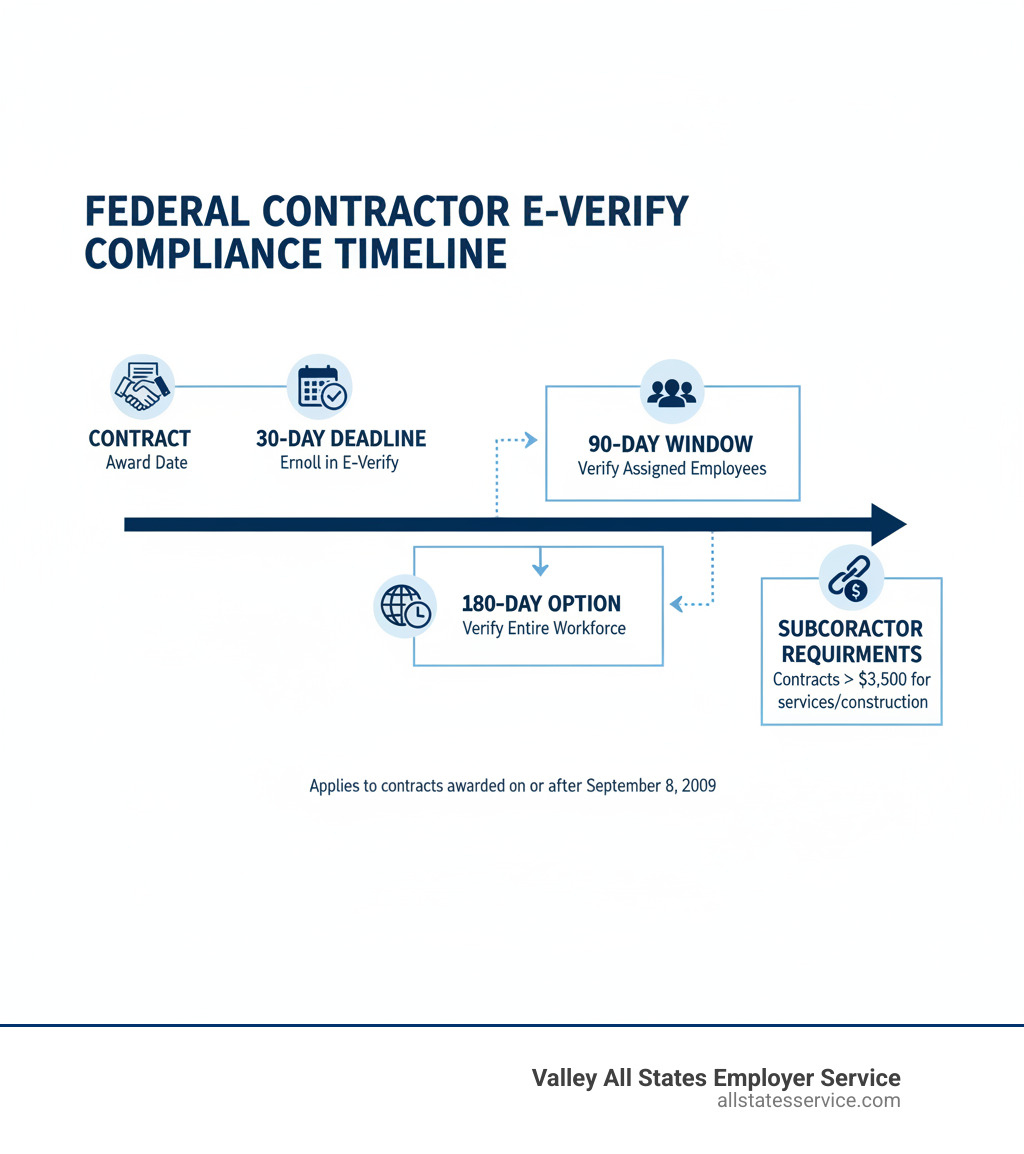
Do federal contractors have specific guidelines for E-Verify? Yes, federal contractors have highly specific guidelines mandated by the Federal Acquisition Regulation (FAR) E-Verify clause. If your federal contract was awarded on or after September 8, 2009, exceeds $150,000, has a performance period of 120 days or more, and includes work in the United States, you are required to:
- Enroll in E-Verify within 30 days of your contract award date
- Verify all new hires within three business days of their start date
- Verify existing employees assigned to the contract within 90 days of enrollment (or your entire workforce within 180 days)
- Follow specific Form I-9 procedures, including photo matching and document retention requirements
- Ensure subcontractors comply if their subcontracts exceed $3,500 for services or construction
As a busy HR manager, you know the stakes are high. A presidential Executive Order and the FAR rule created these requirements to ensure the federal government only works with organizations maintaining a legal workforce. These guidelines are not optional, and non-compliance can lead to contract termination, suspension from future contracts, and significant civil penalties.
The good news is that the rules are clearly defined. This guide walks you through every requirement, from determining if your contract qualifies to understanding the exact timelines for verification and the specific Form I-9 procedures you must follow.
Understanding the E-Verify Federal Contractor Rule
If you’ve landed a federal contract, congratulations! Now you must understand what this means for your hiring process. The E-Verify Federal Contractor Rule adds specific, mandatory requirements to your employment verification procedures.
This rule stems from Executive Order 12989 and the resulting Federal Acquisition Regulation (FAR) E-Verify clause. The goal is to ensure everyone working on federal projects is legally authorized to work in the United States, as part of the government’s effort to maintain a legal workforce. The official E-Verify website offers detailed guidance for Federal Contractors, which is a valuable resource.
So, do federal contractors have specific guidelines for E-Verify? Absolutely. They are mandatory requirements triggered when your contract includes the FAR E-Verify clause. Understanding what E-Verify is is the foundation for compliance.
What is E-Verify and How Does It Work?
E-Verify is an internet-based system that confirms if your employees can legally work in the United States. It’s a partnership between U.S. Citizenship and Immigration Services (USCIS) and the Social Security Administration (SSA), giving it access to databases to verify employment eligibility.
The process is quick. After your new hire completes their Form I-9, you enter that information into the E-Verify system, which compares the Form I-9 data against government records. Within seconds, you get a response. Usually, it’s an “Employment Authorized” result. Sometimes you might receive a Tentative Nonconfirmation, which requires additional steps.
Think of E-Verify as a digital check between your hiring paperwork and federal databases. It’s designed to be fast, but as a federal contractor, you have extra requirements. Our E-Verify Program Complete Guide walks through every detail.
The Core of the Mandate: The FAR E-Verify Clause
It’s critical to know that not every federal contract requires E-Verify. The requirement hinges on whether your contract includes the FAR E-Verify clause (found at 48 C.F.R., Subpart 22.18). This clause makes E-Verify mandatory for your project.
The government contracting official handling your contract decides whether to include this clause. It’s not determined by E-Verify. That’s why reviewing your contract documents is your first step. If the FAR E-Verify clause is there, your obligations are active.
This clause follows specific criteria related to your contract’s value and duration. The key takeaway is this: the clause is the trigger. No clause, no federal contractor E-Verify requirements. Clause present? It’s time to get compliant.
Getting familiar with Federal E-Verify Rules helps you understand what you need to do and why these requirements exist, making compliance more manageable.
Do Federal Contractors Have Specific Guidelines for E-Verify? Qualifying Contracts and Exemptions
Do federal contractors have specific guidelines for E-Verify? Absolutely, and these guidelines are incredibly precise. The rules don’t apply to just any federal contract. They’re triggered by specific criteria that determine whether your contract includes the FAR E-Verify clause. This rule, effective since September 8, 2009, impacts contractors with a new contract or an existing one modified to include this clause. The E-Verify website offers clear guidance on Who is Affected by the E-Verify Federal Contractor Rule.
Criteria for a Contract to Include the FAR E-Verify Clause
The FAR E-Verify clause acts like a filter. Your contract must pass several checkpoints before this requirement applies. Understanding these thresholds helps you know when compliance is mandatory.
Your contract must meet all of these conditions to include the FAR E-Verify clause: It must be awarded on or after September 8, 2009; have a performance period of 120 days or more; have a contract value exceeding $150,000; and include work performed within the United States. Finally, the contract must explicitly include the FAR E-Verify clause itself.
Importantly, if your contract doesn’t include the FAR E-Verify clause, you are prohibited from using E-Verify to verify current employees for that contract. You can, however, still participate in E-Verify voluntarily for new hires.
Are There Any Exemptions or Exceptions?
Even with strict rules, there is flexibility. Some contracts and employees don’t fall under the E-Verify Federal Contractor Rule, and understanding these exemptions can clarify your obligations.
Contracts below the thresholds are exempt. If your contract is valued at $150,000 or less, or the performance period is under 120 days, this requirement doesn’t apply.
Commercially available off-the-shelf (COTS) items also get special treatment. Contracts solely for these ready-made products typically don’t trigger the E-Verify requirement.
Employees with existing security clearances (active confidential, secret, or top-secret) or HSPD-12 credentials are not required to be verified in E-Verify, though you can choose to do so for consistency.
Certain organizations like state and local governments, institutions of higher education, and federally recognized Indian tribes may qualify for exceptions. These allow them to verify only employees working directly on covered contracts, which is practical for large, diverse workforces.
For a complete understanding, check the official guidance on Exemptions and Special Rules.
Do federal contractors have specific guidelines for e-verify regarding subcontractors?
The E-Verify Federal Contractor Rule doesn’t stop at your front door. It flows down through the contracting chain, which means your subcontractors might need to comply too. As a prime contractor, you become the enforcer of this requirement for the companies working under you.
Prime contractors must require E-Verify usage for their subcontractors when several conditions align. First, your prime contract must include the FAR E-Verify clause. Second, the subcontract needs to be for commercial or noncommercial services or construction, not just supplies. Third, the subcontract value must exceed $3,500, a much lower threshold than the prime contract. And finally, the work must be performed in the United States.
When all these conditions are met, you need to include the FAR E-Verify clause in your subcontract, passing the obligation down the line. This makes you responsible for ensuring your subcontractors understand and meet these requirements.
Indefinite-Delivery/Indefinite-Quantity (IDIQ) contracts add another layer of complexity. If a modified IDIQ contract includes the FAR E-Verify clause, the employer, whether prime or sub, must enroll in E-Verify within 30 calendar days of that modification date.
As a practical matter, prime contractors should build compliance requirements into their subcontracts from the start. Many also request proof of E-Verify registration or verification confirmations from their subcontractors to protect themselves. After all, non-compliance at the subcontractor level can create problems that flow back up to you.
Step-by-Step Compliance: Enrollment, Timelines, and Verification
Once your federal contract mandates E-Verify, it’s time to get compliant. This involves specific enrollment procedures, strict timelines, and precise verification methods. Understanding your E-Verify Employer Responsibilities is your first defense against costly mistakes.

Enrollment and Key Deadlines
The moment your federal contract with the FAR E-Verify clause is awarded, the clock starts ticking. You have 30 calendar days from the contract award date to enroll in E-Verify if you’re new to the system. Already using E-Verify but not designated as a federal contractor? You still need to act within that same 30-day window to update your company profile to reflect your status as a “Federal Contractor with FAR E-Verify Clause.”
Once you’re enrolled, the verification deadlines kick in. For all new hires, you must create an E-Verify case within three business days of their start date, right after completing their Form I-9. This applies to every new employee, whether they’ll be working on the federal contract or not.
For existing employees assigned to the contract, you have 90 calendar days from your E-Verify enrollment date (or 30 days from when they’re assigned to the contract, whichever comes later) to verify them. If you choose the broader path and decide to verify your entire workforce, you get 180 calendar days from enrollment to complete E-Verify cases for all existing, non-exempt employees.
These are hard deadlines with real consequences for missing them. For a deeper dive into mastering these critical timelines, our guide on E-Verify Essentials Every Federal Contractor Should Master walks you through every step.
Verifying New vs. Existing Employees
Here’s where do federal contractors have specific guidelines for E-Verify becomes crystal clear, because the rules for existing employees set federal contractors apart from other E-Verify users. You can’t just verify new hires and move on. Your existing workforce might need verification too, depending on which path you choose.
Every new hire must be verified in E-Verify within three business days of their start date. This is non-negotiable and applies across the board, whether they’re assigned to a federal contract or working in a completely different part of your business.
For existing employees, federal contractors face a decision. You can verify only those employees directly assigned to the contract, meaning individuals whose wages and benefits are charged to the contract or who perform substantial duties related to it. These verifications must happen within 90 days of your E-Verify enrollment or within 30 days of the employee’s assignment to the contract, whichever deadline comes later.
Alternatively, you can choose to verify your entire workforce. Many contractors find this approach simpler because it creates one consistent standard across the organization. No more tracking which employees work on which contracts or when someone moves between projects. If you select this option, all existing, non-exempt employees must be verified within 180 calendar days of enrollment, and every new hire going forward gets verified regardless of their assignment.
The choice depends on your organization’s size, how your contracts are structured, and how much administrative complexity you can handle. Either way, consistency matters. Pick your approach, document it clearly, and stick to your timelines religiously.
Do federal contractors have specific guidelines for e-verify when it comes to Form I-9?
Yes, and these guidelines go beyond the standard Form I-9 completion process. The Form I-9 is already the foundation of employment eligibility verification, but when you’re a federal contractor using E-Verify, there are additional mandatory steps that can’t be skipped.
When an employee presents a U.S. Passport, U.S. Passport Card, Permanent Resident Card (Form I-551), or Employment Authorization Document (Form I-766) for Section 2 of their Form I-9, you must use the Photo Matching tool in E-Verify. This means comparing the photo on the employee’s physical document to the photo that appears in the E-Verify system. It’s a visual verification step that adds another layer of accuracy.
You also have a specific document retention requirement. For those same documents (U.S. Passports, Passport Cards, Forms I-551, and I-766), you must make a copy of both sides and keep it with the employee’s Form I-9. This isn’t optional for E-Verify employers, it’s mandatory.
Another critical requirement: employees must provide their Social Security Number on Form I-9. E-Verify simply can’t process a case without it, so there’s no wiggle room here.
The rules around Tentative Nonconfirmations (TNCs) are particularly important. If an E-Verify case returns a TNC, you must follow strict procedures to protect the employee’s rights. You cannot take any adverse action against them, like delaying their training, changing their work schedule, withholding pay, or removing them from the federal contract while they’re working to resolve the mismatch. They must be given the opportunity to contest the TNC, and you must continue their employment during this resolution period. Treating an employee differently because of a TNC is a violation that can result in discrimination charges.
These Form I-9 specifics aren’t just bureaucratic red tape. They’re designed to ensure accurate verification while protecting employees from discrimination. For comprehensive, detailed guidance on completing Form I-9 correctly, especially as an E-Verify employer, the official Handbook for Employers (M-274) is an essential resource that should be on every HR professional’s desk.
Navigating Complex Scenarios and Consequences
Being a federal contractor comes with great responsibility, and E-Verify compliance is no exception. Beyond the day-to-day verification, there are complex situations like mergers and acquisitions that can complicate your obligations. And of course, there’s the ever-present reality of what happens when things go wrong. Let’s walk through these tricky waters together so you can steer them with confidence.

How Do Mergers and Acquisitions Affect E-Verify Duties?
Mergers and acquisitions can turn a straightforward E-Verify process into a real puzzle. When your company acquires another business, you suddenly inherit employees, and with them comes the question: what do we do with their existing Forms I-9? It’s not always intuitive, but the good news is that the rules do provide some clarity.
For E-Verify purposes, acquired employees are generally treated as existing employees, not brand-new hires. This distinction matters because it affects your verification timelines and options. You essentially have two paths forward when handling Form I-9 documentation for acquired staff.
Your first option is to treat all acquired individuals as new hires. This means completing fresh Forms I-9 for everyone coming over from the acquired company. If you go this route, you’d then E-Verify them just like any other new employee under your federal contractor obligations, within three business days of their start date with your organization.
Your second option is to retain the previous employer’s Forms I-9. This can save time and paperwork, but it comes with a responsibility. You’ll need to carefully review those existing I-9s to ensure they were correctly completed, and you’ll need to update them as necessary. If these acquired employees are assigned to a covered federal contract, you must E-Verify them within the appropriate timeframe, which means within 90 days of your enrollment as a federal contractor (or 30 days of their assignment to the contract, whichever comes later).
The key takeaway? Adhering to E-Verify verification timelines post-merger is absolutely critical. Missing these deadlines during the chaos of an acquisition can put your federal contracts at risk. We strongly recommend consulting with legal counsel during any M&A activity to ensure your E-Verify compliance stays seamless throughout the transition.
What Are the Consequences of Non-Compliance?
This is where we need to have a frank conversation. Failing to comply with the E-Verify Federal Contractor Rule isn’t just a paperwork problem or a minor administrative hiccup. The federal government takes its legal workforce policy incredibly seriously, and violations can have severe, business-threatening repercussions.
Contract termination is one of the most immediate consequences. The federal agency that awarded your contract has the authority to terminate it for default if you fail to meet your E-Verify obligations. Imagine losing a major government project, not because you couldn’t deliver the work, but because of an administrative compliance failure. It happens, and it’s devastating.
But it gets worse. You could face suspension or debarment from future federal contracts. This essentially means being blacklisted from bidding on new government work. For many federal contractors, this is a death sentence for that line of business. Government contracts often represent a significant portion of revenue, and being shut out of that market can cripple a company.
There are also civil penalties and back pay to consider. Violations can lead to significant civil monetary penalties. If your company engages in discriminatory practices related to E-Verify (for example, taking adverse action against an employee during a Tentative Nonconfirmation resolution), you could face back pay awards and other remedies under anti-discrimination laws. These penalties can add up quickly and damage your reputation.
Finally, the Department of Homeland Security can revoke your company’s access to the E-Verify system entirely. Without access to E-Verify, you simply cannot comply with future federal contracts that contain the FAR E-Verify clause. It’s a catch-22 that effectively locks you out of federal contracting.
The stakes are genuinely high when it comes to the question do federal contractors have specific guidelines for E-Verify. The answer is yes, and those guidelines carry real consequences. Prevention is always better than cure, which is why understanding and following the rules from day one is so important. We strongly encourage familiarizing yourself with anti-discrimination provisions to avoid common pitfalls. You can find valuable information about avoiding discrimination during the Form I-9 and E-Verify process by visiting the Department of Justice, Civil Rights Division, Immigrant and Employee Rights Section.
The good news? With the right systems, knowledge, and support, compliance is absolutely achievable. Many federal contractors find that partnering with an experienced E-Verify employer agent helps them steer these complex requirements while protecting their business from risk.
Frequently Asked Questions about E-Verify for Federal Contractors
We know you’ve got questions, and we’re here to answer them! Navigating federal contracting and E-Verify can bring up some unique scenarios that don’t quite fit into the standard rulebook. Let’s tackle some of the most common queries we hear from contractors just like you.
Can a federal contractor verify all employees, even those not on a federal contract?
Yes, and honestly, it’s a choice that many contractors make to keep things simple. When you enroll in E-Verify as a federal contractor with the FAR E-Verify clause, you’ll be presented with a decision: verify only “employees assigned to the contract” or your “entire workforce.”
If you select the “entire workforce” option, you’re committing to verify all existing, non-exempt employees within 180 days of your enrollment (or when you update your company profile). From that point forward, you must also verify all new hires, regardless of whether they work on a federal contract or not. Think of it as going all-in.
Many contractors find this approach actually simplifies their compliance processes. Rather than constantly tracking which employee is assigned to which contract and juggling different verification timelines, you apply one consistent standard across your entire organization. It’s less mental gymnastics, fewer opportunities for error, and often easier to explain to your HR team.
What is an E-Verify Employer Agent and how can they help?
An E-Verify Employer Agent is essentially your compliance partner, a third-party service that manages the entire E-Verify process on your behalf. Think of us as your authorized representative in the E-Verify system. We submit E-Verify cases, handle the resolution of Tentative Nonconfirmations (TNCs), and ensure you’re meeting all those intricate rules and tight deadlines that can keep you up at night.
The real value? We help ensure accuracy, meet every deadline, and dramatically reduce the administrative burden on your HR team. Instead of having your internal staff learn every nuance of federal contractor E-Verify requirements, they can focus on what they do best, recruiting, training, onboarding, and supporting your employees, while knowing your E-Verify compliance is handled expertly and impartially. This peace of mind is a core part of our E-Verify Services, designed specifically to take this weight off your shoulders.
What happens if the E-Verify system is down during a deadline?
It’s a valid concern, and thankfully, it’s not as catastrophic as it might sound. System outages happen, even with government technology. When the E-Verify system is unavailable, USCIS typically provides official guidance and extends deadlines accordingly. They understand that you can’t submit cases if the system won’t let you in.
Here’s what’s crucial on your end: document everything. Take screenshots of the error messages, note the exact dates and times you attempted to access the system, and keep a record of your efforts. This documentation is your proof that you tried to comply. As soon as the system comes back online, you must create the E-Verify case immediately, and note the reason for the delay in the designated comment box. Something like “E-Verify unavailable due to system outage” works perfectly.
The days when E-Verify was down don’t count against your standard three-day case creation window, but you still need to act promptly once access is restored. Staying tuned to official E-Verify communications during these periods is essential. It’s one of those situations where being proactive and keeping good records protects you from penalties that aren’t your fault.
Stay Compliant and Confident
So, do federal contractors have specific guidelines for E-Verify? The answer is an emphatic yes. These aren’t vague suggestions or best practices you can choose to follow when convenient. They’re detailed, mandatory requirements with teeth, and the consequences for getting it wrong can be severe. We’re talking about everything from precise contract thresholds and dollar amounts to specific Form I-9 procedures that go beyond what typical employers face, all wrapped up in tight, unforgiving deadlines.
For any business working with the federal government, staying on top of these E-Verify requirements isn’t just about checking a compliance box. It’s about protecting your ability to continue doing business with federal agencies. One misstep, whether it’s missing the 30-day enrollment window, failing to verify employees assigned to your contract within 90 days, or mishandling a Tentative Nonconfirmation, can jeopardize not just your current contract but your entire future in federal contracting.
The reality is that navigating this complex landscape can feel overwhelming, especially when you’re already juggling the actual work of fulfilling your federal contract. Your HR team has enough on their plate without having to become experts in FAR clauses, photo matching requirements, and the nuances of subcontractor verification thresholds. That’s precisely why many smart contractors choose to partner with an expert who lives and breathes E-Verify compliance every single day.
Valley All States Employer Service specializes in managing E-Verify compliance for federal contractors. We handle every step of the process correctly and efficiently, from enrollment and case creation to resolving TNCs and maintaining meticulous documentation. Our role is to become your trusted partner, ensuring you meet every deadline, follow every procedure, and maintain the documentation you need to prove compliance if questions ever arise. This frees you and your team to focus on what you do best: delivering exceptional work on your federal contracts.
Ready to simplify your E-Verify process and gain the confidence that comes from knowing compliance is handled by dedicated professionals? Learn more about our specialized E-Verify for Contractors services, and let’s start a conversation about how we can support your business.