
Navigating E-Verify Requirements for Your Returning Team
Why Getting E-Verify Right for Rehired Workers Matters More Than You Think
E-Verify for rehired workers is not the same process as verifying a brand-new employee, and mixing up the two is one of the most common compliance mistakes HR teams make.
Here’s a quick answer to what most employers need to know:
Quick Reference: E-Verify for Rehired Workers
| Situation | What to Do |
|---|---|
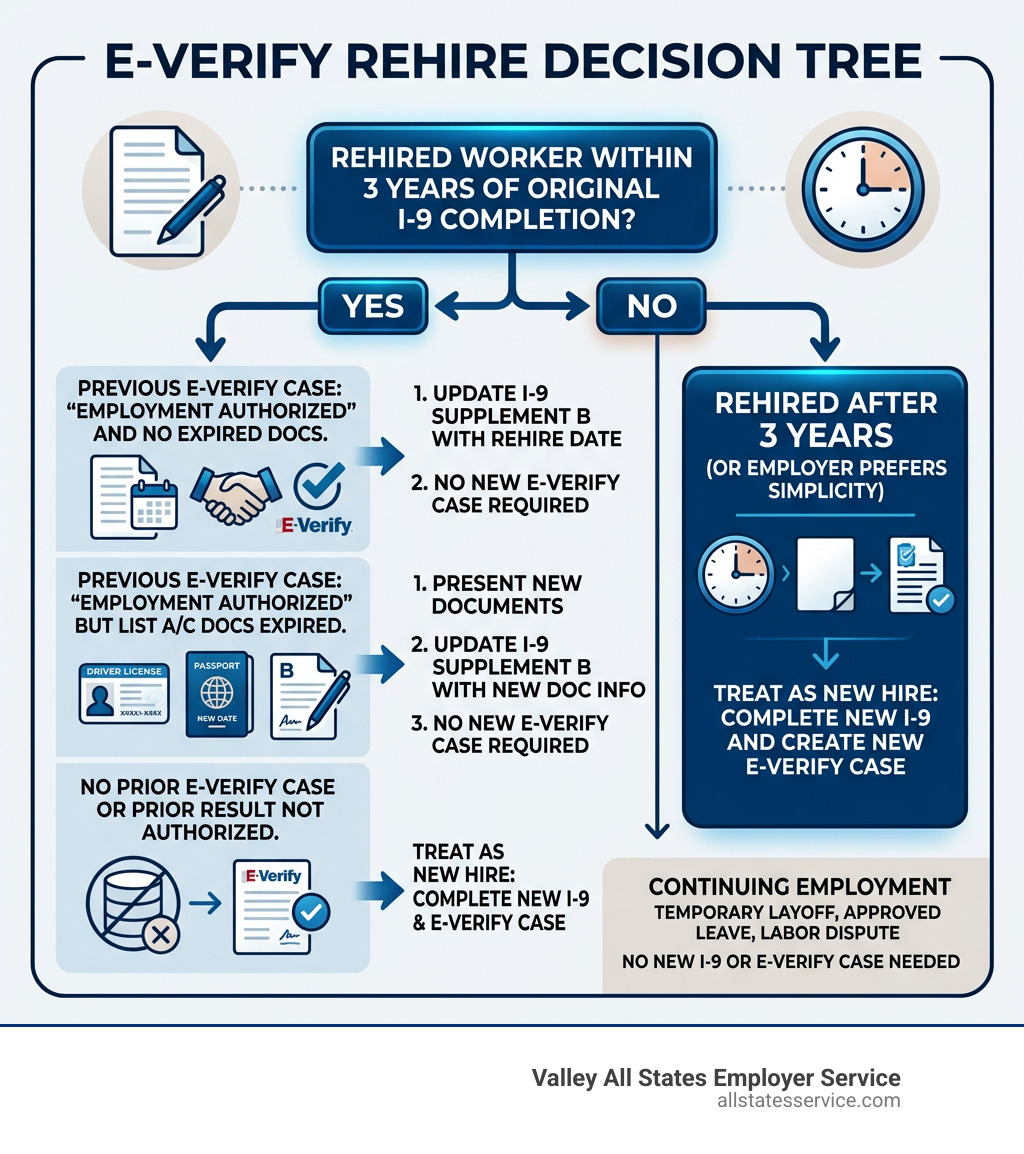
| Rehire within 3 years, prior E-Verify case was “Employment Authorized,” no expired docs | Enter rehire date in Supplement B, no new E-Verify case needed |
| Rehire within 3 years, expired List A or List C documents | Update Supplement B with new doc info, no new E-Verify case needed |
| Rehire within 3 years, but no prior E-Verify case or prior result was not authorized | Complete new Form I-9 and create a new E-Verify case |
| Rehire after 3 years | Treat as a new hire: complete new Form I-9 and create a new E-Verify case |
| Employer prefers simplicity | Optionally treat any rehire as a new hire with a new Form I-9 and E-Verify case |
Rehiring a former employee feels routine. You already know them. They know the job. But from a compliance standpoint, the federal rules around Form I-9 and E-Verify still apply, and the details matter.
Get it wrong and you could face civil fines, audit exposure, or worse. Get it right and you save your team unnecessary paperwork.
This guide walks you through exactly what to do, step by step, whether your returning employee left last month or three years ago.
Understanding the 3-Year Rule for E-Verify for Rehired Workers
The calendar is your most important tool when a former employee walks back through your doors. The “3-year rule” is the primary factor that determines whether you can take a shortcut or if you must start the verification process from scratch.
According to the Handbook for Employers M-274, if you rehire a worker within three years of the date their previous Form I-9 was originally completed, you have the option to rely on that existing form. This window is calculated from the date of the original hire, not the date they left the company.
If the employee returns after that three-year mark, the law is clear: you must treat them exactly like a brand-new hire. This means they must complete Section 1 of a new Form I-9, and you must complete Section 2 and create a brand-new case in E-Verify. Staying on top of these dates is critical for proper record retention.

When we look at E-Verify for rehired workers, we also have to consider the version of the Form I-9 on file. If the employee is returning within three years but the version of the form you used previously has since expired, you should still use Supplement B from the current, valid version of the form and attach it to the old one. This ensures you remain compliant with the latest USCIS standards.
When to Use Supplement B Instead of a New Form I-9
If your employee is returning within that magical three-year window, you don’t necessarily need to hand them a fresh Form I-9. Instead, you can use Supplement B (which many of us still remember as Section 3).
Supplement B is specifically designed for reverification and rehires. It allows us to confirm that the person standing in front of us is the same person whose identity we verified years ago and that they still have the legal right to work in the United States.
To use this option, we must first ensure the original Form I-9 relates to the employee. Then, we check if their work authorization is still valid. If everything is current, we simply record the rehire date, sign the supplement, and we are good to go. This is a huge time-saver for busy HR departments. You can find more details in our e-verify-rehire-requirements-guide.
Handling Expired Documents in E-Verify for Rehired Workers
One of the trickiest parts of the rehire process is dealing with documents that have expired since the employee last worked for you. The rules vary depending on which “List” the document belongs to.
For List A or List C documents, if the original document that established work authorization has expired, you must reverify the employee. This means they need to present a new, unexpired document from the List of Acceptable Documents. You then record this new information in Supplement B.
However, List B documents (which establish identity, like a driver’s license) are handled differently. If a rehire was previously verified in E-Verify and their List B identity document has since expired, you generally do not need to create a new E-Verify case if you are using Supplement B.
| Document Type | Must Reverify if Expired? | E-Verify Action |
|---|---|---|
| List A (e.g., Passport) | Yes | Update Supplement B; No new case if prior auth existed |
| List B (e.g., Driver’s License) | No (for rehires) | Update Supplement B; No new case |
| List C (e.g., Social Security Card) | Yes | Update Supplement B; No new case |
| Permanent Resident Card | No (usually) | Most PRC (Green Cards) don’t require reverification |
Special Rules for Federal Contractors and E-Verify for Rehired Workers
If your business holds federal contracts, the rules for E-Verify for rehired workers get a bit more complex. Federal contractors are often subject to the Federal Acquisition Regulation (FAR) E-Verify clause.
Under these rules, you might be required to verify not just new hires, but also existing employees assigned to the contract. The E-Verify Supplemental Guide for Federal Contractors explains that if a rehired employee was never previously run through E-Verify, or if they are being assigned to a covered federal contract for the first time, you may need to create a case regardless of the three-year rule.
Federal contractors typically have 90 days from the contract award to enroll and 30 days to verify employees assigned to the contract. If you rehire someone specifically to work on a federal project, it is often safest to treat them as a new hire and run a fresh E-Verify case to ensure total compliance with FAR requirements.
Determining if a New E-Verify Case is Necessary
So, when do we actually need to log into the E-Verify portal and create a new case? It boils down to the result of the previous case.
If the employee’s previous E-Verify case resulted in “Employment Authorized,” and you are rehiring them within three years, you are generally not required to create a new case. You can simply update your internal records using Supplement B. This is the “administrative streamlining” that E-Verify allows to keep businesses moving efficiently.
However, you must create a new E-Verify case if:
- You never created an E-Verify case for them during their previous stint.
- Their previous E-Verify case resulted in anything other than “Employment Authorized” (such as a Final Nonconfirmation).
- More than three years have passed since the original Form I-9 was completed.
Many employers choose to master the I-9 rules by simply running a new E-Verify case for every single rehire. While this creates a bit more work, it eliminates the risk of miscalculating the three-year window or missing an expired document.
Exceptions: Continuing Employment vs. True Rehires
Sometimes, an employee leaves and comes back, but the government doesn’t actually consider them a “rehire.” This is known as “continuing employment.” In these specific situations, you don’t need to do a new Form I-9 or an E-Verify case at all.
According to the 8.0 Rules for Continuing Employment, employment is considered continuing if the employee has a “reasonable expectation of employment at all times.”
Common examples include:
- Approved Leaves: Such as FMLA, maternity/paternity leave, or study leave.
- Seasonal Work: If the employee works every summer and there is a clear understanding they will return.
- Temporary Layoffs: Due to a lack of work, where the employee expects to be recalled within a reasonable timeframe.
- Strikes or Labor Disputes: Where the employee returns once the dispute is resolved.
To determine if there is a “reasonable expectation,” USCIS looks at factors like whether the employee’s position was filled by someone else, whether they continued to accrue benefits, and the history of the employer’s recall practices.
Frequently Asked Questions about Rehire Compliance
What happens if E-Verify is down during a rehire?
It doesn’t happen often, but the federal government does occasionally shut down. When that happens, E-Verify goes dark. As noted in recent Forbes reports, the E-Verify system suspends all functions, including case creation and TNC resolution.
If you rehire someone during a shutdown, you still must complete the Form I-9 according to the standard timelines (Section 1 by the first day, Section 2 by the third day). The “three-day rule” for E-Verify is usually suspended during these outages. Once the system comes back online, the government typically provides a grace period to enter the backlog of cases. We always recommend keeping a manual log of these hires so you don’t miss anyone when the system reopens.
Are there penalties for missing a rehire verification?
Yes, and they can be steep. The USCIS penalties for failing to properly verify employees range from civil fines to more severe consequences.
For simple paperwork errors, fines can range from a few hundred to a few thousand dollars per form. However, if an audit finds a pattern of “knowingly hiring” unauthorized workers because rehires weren’t properly checked, the fines can skyrocket. In extreme cases, businesses can be debarred from federal contracts or ordered to pay back pay to workers who were unfairly passed over.
Can I use electronic I-9 and E-Verify systems for rehires?
Absolutely. In fact, we highly recommend it. Digital platforms make managing E-Verify for rehired workers much simpler by automatically flagging when a three-year window is closing or when a document is about to expire.
Large organizations, like Rutgers University, use integrated systems (such as the Guardian system via the MyRutgers portal) to ensure every rehire is handled uniformly. These systems guide HR staff through Supplement B or the creation of a new case based on the data already in the system. You can learn how our solutions streamline E-Verify to see how your business can benefit from this kind of automation.
Final Steps for Compliance Success
Managing a returning workforce is a sign of a healthy company culture, but it shouldn’t be a source of compliance stress. At Valley All States Employer Service, we specialize in taking the guesswork out of the process.
The key to success is consistency. Whether you choose to use Supplement B for every eligible rehire or prefer to treat everyone as a new hire for simplicity, make sure your policy is written down and followed every time.
Keep your records organized and ready for a potential audit. By maintaining meticulous files and staying updated on the latest USCIS rules, you protect your business and your employees.
Ready to simplify your onboarding? Learn more about our I-9 process for rehires and let us handle the heavy lifting of federal compliance for you. Our expert team ensures that every rehire is verified accurately and efficiently, so you can focus on welcoming your team back to work.