
Understanding the Risks: Why Contractor Liability for E-Verify Matters
Can contractor be fined for contractor not complying with e-verify? Yes. Prime contractors can face significant fines and penalties if they knowingly continue to work with a subcontractor who violates E-Verify requirements. Here’s what you need to know:
Prime Contractor Penalties for Subcontractor Non-Compliance:
- Civil fines ranging from $500 to $1,000 per violation
- Contract termination of the federal agreement
- Suspension or debarment from future federal contracts
- Loss of federal funding opportunities
- Criminal penalties in cases of pattern or practice violations
When you win a federal contract that includes the Federal Acquisition Regulation (FAR) E-Verify Clause, you’re not just responsible for your own compliance. You also take on oversight duties for every subcontractor working under that contract.
The stakes are high. A Department of Justice investigation revealed that federal contractors face increasing scrutiny on E-Verify compliance. If you fail to ensure your subcontractors properly verify their employees, you could lose your contract, your reputation, and your ability to bid on future federal work.
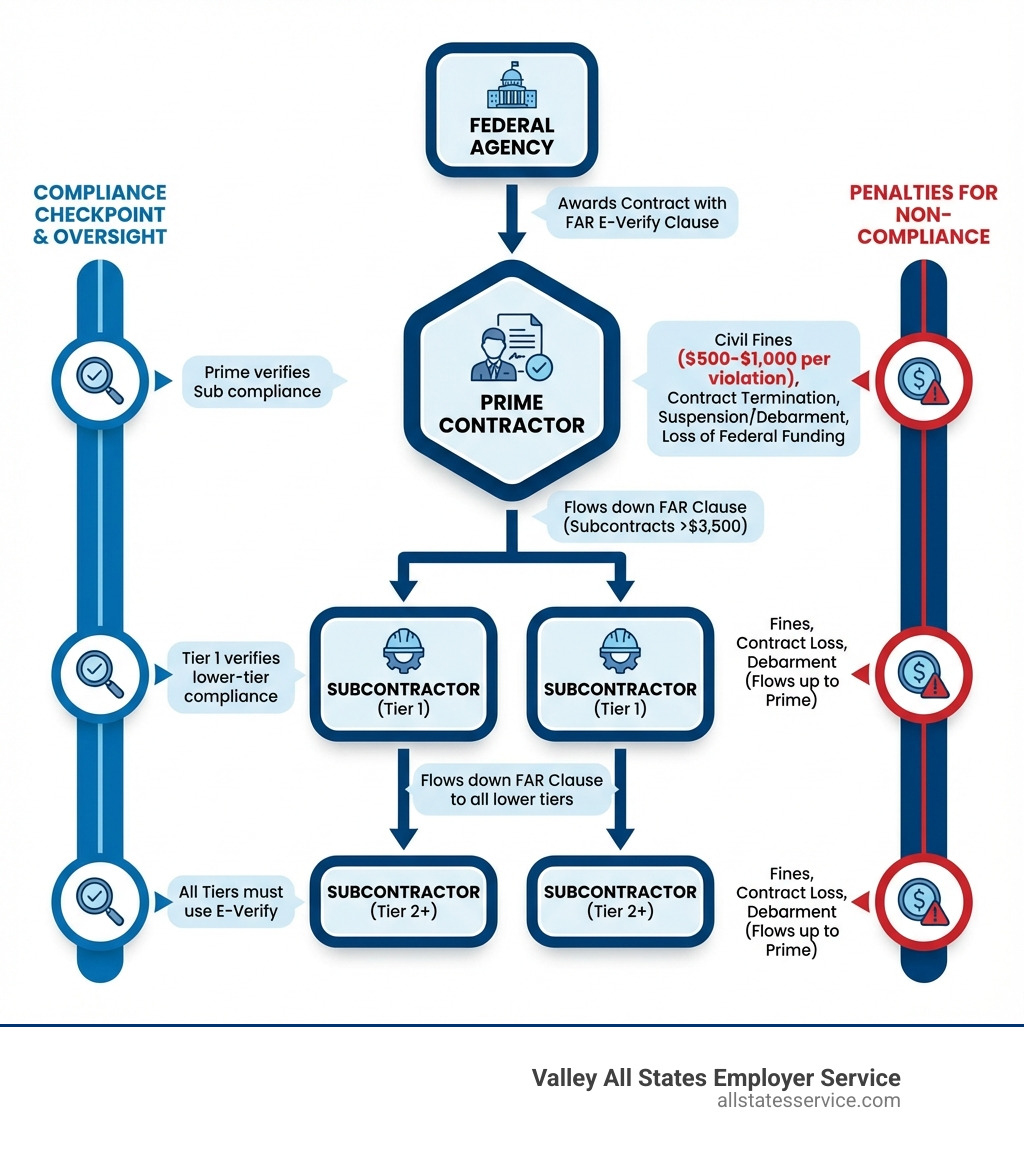
The flow-down effect is simple but strict. When your prime contract includes the FAR E-Verify clause, you must incorporate that same clause into covered subcontracts at every tier. For subcontracts valued over $3,500 involving services or construction performed in the United States, your subcontractors must use E-Verify for their employees working on the federal project.
This isn’t just about paperwork. It’s about protecting your business from financial penalties that can reach thousands of dollars per violation, plus the long-term damage of being barred from federal contracting.
Can contractor be fined for contractor not complying with e-verify vocabulary:
- E-Verify for contractors
- do federal contractors have specific guidelines for e-verify
- e verify supplemental guide for federal contractors
Prime Contractor Responsibility: The Flow-Down Effect of E-Verify Compliance
As a federal prime contractor, your obligations extend beyond your own direct workforce. The Federal Acquisition Regulation (FAR) E-Verify Clause 52.222-54 is a critical component of federal contracts, and it mandates that you ensure compliance throughout your subcontracting chain. This isn’t merely a suggestion; it’s a contractual requirement designed to reinforce the federal government’s policy of doing business only with organizations that maintain a legal workforce.
This “flow-down effect” means that the responsibility for E-Verify compliance cascades from the federal agency to the prime contractor, and then directly to all applicable subcontractors. We understand that navigating these complex regulations can feel like a labyrinth, but with the right understanding and proactive measures, you can ensure your business and your partners remain compliant. For a deeper dive into these requirements, explore our ultimate guide for federal contractors on E-Verify. Keeping up with federal contractor compliance is key to your success and reputation.
When are you responsible for your subcontractor’s compliance?
Your responsibility for a subcontractor’s E-Verify compliance is triggered under specific circumstances. It’s not a blanket requirement for every single subcontractor you engage. We need to look at three key conditions:
First, the prime contract you hold must include the FAR E-Verify clause. If your primary contract with the federal government doesn’t have this clause, then the E-Verify mandate generally won’t flow down to your subcontractors, at least not under the federal contractor rule itself.
Second, the subcontract in question must be for commercial or noncommercial services or construction. This means that if a subcontractor is providing goods, but not services or construction, they might be exempt.
Third, the subcontract must have a value of more than $3,500 and involve work performed within the United States. This monetary threshold ensures that smaller, incidental subcontracts are not unduly burdened, while still capturing significant portions of federal work.
Finally, you, as the prime contractor, are responsible for incorporating the FAR E-Verify clause into these covered subcontracts. This contractual inclusion is what legally binds your subcontractors to the E-Verify requirements. Beyond the legal text, you also have a general oversight duty to ensure your subcontractors are meeting these E-Verify obligations. This is crucial because, as we’ll discuss, simply passing on the clause isn’t enough to shield you from liability if they fail to comply.
Does the E-Verify rule apply to all tiers of subcontractors?
Yes, the E-Verify federal contractor rule is designed to apply comprehensively across all levels of the contracting chain. This means the requirement “flows down” to every tier of subcontractor working on a covered federal contract. It’s not just your immediate, first-tier subcontractors who must comply; if they, in turn, engage their own subcontractors for the federal project, those second-tier subcontractors (and so on) must also adhere to the E-Verify mandate.
Your duty as the prime contractor is to ensure that the FAR E-Verify clause is appropriately included in all covered subcontracts at every tier. This contractual obligation helps establish a clear chain of responsibility. While you aren’t expected to directly manage every single employee verification for every subcontractor, you must implement systems to confirm that the E-Verify clause is properly incorporated and acknowledged. For more detailed information on specific guidelines for federal contractors, you can visit our page on E-Verify guidelines for federal contractors.
Can a Contractor Be Fined for a Subcontractor Not Complying with E-Verify?

This is a question that weighs heavily on many prime contractors. The answer, unequivocally, is yes. A prime contractor absolutely can be fined for a contractor not complying with E-Verify, especially if they knowingly continue to work with a non-compliant subcontractor. The federal government, through agencies like the Department of Homeland Security (DHS) and Immigration and Customs Enforcement (ICE), takes employment eligibility verification very seriously.
When a prime contractor enters into a federal contract that includes the FAR E-Verify clause, they implicitly agree to uphold its terms, which include ensuring their subcontractors do the same. If a subcontractor fails to use E-Verify as required, and the prime contractor is aware of this non-compliance but takes no action, that prime contractor opens itself up to significant liability. This isn’t just about direct violations; it’s also about a failure of due diligence and oversight. Government audits and investigations can uncover these lapses, leading to severe repercussions.
What are the penalties if a contractor is fined for a subcontractor not complying with E-verify?
The penalties for non-compliance can be substantial and multifaceted. For federal contractors, the consequences extend beyond monetary fines and can severely impact your business’s ability to operate and secure future contracts. We’re talking about a range of sanctions that can cripple even well-established companies.
Here’s a breakdown of the potential penalties:
- Civil Fines: These are direct monetary penalties. Federal contractors not in compliance with E-Verify provisions can face civil fines ranging from $500 to $1,000 per violation. Each instance of non-compliance, such as an unverified employee, can count as a separate violation, meaning these costs can quickly escalate.
- Contract Termination: The federal government has the right to terminate your existing contract if E-Verify requirements are not met, either by you or your covered subcontractors. This can lead to significant financial losses, project disruptions, and damage to your reputation.
- Suspension or Debarment: This is perhaps one of the most damaging penalties. Suspension or debarment means you could be temporarily or permanently barred from bidding on or receiving future federal contracts. For businesses heavily reliant on federal work, this can be a death knell.
- Loss of Federal Funding: Non-compliance can lead to corrective actions and the potential loss of federal funding opportunities, impacting your financial stability and growth prospects.
- Criminal Penalties: In more egregious cases, particularly when there is a “pattern or practice” of knowingly hiring or continuing to employ unauthorized aliens, criminal charges can be brought. This can result in fines and even imprisonment for up to six months for individuals involved. If you engage in fraud or make false statements to satisfy verification requirements, you could face fines and up to five years imprisonment.
These penalties underscore the importance of robust compliance. You can learn more about the broader scope of penalties for prohibited practices related to employment eligibility.
Can you be held liable if you were unaware of the non-compliance?
This question digs into the critical concept of “knowingly” under immigration law. While outright knowledge of a subcontractor’s non-compliance would certainly lead to liability, the definition of “knowingly” can be broader than you might expect. It often includes “constructive knowledge” or “willful blindness.”
What does this mean? It means that if you fail to exercise reasonable care or due diligence, and you should have known about the non-compliance, you could still be held liable. For instance, if you have a system in place to monitor subcontractor compliance but fail to follow it, or if there are obvious red flags that you ignore, that could be interpreted as willful blindness.
The Department of Homeland Security (DHS) considers you to have knowingly hired an unauthorized alien if you enter into, renegotiate, or extend a contract or subcontract to obtain the labor of an alien you know is not authorized to work in the United States. This applies to your direct hires and, by extension, to your subcontractors if you have the requisite knowledge.
However, there can be a “good faith” defense. If you can demonstrate that you’ve made a good faith effort to comply with Form I-9 requirements, including those related to E-Verify, you might establish a defense against a charge of knowingly hiring an unauthorized alien, unless the government can prove you had actual knowledge of the unauthorized status. This highlights the importance of maintaining thorough records and a robust compliance system. For more on this, our guide on I-9 audit penalties provides further context.
A Prime Contractor’s Guide to Ensuring Subcontractor Compliance
Ensuring your subcontractors comply with E-Verify regulations is not just about avoiding penalties; it’s about safeguarding your reputation, maintaining your eligibility for federal contracts, and upholding ethical business practices. Proactive measures are your best defense against the significant risks of non-compliance. We believe in empowering our clients with the knowledge and tools to mitigate these risks effectively.
Consider developing a comprehensive strategy that integrates E-Verify compliance into your subcontractor onboarding and management processes. This includes clear communication, consistent monitoring, and providing support where needed. For broader insights into maintaining a compliant workforce, our resources on HR compliance assistance can be a valuable tool.
How can you verify a subcontractor’s E-Verify status?
Verifying a subcontractor’s E-Verify status is a crucial step in your due diligence process. It’s not enough to simply include the FAR E-Verify clause in their contract; you need tangible proof of their enrollment and participation. The good news is that E-Verify provides a straightforward way for subcontractors to demonstrate their compliance.
The most reliable method for a subcontractor to prove their E-Verify enrollment to you, the prime contractor, is to provide a copy of their “Edit Company Profile” page directly from their E-Verify account. This page contains vital information, including their company name and their unique E-Verify Company ID number. This screenshot or printout serves as concrete evidence that they are officially enrolled in the system.
Additionally, you should request to see a copy of their signed Memorandum of Understanding (MOU) with E-Verify. The MOU is the agreement between their company and the Department of Homeland Security, outlining their responsibilities and commitment to the program. Some prime contractors, or specialized services like ours, can also act as E-Verify employer agents to help manage compliance for their clients, providing an additional layer of verification and support.
What steps should you take to avoid being fined for a subcontractor not complying with E-verify?
To effectively mitigate the risk of fines and penalties associated with subcontractor E-Verify non-compliance, we recommend a multi-pronged approach rooted in best practices. Proactivity and clear communication are your strongest allies here.
Here are the essential steps you should take:
- Incorporate the FAR Clause in All Subcontracts: This is non-negotiable. Ensure that the Federal Acquisition Regulation (FAR) E-Verify Clause 52.222-54 is explicitly included in every covered subcontract, at every tier. Make sure your subcontractors acknowledge and understand this requirement.
- Obtain Proof of Enrollment: As discussed, require your subcontractors to provide you with a copy of their E-Verify “Edit Company Profile” page and their signed Memorandum of Understanding (MOU). This should be a standard part of your subcontractor onboarding process.
- Conduct Periodic Checks and Audits: Don’t just set it and forget it. Implement a system for periodic checks to confirm ongoing compliance. This could involve requesting updated proof of enrollment annually or conducting spot checks of their compliance records.
- Train Your Contract Managers: Ensure that your personnel responsible for managing subcontracts are fully trained on E-Verify requirements, the FAR clause, and the procedures for verifying subcontractor compliance. They need to understand what to look for and how to respond to potential issues.
- Establish Clear Reporting Procedures: Define a clear process for how subcontractors should report their E-Verify compliance status and how any issues or Tentative Nonconfirmations (TNCs) are handled. This ensures transparency and allows for timely intervention.
- Document Everything: Maintain meticulous records of all communications, signed contracts with the FAR clause, proofs of E-Verify enrollment, and any actions taken regarding compliance. Robust documentation is your best defense in the event of an audit or investigation.
- Stay Informed: E-Verify regulations can change. Stay updated on the latest guidance from USCIS and any legislative changes that might affect federal contractors.
By implementing these E-Verify best practices, you create a strong framework for compliance that protects your business from the significant financial and reputational costs of non-compliance.
Understanding Exemptions to the Federal Contractor Rule
While the E-Verify federal contractor rule has broad reach, it’s important to understand that there are specific exemptions. Not every single subcontractor, or every type of contract, falls under the mandate. Knowing these exemptions can help you accurately assess your compliance obligations and avoid unnecessary burdens.
We want to clarify that these exemptions are narrowly defined and should not be interpreted broadly. If a subcontractor or contract doesn’t explicitly meet one of these criteria, it’s generally safer to assume that the E-Verify rule applies.
Key exemptions include:
- Subcontractors Providing Only Supplies: If a subcontractor’s role is solely to provide products or materials, and not services or construction, they are typically exempt from the E-Verify federal contractor rule.
- Commercially Available Off-the-Shelf (COTS) Items: Contracts involving only COTS products and services often fall under an exemption. These are standard commercial items sold to the general public.
- Contracts Below the Simplified Acquisition Threshold: Historically, federal contracts valued at $150,000 or less have been exempt from the E-Verify clause. This threshold aligns with the simplified acquisition procedures, aiming to reduce administrative burden on smaller contracts.
- Contracts Shorter Than 120 Days: Contracts with a duration of fewer than 120 days have also historically been exempt. This exemption targets short-term engagements where the administrative overhead of E-Verify might outweigh its benefits.
It’s crucial to note that while these exemptions exist, legislative efforts have been made to expand E-Verify requirements. For example, some proposed legislation aims to remove exceptions for federal contractors based on contract value and duration, pushing for a “Day 1, Dollar 1 E-Verify Act.” This means that while current exemptions may apply, the landscape could shift. Always consult the official Exemptions and Special Rules on the E-Verify website or expert guidance to confirm current applicability. For a broader view of who is required to use E-Verify, you can also check our article on what employers are required to use E-Verify.
Frequently Asked Questions about E-Verify Contractor Fines
We understand that the intricacies of E-Verify compliance, especially when subcontractors are involved, can generate many questions. Here, we address some of the most common concerns regarding fines and penalties for contractors.
What is the subcontract value that triggers E-Verify requirements?
The E-Verify federal contractor rule specifies that subcontractors must use E-Verify if their subcontract is for commercial or noncommercial services or construction, involves work performed in the United States, and has a value of more than $3,500. This threshold is designed to focus compliance efforts on more significant contractual relationships.
What documentation can a subcontractor provide as proof of E-Verify enrollment?
To prove their E-Verify enrollment to a prime contractor, a subcontractor should provide a copy of their “Edit Company Profile” page from their E-Verify account. This page, which can be printed directly from the E-Verify system, clearly displays their company name and their unique E-Verify ID number, serving as official proof of their active enrollment. We also recommend requesting a copy of their signed Memorandum of Understanding (MOU).
What happens if a prime contractor knowingly works with a non-compliant subcontractor?
If a prime contractor knowingly continues to work with a subcontractor who is in violation of the E-Verify requirements, the prime contractor can face severe consequences. These penalties can include civil fines (ranging from $500 to $1,000 per violation), contract termination for the federal agreement, suspension or debarment from future federal contracts, and the loss of federal funding opportunities. In cases of a “pattern or practice” of violations, criminal penalties are also a possibility. It is imperative to address any known non-compliance promptly to avoid these significant liabilities.
Navigating E-Verify with Confidence
The landscape of E-Verify compliance for federal contractors and their subcontractors is undeniably complex, with significant risks for those who fail to meet their obligations. However, it’s not a landscape you have to steer alone. By embracing proactive compliance strategies, understanding the flow-down requirements, and implementing robust oversight mechanisms, you can protect your business from the costly consequences of non-compliance.
We believe that confidence in your compliance posture comes from clarity and consistent action. The cost of negligence, both financially and reputationally, far outweighs the investment in a strong E-Verify program.
At Valley All States Employer Service, we specialize in providing expert, impartial, and efficient E-Verify workforce eligibility verification. Our services are designed to minimize errors and administrative burden, allowing you to focus on your core business while we handle the complexities of federal and state compliance. Whether you’re a prime contractor looking to strengthen your subcontractor oversight or a subcontractor aiming for seamless compliance, we are here to help.
Don’t let the fear of fines or the intricacies of regulations hold your business back. Take control of your E-Verify compliance today and secure your future in federal contracting. For more detailed insights and solutions custom to your needs, explore our dedicated resources on E-Verify for contractors.
Ready to ensure your E-Verify compliance is airtight and protect your business from unnecessary penalties? Contact our team at Valley All States Employer Service today for expert assistance.