
Why Understanding the Employment Background Check Process Matters
You have a conditional job offer on the table, and now you are told it depends on the employment background check process. That moment can feel stressful, especially if you are not sure what happens next or how much employers can really see.
The employment background check process is a structured set of steps employers use to confirm your identity, qualifications, and history before making a final hiring decision. In the United States, this process is mainly governed by the Fair Credit Reporting Act (FCRA). It usually includes your written consent, verifying your education and employment history, and checking criminal records. Depending on the role, it may also include reviewing credit history or driving records. Most checks take from three days up to two weeks, depending on how detailed they are.
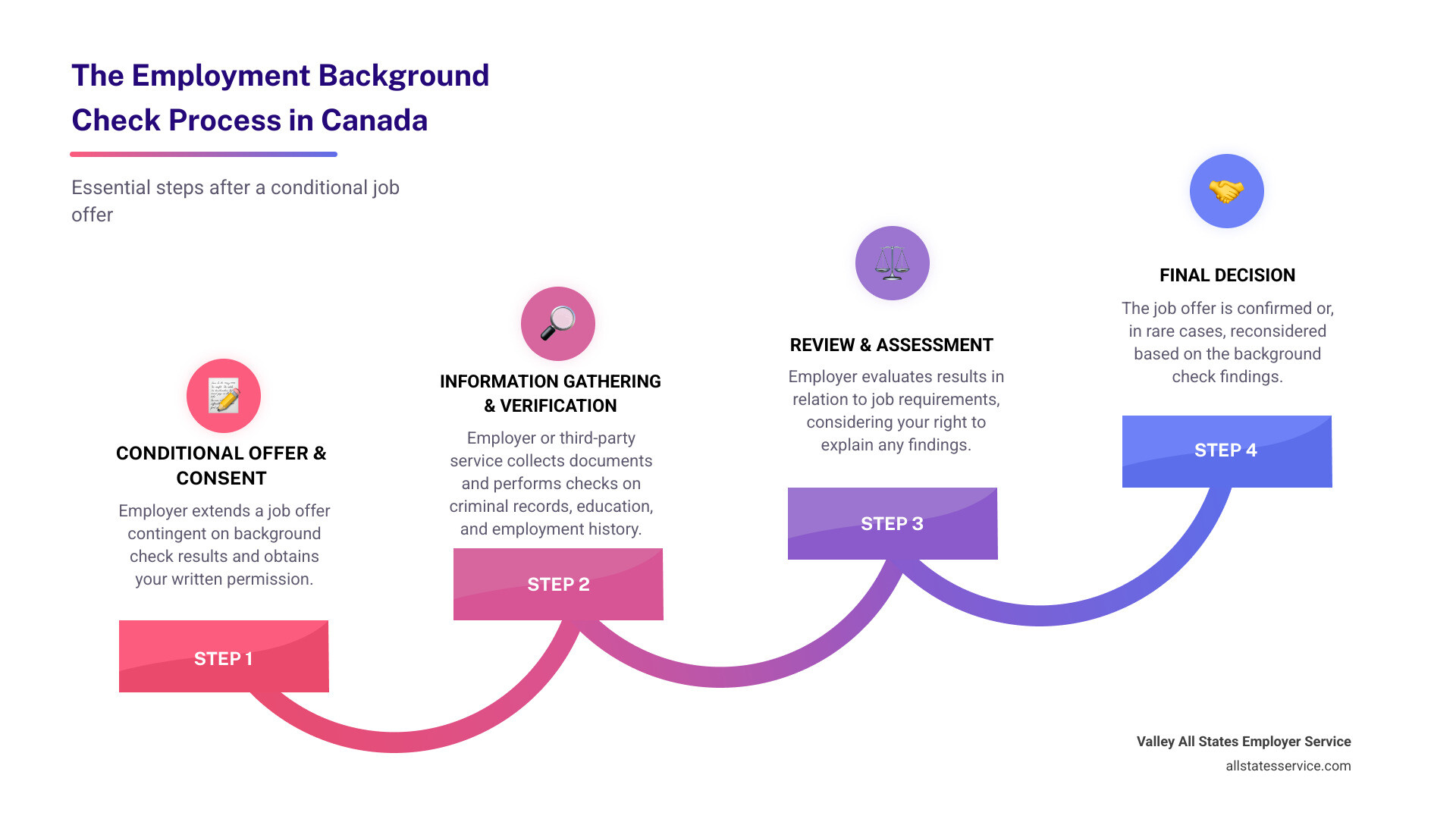
Key stages in the employment background check process:
- Conditional offer and consent: The employer makes a job offer that depends on background check results and gets your written permission, as required by the FCRA.
- Information gathering: The employer or a third party, called a Consumer Reporting Agency (CRA), collects needed documents, contact details, and references.
- Verification checks: Criminal records, education, employment history, and any other relevant information are confirmed.
- Review and assessment: The employer reviews the results in relation to the job, following EEOC guidance and internal policy.
- Final decision: The offer is confirmed or, if the employer is thinking about not hiring you, they follow a specific legal process that gives you a chance to respond.
You might be wondering what a background check will reveal, how long it will take, and what rights you have if something appears that you did not expect. You are not alone. A 2023 survey found that about 95% of employers with at least one location in North America use some form of employee background screening.
For U.S. job seekers, understanding the employment background check process is essential. Federal and state laws give you important protections, including privacy rights and the ability to dispute errors.
This guide walks you through each major stage of the employment background check process in the United States, from the first disclosure form to the final hiring decision. You will see what employers can legally review, what they usually focus on, and what to do if your report contains a mistake.
Whether you are entering the job market for the first time or changing careers after many years, knowing what to expect can calm your nerves and help you prepare. The goal of an employment background check is not to trap you, it is to support workplace safety, verify qualifications, and confirm that you are a good fit for the role.
Important employment background check process terms:
Ready to feel more confident about your next job offer? Use these resources to learn how the process works and what your rights are before your next interview.
What is an Employment Background Check in the U.S.?
An employment background check process is a key tool U.S. employers use to make informed hiring decisions. It can feel like your history is under a spotlight, but the real purpose is to support a safe, productive, and trustworthy workplace for everyone.
Employers rely on this process to:
- Confirm that the information on your resume is accurate
- Reduce risks to customers, coworkers, and company assets
- Meet industry rules and legal compliance standards
With a large and diverse workforce, careful background checks help employers bring in people who are qualified and who fit the organization’s safety and trust standards. You can find more info about pre-employment screening to see how this fits into a full hiring program.
What Information Shows Up on a Background Check?
What an employer checks depends on the role, the industry, and state laws. In general, the employment background check process aims to confirm that the details you shared are correct.
- Criminal records: Often a central part of the report. Employers review criminal convictions at the county, state, and federal levels. The Equal Employment Opportunity Commission (EEOC) recommends that employers consider the type of offense, how long ago it happened, and how closely it relates to the job.
- Employment history verification: This confirms past job titles, dates of employment, and sometimes core responsibilities with previous employers. It is used to verify that your resume lines up with official records.
- Education verification: Employers contact schools, colleges, and training programs to confirm degrees, diplomas, or certifications you listed.
- Credit history: For jobs involving financial duties, access to money, or sensitive financial data, a credit check may be used as part of the employment background check process. This requires your clear consent and must relate to the work you will do. Several states and cities limit when employers can use credit history.
- Driving records (MVR): If the role requires you to drive, your Motor Vehicle Record will likely be checked. This includes traffic violations, license status, and any restrictions.
- Professional licenses and certifications: In regulated fields such as healthcare, legal, or financial services, employers verify that your licenses are active and in good standing.
Protected details like your race, religion, or other legally protected characteristics do not appear on a standard background report and cannot be used in hiring decisions.
Common Types of Background Checks
Employers in the U.S. often combine several checks as part of their employment background check process so they get a complete and fair picture.
- Criminal record check: Searches multiple databases for criminal convictions. These can include county, state, and federal courts, along with national databases.
- Checks for work with vulnerable groups: For jobs involving children, older adults, or other vulnerable people, checks may include sex offender registries or child abuse registries.
- Education and employment verification: Confirms your academic achievements and work history. This helps employers trust the information in your application. For a deeper look, see this guide to Pre-Employment Work History Verification.
- Credit check: Used for roles that involve money management or access to sensitive accounts. These checks review your credit history for signs of financial risk. They are always done with your consent and must follow the FCRA and any state rules.
- Reference check: Employers speak with the professional references you list to get insight into your skills, attitude, and fit for the role.
- Motor Vehicle Record (MVR) check: Reviews your driving history with the Department of Motor Vehicles and confirms that your license is valid.
When you understand what each part of the employment background check process covers, it becomes easier to prepare and answer questions confidently.
The Legal Landscape: Your Rights and Employer Responsibilities
When you go through an employment background check process in the U.S., there is a balance between your right to privacy and an employer’s need to manage risk. Federal and state laws are designed to protect you, as long as the employer and any background verification company follow the rules.
The basic idea is simple, any information collected should be relevant to the job and obtained with your clear consent.
Your Rights as a Job Applicant in the U.S.
As a job applicant, you have important rights during the employment background check process.
- Right to consent: Employers must get your written permission before they run a background check through a third party. Under the Fair Credit Reporting Act (FCRA), the disclosure and your authorization must be on a separate, easy to understand document.
- Right to a copy of the report: If an employer decides not to hire you based on the background check, you have the right to see the report they used.
- Right to dispute errors: If you find mistakes or incomplete details in your background check report, you can dispute them with the Consumer Reporting Agency (CRA) that prepared it. The CRA then has to investigate.
- Protection from discrimination: Employers cannot use background check information in a way that discriminates against you based on race, color, religion, sex, national origin, age, disability, or other protected traits. The Equal Employment Opportunity Commission (EEOC) enforces these protections.
Most of these rights come from federal laws such as the Fair Credit Reporting Act (FCRA), which controls how CRAs collect and share personal information.
Key Laws Employers Must Follow
For employers, following privacy and anti discrimination laws during the employment background check process is not optional, it is a legal requirement.
- FCRA basics: The Fair Credit Reporting Act is the main federal law for background checks. It sets national rules for consent, what CRAs can report, how long certain records can be reported, and how employers must handle adverse action, which is when they decide not to hire or promote someone based on the report. The Federal Trade Commission (FTC) and the Consumer Financial Protection Bureau (CFPB) help enforce the FCRA.
- State and local rules: Many states, counties, and cities have extra protections. These may include “ban the box” laws that limit when an employer can ask about criminal history, or restrictions on using credit reports or salary history in hiring.
- EEOC guidance: The EEOC has issued detailed guidance on when and how employers can use arrest and conviction records. It encourages employers to look at the nature of the offense, the time passed since the offense, and the job duties, rather than using blanket bans.
- Penalties for breaking the rules: Employers and CRAs that do not follow the FCRA can face legal action. Willful violations can lead to statutory damages for each violation, possible punitive damages, and payment of the applicant’s legal fees.
If your organization runs background checks, this is a good time to review your policies, train your hiring teams, and make sure you are aligned with federal employment compliance. That way, your employment background check process protects both your business and your applicants.
The Step-by-Step Employment Background Check Process in the U.S.
Once you receive a conditional job offer, the employment background check process usually follows a clear sequence. Knowing these steps ahead of time can help you feel prepared and less anxious.
Step 1: The Disclosure Form and Your Consent
The first formal step in the employment background check process is the disclosure and authorization form.
- What is a disclosure and authorization form? This document tells you that a background check will be done and usually lists the types of checks that will be included.
- Timing after a conditional offer: In most cases, employers send this form after making a conditional offer of employment. That means they are interested in hiring you, as long as the results of the background check are acceptable.
- Your written consent: You must sign the authorization form before any checks begin. Under the FCRA, the disclosure that a check will be run must be in a simple, standalone document. Your written consent allows the employer and the background verification company to move forward.
- Scope of the check: The form explains what will be checked. For example, if the job involves driving, it may include a Motor Vehicle Record check. If it is a financial role, there may be a credit check. You can learn more about the verification process and how it may apply to different positions.
Step 2: Information Gathering by the Employer or Third Party
After you sign the form, the employer or their Consumer Reporting Agency starts collecting the information needed for your report.
- How checks are carried out: Many employers partner with a specialized background verification company that focuses on legal compliance and efficient screening.
- Information you provide: You may be asked for your full name, date of birth, Social Security Number, and recent addresses to help match records correctly.
- Verifying your resume: The primary goal at this stage is to compare what you shared on your application and resume with official records. This includes confirming dates of employment, job titles, and education.
Step 3: The Checks Are Performed
Next, the checks outlined in your consent form are completed. This is the most detailed phase of the employment background check process.
| Check Type | What’s Searched For |
|---|---|
| Criminal record search | Conviction records at county, state, and federal courts, and in some cases a national criminal database search. |
| SSN trace | Verifies that your Social Security Number is valid and shows past addresses and names connected with it. |
| Employment verification | Confirms job titles, dates of employment, and sometimes eligibility for rehire with former employers. |
| Education verification | Confirms degrees, diplomas, and enrollment dates with schools or training programs. |
| Motor Vehicle Record (MVR) | Checks state DMV records for license status, violations, and accidents. |
| Credit report | When allowed and relevant, reviews credit history for signs of financial risk. The report does not include your credit score. |
Once these steps are complete, the employer reviews the results, compares them to the job requirements, and makes a final decision.
Want to strengthen your own employment background check process or prepare your business to hire confidently? Ready to simplify compliance and protect your organization? Contact our team today to discuss customized background screening solutions and next steps.