
What is needed for i 9 verification: Ultimate 2025 Guide
Why Knowing What is Needed for I-9 Verification Matters
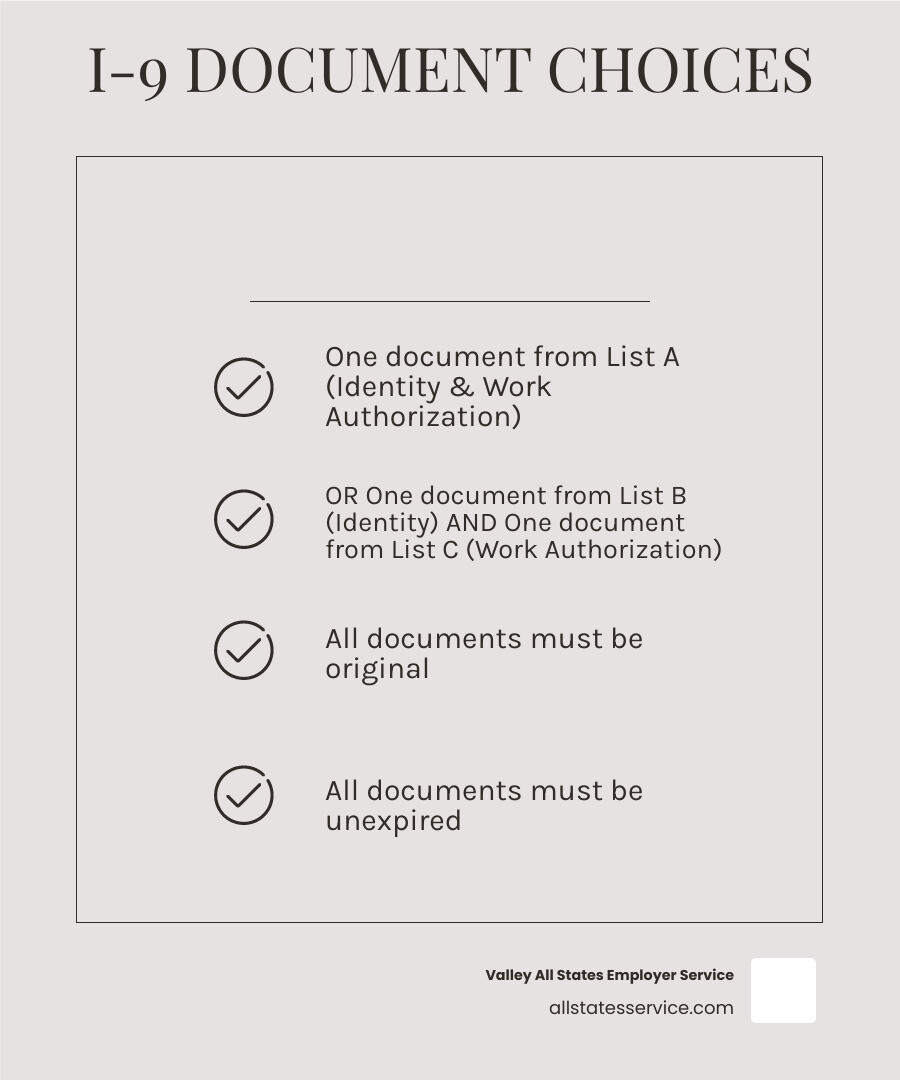
What is needed for I-9 verification is actually simpler than most people think. When you start a new job in the U.S., you need to bring documents that prove two things: who you are and that you’re legally allowed to work here. You have two options:
- Option 1: Bring ONE document from List A (proves both identity and work authorization)
- Option 2: Bring ONE document from List B (proves identity) AND ONE document from List C (proves work authorization)
All documents must be original and unexpired.
Starting a new job is exciting, but it can also feel overwhelming when you’re faced with a stack of paperwork on day one. Federal law requires employers to verify the identity and employment authorization of every person they hire. This happens through a form called the I-9, and it’s not optional.
The good news? Once you understand which documents are acceptable, the process becomes straightforward. The I-9 form isn’t designed to be a barrier. It’s simply a way to ensure everyone working in the United States is legally authorized to do so.
Many new hires show up on their first day unsure of what to bring. Some bring the wrong documents. Others bring photocopies when originals are required. These mistakes can delay your start date or create extra work for both you and your employer.
This guide will walk you through exactly what documents you need, what to do in special situations, and how to make your first day as smooth as possible. Whether you’re a U.S. citizen presenting a passport or a permanent resident showing your green card, you’ll know exactly what’s expected.
First Things First: What is Form I-9?
Think of Form I-9 as your employment paperwork passport. Officially called the Employment Eligibility Verification form, it’s the document that confirms you’re legally allowed to work in the United States. The U.S. Citizenship and Immigration Services (USCIS) requires every employer to complete this form for every new hire, no exceptions.
This requirement goes back to 1986 with the Immigration Reform and Control Act. The goal was straightforward: make sure everyone working in the U.S. has legal authorization to do so. It doesn’t matter if you’re a U.S. citizen who’s lived here your whole life or a permanent resident with a green card. Everyone goes through the same process.
What is needed for I-9 verification starts with understanding how the form works. You and your employer both have specific jobs to do, and timing matters.
Your responsibility is Section 1. This is where you provide basic information and attest to your work authorization status. You must complete this section on or before your first day of work. Your employer can’t ask you to fill it out before you’ve accepted the job offer, so don’t worry if they haven’t sent it yet.
Your employer handles Section 2. After you complete your part, they examine your documents and fill out their section. They have three business days from your first day to get this done. If you start on Monday, they need to finish by Thursday. There’s one exception: if you’re hired for a job that lasts less than three days, Section 2 must be completed on your very first day.
Understanding these deadlines helps everyone stay on track. You bring the right documents, your employer verifies them promptly, and you’re officially ready to work. For a deeper dive into the form itself, check out our guide on What is an I-9?
The Three Document Lists: Your Options for I-9 Verification
When it comes to proving your identity and work authorization for Form I-9, you’ve got options. The government doesn’t make you jump through a single hoop. Instead, they offer three lists of acceptable documents, and you get to choose what works best for you.
Here’s the simple breakdown of what is needed for I-9 verification: You can present one document from List A (which covers both identity and work authorization), or you can go with the combo approach by presenting one document from List B (for identity) plus one document from List C (for work authorization). Think of List A documents as the all-in-one option, while Lists B and C are the mix-and-match route.
One critical rule applies no matter which path you choose. All documents must be original and unexpired. Your employer needs to physically examine them. That means no photocopies, no pictures on your phone, and no laminated cards you made at home. The only exception is when an authorized alternative procedure for remote examination is specifically permitted, which we’ll cover later.
The official Form I-9 Acceptable Documents – USCIS page always has the most current information, but let’s walk through what each list includes and how to choose the right documents for your situation.
List A: Documents That Prove Both Identity & Work Authorization
List A documents are the workhorses of I-9 verification. They do double duty by establishing both who you are and your right to work in the U.S. with just one item. If you’ve got one of these in your wallet, you’re all set.
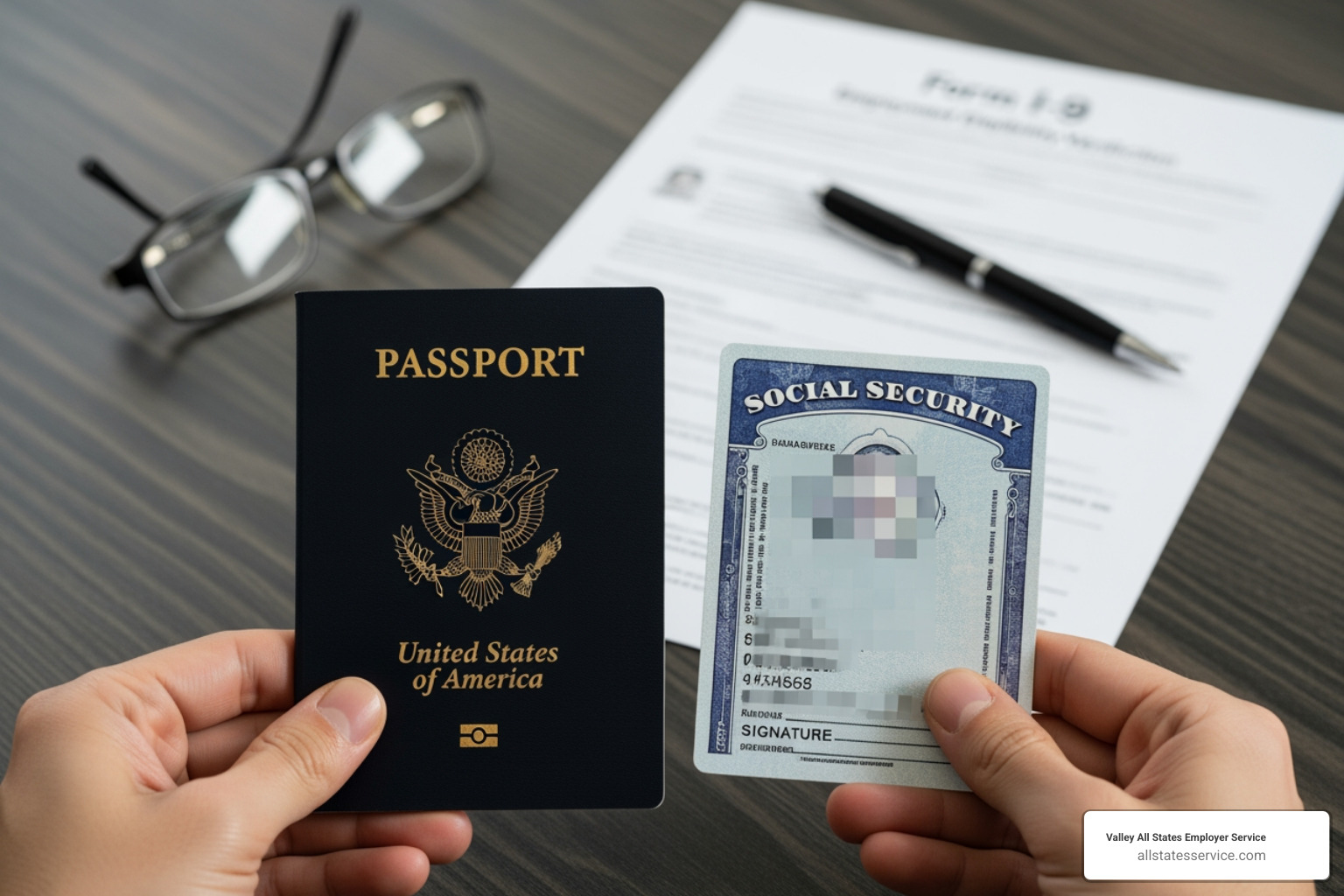
The U.S. Passport or U.S. Passport Card tops the list as one of the most straightforward options. Most employers recognize them instantly, and they’re hard to beat for simplicity. If you’re a lawful permanent resident, your Permanent Resident Card (Form I-551), commonly called a Green Card, works perfectly here too.
Some people have a Foreign Passport with a Temporary I-551 Stamp or Printed Notation on a Machine-Readable Immigrant Visa. This applies if you’re waiting for your actual Green Card to arrive. Your stamped passport serves as proof in the meantime.
The Employment Authorization Document (EAD) Card (Form I-766) is another List A document, and this is worth highlighting because people sometimes get confused. The Form I-766 with your photo on it belongs to List A, not List C. It proves both identity and work authorization on its own.
For certain nonimmigrants, a Foreign Passport with Form I-94 or Form I-94A Arrival-Departure Record that contains an endorsement to work qualifies as well. This applies to specific visa types that come with work privileges. Citizens of the Federated States of Micronesia or the Republic of the Marshall Islands can use their passport along with their I-94 or I-94A form.
Whatever List A document you choose, check that expiration date carefully. Documents must be unexpired unless the issuing authority has officially extended their validity. For more details on choosing the right documents, take a look at our guide on Documents for I-9.
List B: Documents That Prove Your Identity
If you don’t have a List A document handy, no problem. You can use the combination approach instead. List B documents prove your identity, but they don’t say anything about your work authorization. That’s where List C comes in, which you’ll pair with your List B choice.
Most people reach for their Driver’s License or ID Card Issued by a State or Outlying Possession of the United States. These are the most common List B documents, and chances are you already have one. The key is that it needs a photograph or other identifying information like your name, date of birth, gender, height, eye color, and address.
Beyond driver’s licenses, you can use an ID Card Issued by Federal, State, or Local Government Agencies or Entities. This covers a range of official government-issued identification. Students often use a School ID Card with a Photograph from their high school or college.
Other acceptable options include a Voter’s Registration Card, a U.S. Military Card or Draft Record for current or former service members, or a Military Dependent’s ID Card if you’re the dependent of someone in the armed forces. Those working in maritime roles might have a U.S. Coast Guard Merchant Mariner Card.
If you’re a member of a recognized tribe, a Native American Tribal Document works as well. Even a Driver’s License Issued by a Canadian Government Authority is acceptable for proving identity.
One thing to keep in mind, especially if your employer uses E-Verify: documents with a photograph work best. If your List B document doesn’t have a photo, it needs enough identifying information to verify who you are.
List C: Documents That Prove Your Work Authorization
After you’ve selected a List B document to prove your identity, you need one document from List C to prove you’re legally allowed to work in the U.S. This list focuses entirely on work authorization, nothing else.
The U.S. Social Security Card is by far the most frequently used List C document. It’s small, fits in your wallet, and almost everyone has one. But here’s the catch: it must be unrestricted. If your card has wording like “NOT VALID FOR EMPLOYMENT,” “VALID FOR WORK ONLY WITH INS AUTHORIZATION,” or “VALID FOR WORK ONLY WITH DHS AUTHORIZATION,” it won’t work for I-9 purposes.
Your Birth Certificate Issued by a State, County, Municipal Authority, or Territory of the United States also proves work authorization. This needs to be an original or certified copy with an official seal. Just be aware that Puerto Rico birth certificates issued before July 1, 2010, generally aren’t acceptable.
The Certification of Report of Birth Issued by the U.S. Department of State (Form DS-1350) is another option that proves U.S. citizenship. You might also have a U.S. Citizen ID Card (Form I-197) or an Identification Card for Use of Resident Citizen in the United States (Form I-179), both of which confirm citizenship status.
Finally, there are various Employment Authorization Documents Issued by the Department of Homeland Security (DHS) that fall under List C. These are different from the List A Employment Authorization Document (Form I-766). The List C version covers other DHS-issued documents that establish employment authorization.
You need to present one List B document and one List C document together if you’re not using a List A document. That’s the combo that satisfies the I-9 requirements. For more guidance on ensuring your work authorization is properly verified, check out our page on Work Authorization Verification.
What is Needed for I-9 Verification in Special Situations?
Life doesn’t always fit into neat boxes, and neither does I-9 verification. Sometimes you’re dealing with a situation that’s a little different from the standard “show up with your passport” scenario. Maybe you’re just starting your first job as a teenager, or perhaps your wallet was stolen last week and you’re scrambling to replace everything. Or maybe you’re starting a remote position and wondering how on earth you’re supposed to physically present documents to someone who’s three states away.
The good news? The I-9 process has provisions for these situations. Let’s walk through the most common special cases so you know exactly what is needed for I-9 verification when things aren’t quite straightforward.

What is needed for I-9 verification if you’re under 18?
Getting your first job is exciting, but if you’re under 18, you might not have a driver’s license or state ID yet. That’s perfectly fine. The I-9 process recognizes that minors often don’t have the same documents as adults.
If you don’t have a List B identity document, you can use alternatives that might surprise you. A school record or report card works. So does a clinic, doctor, or hospital record. For younger teens, even a day-care or nursery school record is acceptable. These documents serve as proof of your identity when the standard options aren’t available yet.
There’s one more thing to know. Your parent or legal guardian may need to help you complete Section 1 of Form I-9. They’ll also fill out Supplement A, which is essentially them certifying that they helped you with the form. This doesn’t change what you need to bring, it just acknowledges that you might need some assistance with the paperwork.
These alternative documents only cover your identity (the List B requirement). You’ll still need to present a List C document to prove your work authorization. For most minors who are U.S. citizens, that’s typically a Social Security card or birth certificate.
What is needed for I-9 verification if your documents are lost, stolen, or damaged?
Let’s say your wallet was stolen, or your apartment flooded and damaged your documents. You’ve already applied for replacements, but they won’t arrive for weeks. Can you still start your new job?
Yes, you can. The USCIS allows you to present acceptable receipts as temporary proof while you wait for replacement documents. This is sometimes called the 90-day rule, and it’s designed to help people in exactly this situation.
Here’s how it works. When you apply for a replacement document, whether it’s a Social Security card, driver’s license, or Permanent Resident Card, you typically receive a receipt confirming your application. You can present this official receipt to your employer during your I-9 verification. This buys you time, usually 90 days from your date of hire, to obtain and present the actual replacement document.
The receipt you present must match the type of document you’re replacing. A receipt for a replacement Social Security card serves as a temporary List C document. A receipt for a replacement Green Card would be a temporary List A document. Not every type of receipt is acceptable, so it’s worth checking the official Handbook for Employers (M-274) if you’re unsure.
This provision ensures you don’t have to delay starting work just because you’re waiting for a replacement document. Just make sure you follow through and present the actual document within the required timeframe.
What about remote employees?
Remote work has transformed how we think about employment, but it’s created a practical challenge for I-9 verification. How do you physically examine someone’s documents when they’re working from home in another city or state?
Traditionally, employers used an authorized representative to handle this. This person could be anyone the employer designates (except the employee themselves) who would physically meet with you, examine your documents, and complete Section 2 of the I-9 form on behalf of the employer. This option still exists and works well in many situations.
More recently, the Department of Homeland Security introduced an alternative procedure that’s particularly useful for fully remote employees. Employers who are enrolled in E-Verify and in good standing can examine your documents remotely through live video inspection. During this video call, you show your original documents to the camera, and the employer examines them in real time. The employer must check a specific box in Section 2 indicating they used this alternative procedure, and they need to keep clear copies of the documents you showed.
This flexibility means you can complete your I-9 verification without traveling to an office or finding a local representative. If you’re curious about how this works in practice or want to understand the requirements in more detail, our guide on Remote I-9 Verification breaks down the entire process step by step.
The key takeaway? Remote employment doesn’t mean skipping I-9 verification. It just means the process adapts to meet you where you are.
Understanding E-Verify and Its Role in the I-9 Process
Once you’ve gathered what is needed for I-9 verification and completed your Form I-9, you might wonder what happens next. For many employers across the United States, the story doesn’t end there. They take an additional step by using E-Verify, an internet-based system that adds another layer of verification to the employment eligibility process.
E-Verify is operated by U.S. Citizenship and Immigration Services (USCIS) in partnership with the Social Security Administration (SSA). Think of it as a double-check system. After your employer completes Section 2 of your Form I-9, they enter your information into E-Verify, which then compares what you provided against government databases maintained by DHS and SSA. This electronic verification helps confirm that the information on your I-9 matches official records, significantly reducing the chance of errors and ensuring everyone hired is legally authorized to work.
Not every employer is required to use E-Verify, but many choose to participate voluntarily. Some states and certain federal contractors are required to use the system. If your employer participates in E-Verify, there are a few things you should know.
First, you must provide your Social Security number in Section 1 of Form I-9. This isn’t optional when your employer uses E-Verify. The system needs your SSN to create a case and verify your employment eligibility.
Second, if you’re presenting a List B document to prove your identity, that document must contain a photograph. This is an E-Verify requirement that helps the system verify your identity more effectively. So while a voter’s registration card might be acceptable as a List B document in general, it wouldn’t work for an employer participating in E-Verify because it typically doesn’t have a photo.
Your employer must create an E-Verify case within three business days after your first day of employment. They’ll use the information from your completed Form I-9 to do this. The system usually provides results quickly, often within seconds, though some cases may require additional review.
E-Verify is a powerful tool that helps employers maintain a compliant workforce while protecting the integrity of the hiring process. At Valley All States Employer Service, we specialize in providing expert, impartial, and efficient E-Verify processing. We understand that navigating employment eligibility verification can feel overwhelming, and we’re here to minimize errors and administrative burden for our clients.
To learn more about how this system works and how it might affect your employment verification process, visit our page on What is E-Verify? or check out the official E-Verify website for detailed information directly from the source.
Frequently Asked Questions about I-9 Documents
Starting a new job comes with questions, and we hear many of the same ones when it comes to I-9 documents. Let’s tackle the most common concerns so you can walk into your first day with confidence.
Can my employer tell me which documents to bring?
Here’s something important to know: your employer cannot tell you which specific documents to bring for what is needed for I-9 verification. This surprises many people, but it’s actually the law. You have the right to choose which acceptable documents you present.
Whether you decide to bring one document from List A, or combine one from List B with one from List C, that choice is entirely yours. Your employer must accept any valid, unexpired document or combination of documents from the official lists, as long as they reasonably appear genuine and relate to you. This isn’t just a suggestion. Federal anti-discrimination provisions protect your right to choose your own documents.
If an employer insists you bring a specific document, like demanding a passport when you’d prefer to use a driver’s license and Social Security card, that could be considered discrimination based on national origin or citizenship status. The penalties for employers who violate these rules are significant. We believe in fair hiring practices, and that starts with respecting your document choices.
What happens if I don’t provide the documents in time?
Timing matters when it comes to I-9 verification, and the deadlines are strict. You must complete Section 1 of Form I-9 on your first day of employment. Then your employer has three business days from your start date to examine your documents and complete Section 2.
If you don’t complete Section 1 or present acceptable documentation within this three-business-day window, your employer is legally required to terminate your employment. This isn’t a decision they get to make based on circumstances or goodwill. It’s a federal mandate. For jobs lasting less than three days, Section 2 must be completed on your very first day, making the timeline even tighter.
Non-compliance creates serious compliance risks for employers, including substantial fines and legal complications. Nobody wants that, especially when it’s so easy to avoid. The best approach? Come prepared with your documents on day one. For more information about the consequences of non-compliance, explore our guide on I-9 Compliance Penalties.
Can I use a photocopy or a picture on my phone?
In most cases, no. Your employer must physically examine your original, unexpired documents. This means photocopies won’t work, pictures on your phone won’t cut it, and emailed scans aren’t acceptable. The whole point of the physical examination is for your employer to verify that the documents reasonably appear genuine and relate to you.
There is one specific exception to this rule. The Department of Homeland Security has authorized an alternative procedure for document examination, primarily designed for remote employees. This option is only available to employers who are enrolled in E-Verify and in good standing. Under this alternative procedure, your employer can examine clear copies of your documents through live video interaction. If this method is used, the employer must retain copies of these documents and check a box on your Form I-9 indicating the alternative procedure was followed.
Unless your employer explicitly tells you they’re using this DHS-authorized alternative procedure for remote verification, always plan to present original documents for physical inspection. When in doubt, bring the originals. For more insights on how document verification works, check out our page on Verifying I-9 Documents.
Conclusion: Be Prepared and Confident for Your First Day
Your first day at a new job should be about excitement and new beginnings, not paperwork stress. Now that you understand what is needed for I-9 verification, you’re already ahead of the game. The process is straightforward when you know what to expect: bring one document from List A that proves both your identity and work authorization, or bring one document from List B to prove who you are plus one from List C to show you’re authorized to work. Simple as that.
The most important thing to remember? Always bring original, unexpired documents for physical inspection. Unless your employer specifically tells you they’re using a DHS-authorized alternative procedure for remote verification, leave the photocopies and phone pictures at home. And timing matters. Complete your Section 1 on day one, and make sure your employer can review your documents within three business days. Miss that window, and your employer has no choice but to end your employment. It’s federal law, not a suggestion.
Here’s something that surprises many new hires: you get to choose which documents to present. Your employer cannot tell you to bring a specific document or refuse an acceptable one. That’s your legal right, and it’s protected by federal anti-discrimination provisions.
At Valley All States Employer Service, we understand that compliance can feel complicated. That’s exactly why we exist. We provide comprehensive workforce eligibility verification solutions across the United States, including Maryland, making the I-9 and E-Verify process smooth and error-free for both employers and employees. Our expert, impartial processing means fewer headaches, less administrative burden, and more time to focus on what really matters: building great teams and doing great work.
Want to dive deeper into the complete process? Check out our Form I-9 Ultimate Guide for everything you need to know. And if you’re an employer looking to streamline your verification process and ensure perfect compliance, we’re here to help. Let us handle the details so you can get back to running your business with confidence.