
Why the Employee Verification Process Matters More Than Ever
The employee verification process is the systematic method employers use to confirm a candidate’s identity, work history, and legal authorization to work. It typically involves obtaining consent, verifying employment history, completing Form I-9, checking documents, and may include E-Verify and background checks.
Here’s what the employee verification process includes:
- Obtaining candidate consent before starting any verification
- Verifying employment history by contacting previous employers
- Completing Form I-9 to confirm identity and work authorization
- Examining acceptable documents from Lists A, B, or C
- Using E-Verify (when required) to match information with government records
- Conducting background checks for criminal records, education, and references
Hiring a new team member can feel exciting. But according to the U.S. Bureau of Labor Statistics, there are 1.6 available job openings for every unemployed person right now. That means you’re competing for talent, and you need to move fast.
The problem? Moving fast doesn’t mean cutting corners on compliance.
As one HR professional put it: “A candidate might look perfect on paper, but how can you be sure?” The answer lies in thorough verification, but that creates a new challenge. Between Form I-9 requirements, E-Verify obligations, background checks, and document examination rules, the employee verification process has become a compliance maze that can slow down hiring and expose your company to serious penalties if done incorrectly.
The stakes are high. Knowingly hiring unauthorized workers is unlawful. Failing to properly complete Form I-9 can result in civil money penalties. And in today’s tight labor market, delays in verification can mean losing top candidates to faster competitors.
This guide breaks down the entire employee verification process, from basic employment history checks to I-9 compliance and E-Verify enrollment. Whether you’re hiring your first employee or your hundredth, you’ll learn how to verify candidates quickly, accurately, and legally.
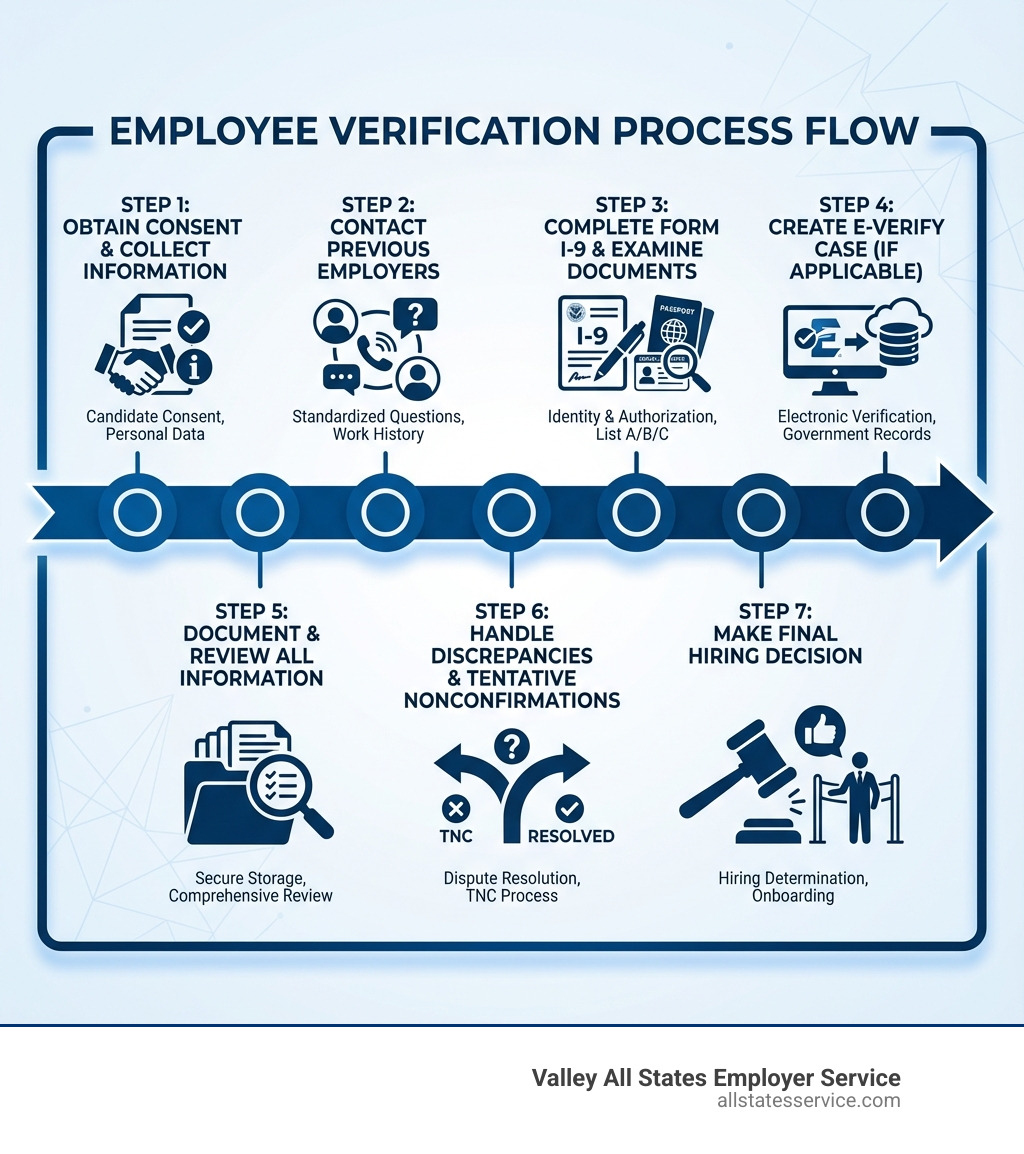
Basic Employee verification process glossary:
Core Steps of Pre-Employment Verification
The journey of verifying a new employee’s history begins long before they set foot in the office. It’s a critical phase that ensures we’re making informed hiring decisions and maintaining a compliant workforce. Let’s walk through the fundamental steps.
The Manual Employee Verification Process: Key Steps
The manual employee verification process involves several essential steps that HR professionals and recruiters follow to ensure the accuracy of a candidate’s work history.
First and foremost, candidate consent is non-negotiable. We must obtain a job seeker’s explicit permission before initiating any verification. This isn’t just a courtesy, it’s a legal requirement, particularly under regulations like the Fair Credit Reporting Act (FCRA) in the United States. Consent ensures we respect the candidate’s privacy and operate within legal boundaries.
Once consent is secured, we begin collecting information. This typically involves gathering necessary details such as previous job titles, employment dates, company names, and contact information for past employers. The Work Number, for example, partners with over 2.5 million employers to collect this data, updating it every pay period.
Next, we need to contact previous employers for verification. This can be done via phone or email. When reaching out, it’s crucial to ask standardized questions. This practice helps us avoid potential bias, ensures fairness across all candidates, and guarantees we gather consistent, comparable information. Standardized questions also help us stay compliant and avoid asking questions that could be discriminatory.
What specific employment details are verified? We look to confirm key information like job title, a brief description of responsibilities, start and end dates of employment, whether the position was full-time or part-time, and sometimes, the reason for leaving. This level of detail helps us understand a candidate’s genuine experience and fit for the role.
The employee verification process can vary between companies and roles. Some employers might only verify the most recent job, while others dig into an entire employment history. The depth of detail sought can also differ, from merely confirming job titles and dates to exploring performance or reasons for departure. Our goal is always to gather sufficient, relevant information for our specific hiring needs.
For a deeper dive into confirming work history, explore our guide on Pre-Employment Work History Verification.
Documenting Information and Handling Discrepancies
After contacting previous employers and gathering information, the next crucial step is documenting and reviewing all obtained details. This involves carefully logging phone calls, emails, and any other communications, along with the information confirmed. Clear, concise records are essential for audit trails and future reference.
It’s not uncommon for discrepancies to arise between a candidate’s claims and the verified information. When this happens, we must investigate discrepancies carefully. Was it an innocent mistake, a misunderstanding, or a deliberate misrepresentation? We always believe in giving candidates a chance to explain any inconsistencies or gaps in their employment history. This fosters transparency and ensures fairness.
We then evaluate the explanation and the nature of the discrepancy. A slight difference in job titles might be an innocent oversight, while a significant misstatement of employment dates or responsibilities could raise red flags. Our approach is to understand the full context before making a final decision.
Finally, when is a follow-up necessary in the employee verification process? A follow-up is essential if initial contact fails to provide all the necessary information, if clarification is needed on a particular detail, or if the candidate provides an explanation for a discrepancy that requires further confirmation. Thorough follow-up ensures we have a complete and accurate picture.
The U.S. Employee Verification Process: I-9 and E-Verify Compliance
In the United States, verifying employment eligibility isn’t just good practice, it’s a legal mandate. This means understanding and correctly implementing Form I-9 and, for many, the E-Verify system.
Understanding Form I-9: The Cornerstone of Eligibility Verification
Form I-9, Employment Eligibility Verification, is the bedrock of confirming an employee’s legal right to work in the United States. It’s a key element of the web-based employment eligibility verification process. Every employer in the U.S. must complete a Form I-9 for each new employee hired, regardless of citizenship status. This process ensures we are hiring an authorized workforce and complying with federal immigration law.
The employer’s responsibilities for Form I-9 are clear: we must timely and properly complete and retain the form for every new hire. This includes ensuring Section 1 is completed by the employee and Section 2 is completed by us, the employer or our authorized representative.
Section 1: Employee Information and Attestation must be completed by the employee on or before their first day of employment. This section requires the employee to attest to their employment authorization status and provide personal information. While providing a Social Security Number (SSN) is voluntary for general Form I-9 purposes, it becomes mandatory if we use E-Verify to confirm their eligibility.
Section 2: Employer Review and Verification must be completed within three business days of the employee’s first day of employment. During this step, we, or our authorized representative, must physically examine original, acceptable, and unexpired documentation presented by the employee. These documents prove both identity and employment authorization.

Employees have the right to choose which documents they present from the Lists of Acceptable Documents. They can present:
- One document from List A (which establishes both identity and employment authorization)
- One document from List B (which establishes identity only) AND one document from List C (which establishes employment authorization only)
We cannot specify which documents an employee must present. Our role is to accept documentation that reasonably appears to be genuine and relates to the person presenting it.
For a comprehensive understanding of this crucial form, check out our guide on What is an I9. You can also find detailed information about the acceptable documents in our I-9 Acceptable Documents Ultimate Guide.
How E-Verify Improves the Employee Verification Process
E-Verify is a web-based system that significantly improves the employee verification process by allowing employers to electronically confirm the eligibility of their newly hired employees to work in the U.S. It operates by matching information from the employee’s Form I-9 against records available to the Social Security Administration (SSA) and the U.S. Department of Homeland Security (DHS). This system helps us maintain a legal workforce, prevent unauthorized employment, and protect American jobs.
E-Verify is free and available to participants across all 50 states and U.S. territories. It takes the information from Form I-9 and electronically compares it with government records. For example, if an employee presents a U.S. Passport, E-Verify will check DHS records. If they present a Social Security card, it checks SSA records.
Sometimes, E-Verify might generate a Tentative Nonconfirmation (TNC), which means the system cannot immediately confirm an employee’s authorization. This does not mean the employee is unauthorized to work. When a TNC occurs, we have specific employer procedures for handling TNCs:
- We must notify the employee of the TNC.
- We provide the employee with a “Referral Date Confirmation,” giving them a prescribed time (typically eight federal government workdays) to contact the appropriate agency (SSA or DHS) to resolve the mismatch.
- We cannot terminate or take any adverse action against an employee based solely on a TNC.
E-Verify also offers flexibility in how we examine documents. A significant development came with the Department of Homeland Security’s final rule, effective August 1, 2023, which authorized alternative procedures for examining Form I-9 documentation. This means that if we participate in E-Verify, we may be eligible to remotely examine an employee’s documents, rather than requiring physical presence. This is particularly beneficial for remote hiring.
E-Verify complements Form I-9 by providing an additional layer of verification, helping us stay compliant with federal immigration law. For more details on this system, visit E-Verify.gov. You can also learn more in our dedicated guides on What is E-Verify and I-9 E-Verify Compliance Guide.
Advanced Verification: Background Checks and Special Cases
Beyond the foundational I-9 and E-Verify processes, a comprehensive employee verification process often extends to more in-depth background checks and specific considerations for foreign workers.
Conducting Comprehensive Pre-Employment Background Checks
For many roles, a thorough pre-employment background check is a wise investment. It helps us confirm qualifications, assess trustworthiness, and mitigate risks. While the specifics can vary, common elements include:
- Criminal record checks: These provide insights into an applicant’s criminal history, which can be crucial for roles involving sensitive information, vulnerable populations, or positions of trust. For instance, a financial role might require a clear criminal record.
- Education and credential verification: We verify academic degrees, certifications, and licenses to ensure candidates possess the stated qualifications. This prevents hiring mistakes, protects our company’s reputation, and ensures compliance in regulated fields.
- Professional reference checks: These go beyond the resume, offering a clear snapshot of a candidate’s work ethic, character, and interpersonal skills from former supervisors or colleagues. Standardized questions help us gain valuable insights into how a candidate performs in a work environment.
- Purpose of credit checks in the hiring process: Credit checks are typically reserved for positions with significant financial responsibilities, such as those in banking, accounting, or executive roles. They help us assess a candidate’s financial judgment and reliability, which can be an indicator of responsibility and integrity. Under the FCRA, any verifier requesting this information must undergo a thorough credentialing process and have a legally required, permissible purpose for access.
These checks provide us with “peace of mind insurance,” allowing us to hire with greater confidence. To understand more about how E-Verify fits into broader background checks, see our resource on E-Verify Background Checks.
Verifying Foreign Students and Workers in the U.S.
The employee verification process includes specific considerations when hiring foreign students and workers in the U.S., particularly those on F-1 and M-1 visas. These individuals have unique employment authorization rules that employers must understand for Form I-9 compliance.
Foreign students pursuing academic or language training are classified as F-1 nonimmigrants, while those in nonacademic or vocational studies are M-1 nonimmigrants.
On-campus employment for F-1 students is generally permitted up to 20 hours a week when school is in session and full-time during breaks, after their first academic year. For Form I-9, we verify their unexpired foreign passport and Form I-94 indicating F-1 status.
Optional Practical Training (OPT) allows F-1 students to gain practical experience directly related to their major. USCIS may authorize up to 12 months of OPT. For Form I-9, we verify their Employment Authorization Document (EAD card).
Curricular Practical Training (CPT) is an alternative for F-1 students to engage in work experience that is an integral part of their curriculum. This requires an endorsement on their Form I-20 by a Designated School Official (DSO).
For F-1 students with STEM (Science, Technology, Engineering, and Mathematics) degrees, a STEM OPT extension can provide an additional 24 months of work authorization. Crucially, employers hiring STEM OPT students must be enrolled and in good standing with E-Verify.

A unique situation arises with cap-gap extensions, which affect F-1 students whose H-1B cap-subject petition has been timely filed and is pending. This extension allows them to continue working beyond their OPT EAD expiration date until October 1st, or until their H-1B petition is approved or denied, whichever is earlier. For Form I-9, we verify their Form I-797C, Notice of Action, showing the H-1B petition was timely filed. We must also reverify their employment authorization on or by March 31 of the new fiscal year if the H-1B petition is still pending.
M-1 vocational students have more restricted employment options. They can only accept employment after completing their course of study, as part of a practical training program, and require an EAD. They are limited to a maximum of six months of practical training.
Understanding these nuances is vital to ensure proper Form I-9 completion and compliance when hiring foreign students.
A Note on Canadian Employment Verification
While our primary focus is on the United States, it’s worth noting that the employee verification process can differ significantly in other countries. For instance, in Canada, the process often involves Employment Verification Letters.
An Employment Verification Letter in Canada is a formal document issued by an employer to confirm an individual’s employment details. It’s frequently needed for purposes like applying for a mortgage, renting an apartment, or immigration applications.
The information typically included in an Employment Verification Letter covers:
- Employee’s full name and job title
- Start date of employment
- Current employment status (full-time, part-time, permanent, temporary)
- Annual salary or wage (often only with employee consent or if specifically requested by the verifier)
- Employer’s contact information and the letter issuer’s name and title.
The differences between manual and automated processes for issuing Employment Verification Letters are significant. Manually, HR might spend valuable time gathering data from various systems, drafting, and reviewing each letter. This can take several business days. Automated systems, often integrated with Human Capital Management (HCM) software, can generate and deliver accurate, branded letters in seconds, greatly improving efficiency and employee experience.
Legal considerations are paramount. In Canada, federal and provincial privacy laws, such as the Personal Information Protection and Electronic Documents Act (PIPEDA), govern how personal information, including employment data, is collected, used, and disclosed. Employers must obtain consent before sharing information and only disclose what is necessary and relevant.
While these Canadian practices differ from U.S. requirements, they highlight the universal importance of accuracy, consent, and legal compliance in any employee verification process.
Modernizing Verification with Automated Solutions
The complexities of the employee verification process demand efficient and reliable solutions. This is where automated systems and third-party services truly shine, offering benefits for employers and employees alike.
The Role of Third-Party Verification Services
As we’ve seen, managing Form I-9 compliance, E-Verify, and other background checks can be a significant administrative burden. This is precisely where Valley All States Employer Service steps in. We provide outsourced E-Verify workforce eligibility verification, operating in the employment compliance and HR services industry. Our unique selling point is expert, impartial, and efficient E-Verify processing, minimizing errors and administrative burden for our clients.
What are the benefits of using Verification Exchange for employers?
- Fewer manual verification requests: Agencies and organizations no longer need to contact us directly, which significantly reduces the manual workload.
- Lower administrative costs and burdens: Streamlining the process frees up our HR resources.
- Increased compliance: Expert handling ensures we meet all legal requirements, reducing the risk of penalties.
For verifiers, whether they are lenders, property managers, or government agencies, the benefits are equally compelling:
- Faster, more informed decisions: Instant access to verified employment and income data means loans can be approved faster, government benefits issued sooner, and job offers sent quicker.
- Reduced fraud: Secure, consent-based systems help mitigate exposure to unauthorized access and fraudulent claims.
- Increased compliance: Verifiers can trust the data they receive is accurate and legally obtained.
And for employees, the advantages are clear:
- Convenience and peace of mind: Your data is kept secure, and important decisions can be expedited without additional action needed from you.
- Faster decisions for life events: Employment and income verifications are available instantly, making it easier to apply for credit, housing, or benefits.
- Discreet information sharing: Services like The Work Number facilitate consensual digital exchange of employment information, offering a more discreet alternative than manual phone calls, especially when seeking a new role.
Our services ensure your employee verification process is not just compliant, but also efficient and seamless for all parties involved. Learn more about our comprehensive solutions in our Outsourced Employee Verification Ultimate Guide.
Employee Data Control and Dispute Resolution
In the age of digital information, employees also have significant control over their personal employment data and recourse if they find inaccuracies. Services like Verification Exchange and The Work Number empower individuals in this regard.
Your Consumer Employment Report (CER), also known as an Employment Data Report (EDR), is a record of your employment and income information. You can, and should, visit the “My Personal Data” section of The Work Number website to view and download your EDR. This report also lists every entity that has requested information on you through The Work Number within the past 24 months.
How can employees manage their personal data and dispute information on their Consumer Employment Report (CER)?
- Access your data: Regularly review your CER/EDR to ensure its accuracy.
- Dispute inaccurate information: If you find any information that needs to be updated or is incorrect, you have the right to dispute it. You can typically file a dispute online, by mail, or by phone.
- Resolution process: Within 30 days of your dispute request, the service will notify you of the results of their data dispute investigation. If they find any information that needs to be updated on your CER, they will take care of it.
- Data security: Your data is kept secure, and exposure to unauthorized access is mitigated through seamless information transfer between employers and verifiers.
Our operations are compliant with privacy regulations, which ensures employees have access to their verification request history and a method for recourse if they have a dispute with the verification. If you need to initiate a dispute, you can start your dispute here. This level of transparency and control is vital for maintaining trust and accuracy in the employee verification process.
Conclusion
Navigating the employee verification process can indeed feel like a maze, fraught with legal obligations, detailed documentation, and the need for precision. From the initial steps of obtaining candidate consent and manually verifying employment histories, to the stringent requirements of Form I-9 and the advanced capabilities of E-Verify in the U.S., each stage demands careful attention. We’ve explored how discrepancies must be handled with fairness, the specific nuances of verifying foreign students’ eligibility, and the significant advantages that automated, third-party solutions offer.
The complexity of the employee verification process underscores the importance of compliance. Errors or omissions can lead to substantial penalties and legal challenges. However, with the right knowledge and tools, it’s entirely possible to streamline these processes, reduce administrative burden, and ensure a compliant, authorized workforce.
At Valley All States Employer Service, we understand these challenges intimately. Our expertise lies in providing efficient, impartial, and expert E-Verify and I-9 processing, taking the guesswork and heavy lifting off your plate. We help you minimize errors, manage compliance, and free up your valuable HR resources, allowing you to focus on what you do best: building a great team.
Ready to streamline your E-Verify and I-9 compliance? Explore our expert services.