
E-Verify for Small Businesses: Avoid 2025 Fines
Why E-Verify Matters for Small Business Success
E-verify for small businesses is a government-run system that helps you confirm whether your new employees can legally work in the United States. While it’s voluntary for most companies, many states now require it, and understanding how it works could save your business from costly compliance issues.
Here’s what you need to know about E-Verify:
- What it is: An online system run by the Department of Homeland Security that checks employee eligibility against government databases
- When it’s required: Mandatory for federal contractors and businesses in certain states like Arizona, Alabama, Mississippi, and South Carolina
- How it works: You complete Form I-9 first, then submit employee information to E-Verify within three business days of hire
- Key benefit: Provides legal protection by demonstrating good-faith efforts to hire authorized workers
- Cost: Free to use directly, though many businesses use paid services to manage the process
As one busy HR manager put it: “E-Verify gives you, the employer, peace of mind that your employees are legally authorized to work in the United States.”
The system complements your existing Form I-9 process by taking employment verification to the next level. Most case results appear within three to five seconds, and nearly 3 million worksites already use E-Verify proactively.
Whether E-Verify is right for your business depends on your location and industry. Many companies find it reduces liability, while others view it as an administrative burden.
What Exactly is E-Verify? A Primer for Small Business Owners
Think of E-Verify as your digital verification assistant. This internet-based system, operated by U.S. Citizenship and Immigration Services (USCIS) under the Department of Homeland Security (DHS), works alongside the Social Security Administration (SSA) to help you electronically confirm whether your new employees can legally work in the United States.
It’s a quick double-check that gives you confidence in your hiring decisions. For small businesses, accidentally hiring someone who isn’t authorized to work can be a major risk. That’s where e verify for small businesses becomes invaluable.
The system is designed with Workforce Eligibility Verification in mind, making it easier for employers like you to stay compliant while building your team.

How is E-Verify Different from Form I-9?
Many business owners think E-Verify and Form I-9 are the same thing, but they’re actually teammates working together.
Form I-9 is your starting point. Every employer in the United States must complete this Employment Eligibility Verification form for each new hire. During this process, your employee provides personal information and shows you documents that prove both their identity and work authorization. You examine these documents and complete the form.
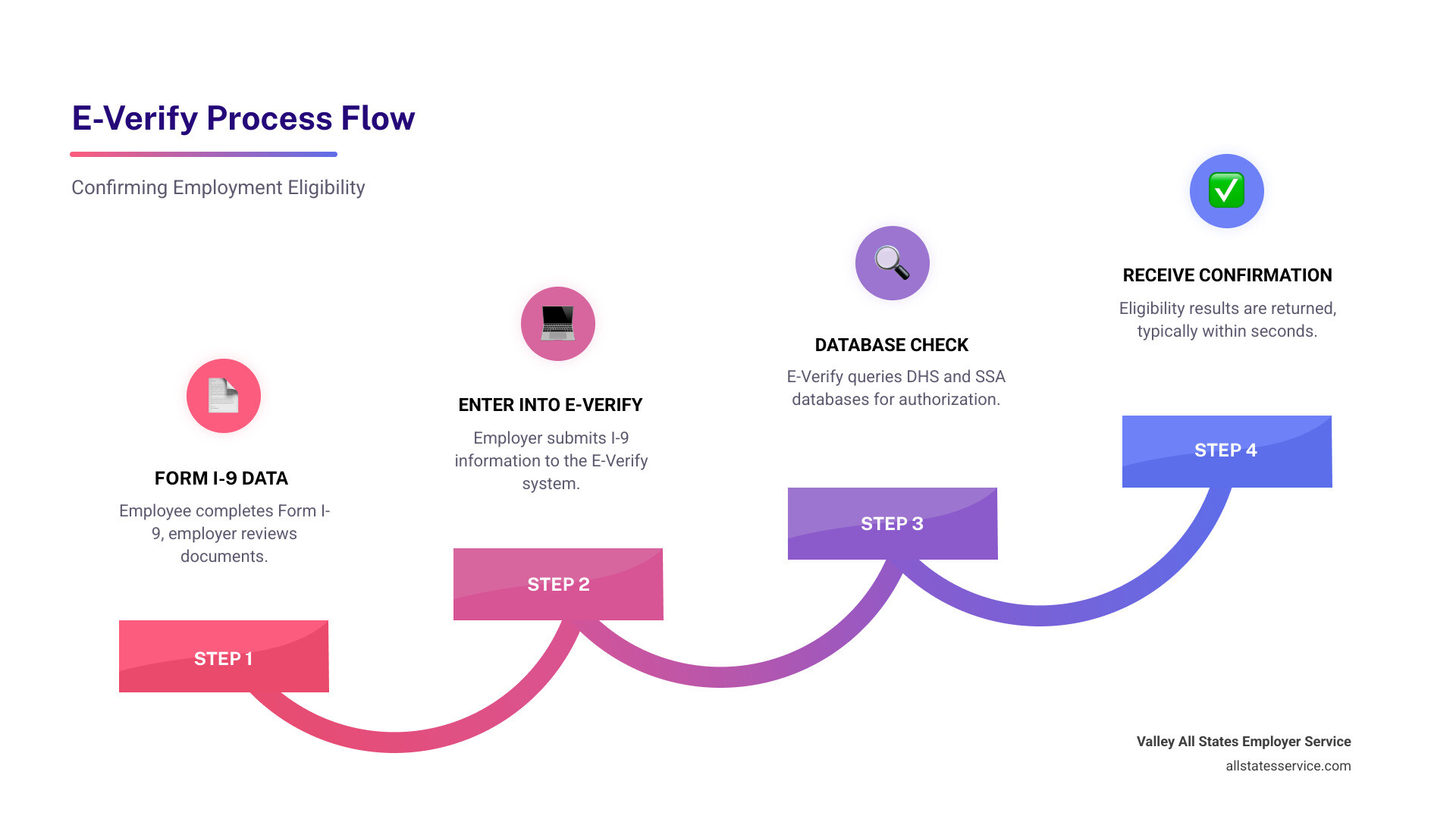
E-Verify picks up where Form I-9 leaves off. After you’ve completed the I-9, you enter that same information into the E-Verify system. The system then checks this data against government databases maintained by DHS and SSA. It’s like having a direct line to verify that the information on those documents is legitimate.
Think of it this way: if Form I-9 is collecting the puzzle pieces, E-Verify is making sure they all fit together correctly. E-Verify complements your I-9 process rather than replacing it. Both are essential parts of your verification toolkit.
Want to dive deeper into the foundation? Check out What is an I-9? for more details.
Key Benefits for Your Business
Using E-Verify offers compelling advantages that go beyond just checking a compliance box.
Peace of mind is a major benefit. Knowing your employees are legally authorized to work prevents future complications and worry.
The system demonstrates good-faith compliance, which can be your shield if legal questions arise. Using E-Verify shows you made a genuine effort to follow immigration laws, significantly reducing your liability.
Document fraud is becoming increasingly sophisticated, but E-Verify fights back with features like photo matching. The system compares photos on presented documents with government records, adding an extra security layer.
E-Verify can also help employees. If there’s a mismatch in government records, the system alerts them so they can correct errors with the SSA or DHS, ensuring record accuracy.
The streamlined hiring process is another major advantage. Most E-Verify results pop up within three to five seconds, so you can move from verification to onboarding without missing a beat.
Finally, the system is genuinely business-friendly. You don’t need special software, just a secure internet connection and web browser. Plus, there are comprehensive tutorials and customer support to help you. As the government puts it, E-Verify is Business Friendly, offering flexible user roles and reporting features that make compliance tracking straightforward.
The Big Question: Is E-Verify Mandatory for Your Business?
A common question for small business owners is: “Do I actually have to use E-Verify?” The answer depends on your location and business activities.
At the federal level, e verify for small businesses is mostly voluntary. Most private employers can choose whether or not to participate. However, the rules can get more complicated.
You’re legally required to use E-Verify if you’re a federal contractor with contracts that include the Federal Acquisition Regulation (FAR) E-Verify clause. This means you’ll need to verify all employees working under those contracts, and often all your new hires.
What often catches business owners off guard are the state-level mandates. An increasing number of states have their own requirements, creating a patchwork of rules.
Understanding State-Specific E-Verify Requirements
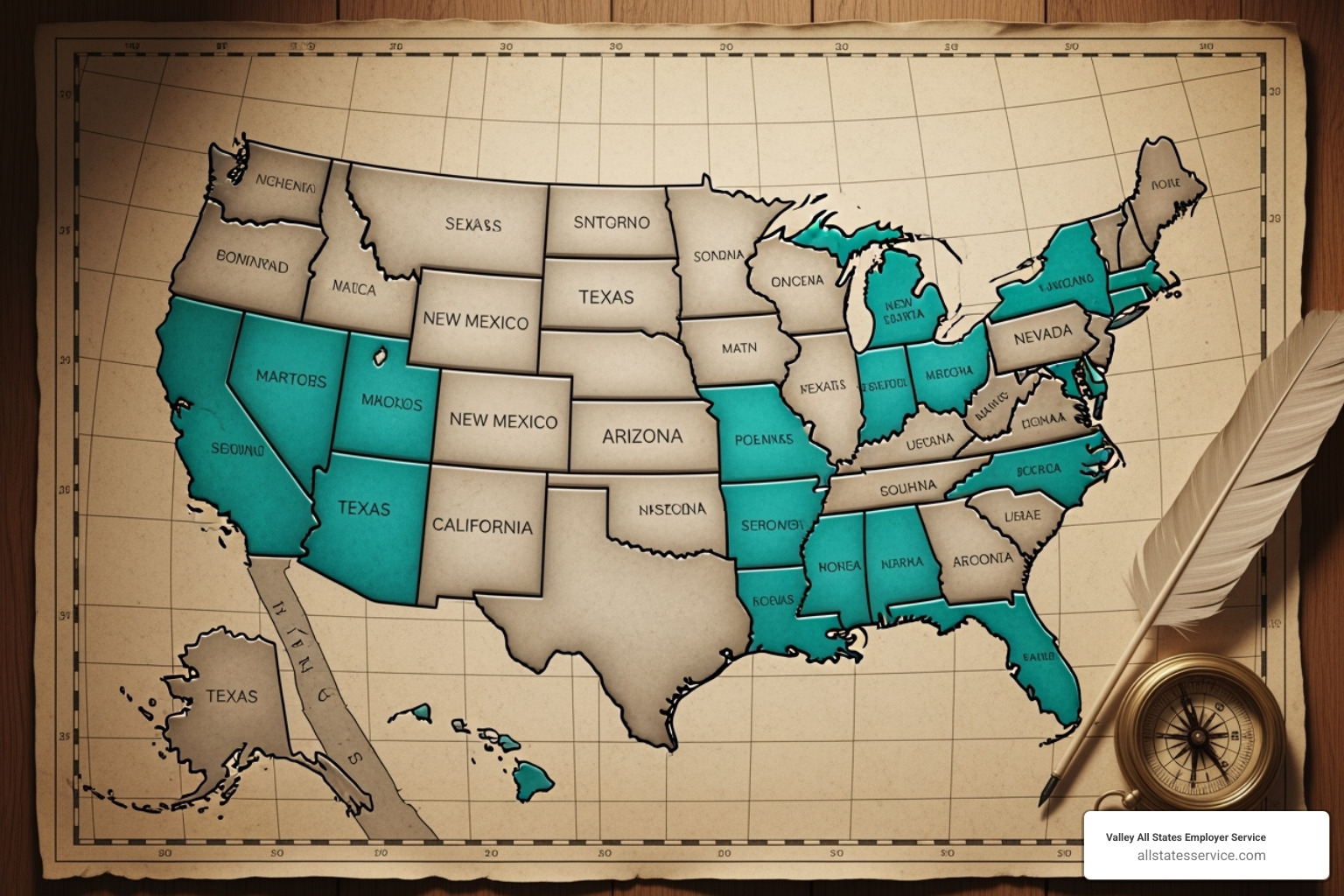
The state-by-state landscape for E-Verify requirements can feel like a maze. What’s required in one state might be completely different from another.
Some states like Arizona, Mississippi, Alabama, and South Carolina require virtually all employers to use E-Verify for new hires. Other states take a more targeted approach, requiring only public employers or state contractors to participate.
Then there are states with employee count thresholds, where you might only be required to use E-Verify if you have a certain number of employees. Some cities and counties have even added their own local requirements.
Laws are constantly evolving, as seen with recent changes in Florida. What was optional last year might be mandatory this year.
This is why staying current with E-Verify requirements by state is so crucial for your business planning. The rules change, and ignorance isn’t a valid defense.
Penalties for Non-Compliance
Failing to follow the rules can have severe consequences, potentially damaging or even closing your business.
Monetary fines are often the first penalty, and they can be substantial, increasing with repeat violations.
In some states, non-compliance can lead to the suspension or revocation of your business license, forcing you to shut down operations.
If you work with government contracts, debarment means you’ll be locked out of future opportunities while your competitors step in.
Perhaps most damaging is the reputational harm that comes with being found in violation of employment laws. Word travels fast, and customers, potential employees, and partners all pay attention.
The good news? Proper HR Compliance for Small Business doesn’t have to be overwhelming. It’s about building systems that protect your business while you focus on growth.
A Step-by-Step Guide to E-Verify for Small Businesses
Ready to get your business enrolled in E-Verify? The system is designed for busy small business owners. You won’t need special software, just an internet connection and about 30 minutes to enroll.
The key to smooth enrollment is preparation. Before you start, gather all the information you’ll need so you can complete the process in one sitting.
You’ll have a choice to make during enrollment: handle E-Verify yourself as an “Employer” or work with an “E-Verify Employer Agent.” Most e verify for small businesses start with the Employer option for direct control. However, if you’re already feeling overwhelmed by HR tasks, an agent might be worth considering.
The Enrollment Process for small businesses
Let’s walk through what happens when you enroll your company in E-Verify. The process takes place entirely online.
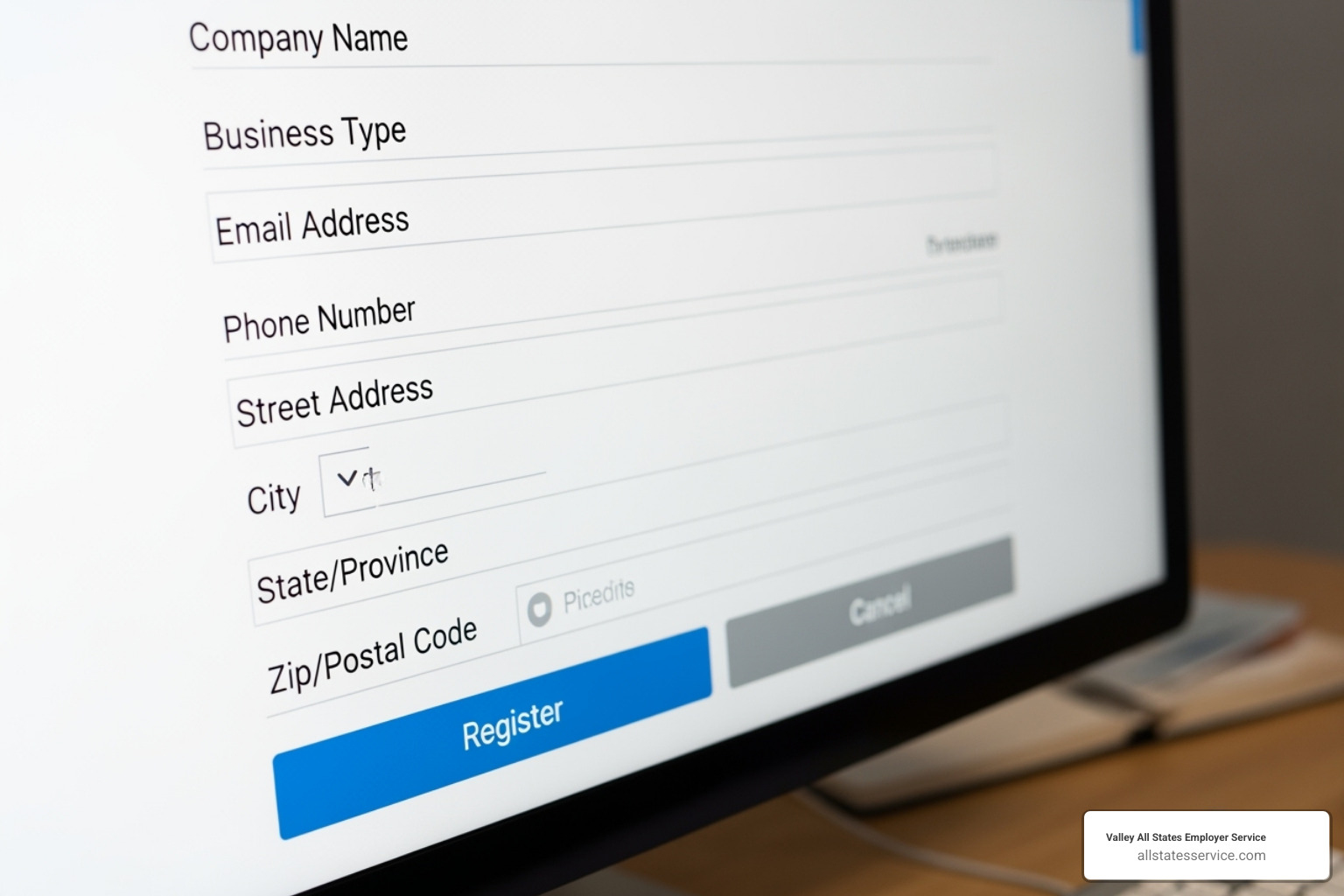
Start by visiting the official E-Verify website and clicking “Enroll Now.” First, you’ll need to read and agree to the Memorandum of Understanding. It outlines your responsibilities as an E-Verify employer, so review it carefully.
Next, you’ll choose your access method. For most small businesses, the “Employer” access method is the right choice. The “E-Verify Employer Agent” option is for third-party services that handle E-Verify on behalf of multiple employers.
Now comes the information gathering phase. You’ll need your company’s legal name (as it appears on tax documents), your Employer Identification Number (EIN), and your primary physical address. If your mailing address differs, have that ready too.
The system will ask for the first three digits of your NAICS code (North American Industry Classification System). If you don’t know your NAICS code, you can find it on the Census Bureau website or your business tax returns.
You’ll also need to provide details about all hiring sites that will participate in E-Verify. If you have multiple locations, you can add them one at a time or upload them all at once. Even if you work from home, you’ll need to list your primary business address as a hiring site.
The system requires you to designate at least one Program Administrator and one Signatory. The Program Administrator manages users and cases, while the Signatory has the authority to sign the Terms and Conditions. In many small businesses, this is the same person.
Before submitting, carefully review all information to avoid delays. After you submit, save a copy of the electronically signed Terms and Conditions for your records.
The Official Enrollment Checklist can help ensure you have everything ready. For more detailed guidance, check out the official resource on The Enrollment Process | E-Verify.
What You Need to Post
Once you’re enrolled in E-Verify, federal law requires you to inform job applicants and employees about your participation through specific workplace postings.
You must prominently display two notices at all hiring sites: the “Right to Work” poster and the “E-Verify Participation” poster. These are legal requirements that help ensure transparency.
Both posters are available for free download from the E-Verify website in multiple languages. They need to be displayed where job applicants and employees can easily see them, such as in break rooms or near time clocks.
The Right to Work poster explains employees’ rights, while the E-Verify Participation poster informs people that your company uses E-Verify to confirm work eligibility.
Navigating the E-Verify Process: From New Hire to Confirmation
Once you’re enrolled, E-Verify integrates into your hiring process. Think of it as one extra onboarding step that provides significant peace of mind.
The key thing to remember is that e verify for small businesses is a post-hire process. You can’t use it to screen job candidates or as a replacement for your current hiring practices. It’s a confirmation tool that works after you’ve made your hiring decision.
How an E-Verify Check Works
Running an E-Verify check is straightforward once you understand the sequence. The process builds on the Form I-9 work you’re already doing.
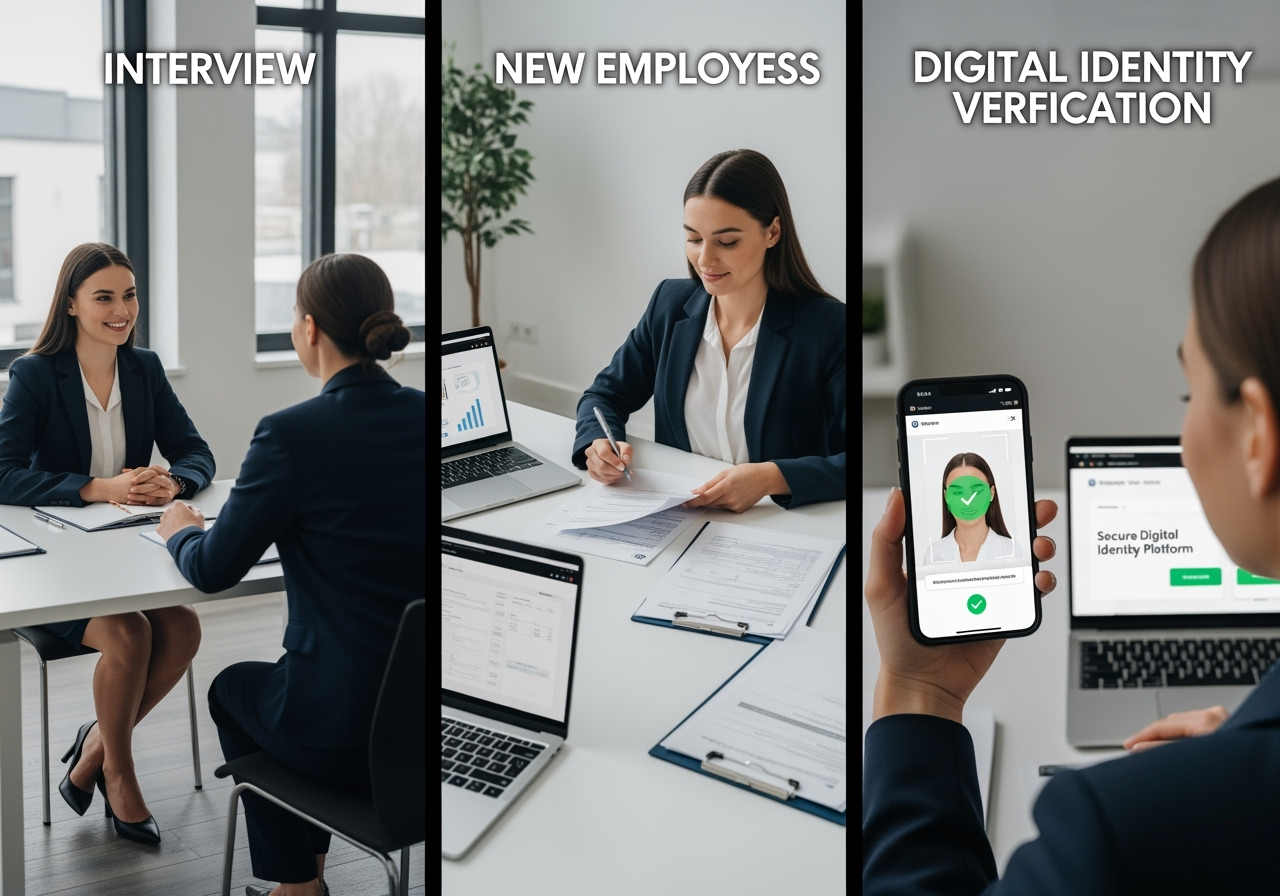
First, you extend a job offer and your new employee accepts it. Your new hire then completes Section 1 of Form I-9, providing their personal information and attesting to their work authorization status.
Next, you complete Section 2 of Form I-9 by examining the employee’s identity and work authorization documents.
After completing the I-9, you or your designated E-Verify user enters the employee’s information from their Form I-9 into the E-Verify system. The system then checks this information against DHS and SSA databases.
The three-day rule is absolutely critical. You must submit your new hire for verification no later than the third business day after they start work for pay. Missing this deadline can put you out of compliance.
Most of the time, you’ll get an “Employment Authorized” result within three to five seconds, allowing you to complete the step while your new hire finishes their paperwork.
Understanding this workflow is essential for maintaining New Hire Eligibility and staying compliant.
Handling a Tentative Nonconfirmation (TNC)
Sometimes, you’ll receive a Tentative Nonconfirmation or TNC. Don’t panic. A TNC simply means the information you entered doesn’t match government databases.
Crucially, a TNC is not a final determination. It does not mean you should fire the employee or take any other negative action.
When you receive a TNC, you must provide your employee with a “Further Action Notice” that explains the mismatch and outlines the next steps. Your employee then has eight federal workdays from the date of the TNC to contact either SSA or DHS to resolve the discrepancy.
During this time, you must continue to allow the employee to work. You can’t suspend them, delay training, or change their pay because of the TNC. This protection exists because many TNCs result from simple issues like data entry errors or outdated government records.
Once they’ve attempted to resolve the TNC, E-Verify will issue a final result, either “Employment Authorized” or “Final Nonconfirmation.” Only after receiving a Final Nonconfirmation can you consider taking adverse action.
Best Practices for e verify for small businesses
Successfully implementing E-Verify requires consistent practices that protect your company and your employees.
Consistency is your best friend. Apply the system to all new hires to avoid discrimination claims and ensure fair treatment.
Timing matters. Never use E-Verify for pre-employment screening. Always wait until after you’ve completed the Form I-9.
Accurate record keeping protects your business. Record the E-Verify case number on the employee’s Form I-9 or print the case details and keep them with the I-9 form.
Data privacy is a top priority. E-Verify cases contain sensitive personal information, so limit access to only those who need it.
Training your staff properly prevents costly mistakes. Anyone handling Form I-9s and E-Verify submissions needs thorough training on procedures and compliance.
Leveraging professional assistance often makes sense. Services like I-9 Verification Assistance can ensure your Form I-9s are completed correctly, which is the foundation for accurate E-Verify checks.
Making E-Verify Work for You: Agents and Future Trends
Running a small business means wearing many hats. Adding E-Verify for small businesses compliance to an already overwhelming list can feel like too much.
The good news? You don’t have to handle everything yourself. There are smart ways to make E-Verify work for your business without drowning in paperwork.

What is an E-Verify Employer Agent?
Think of an E-Verify Employer Agent as your compliance partner. They’re third-party service providers authorized by USCIS to handle the E-Verify process on your behalf. For small businesses without a dedicated HR department, this can be a game-changer.
An agent is valuable because they review your Form I-9s with expert eyes, catching technical errors. Many also offer electronic I-9 systems to prevent common mistakes.
Your agent handles submitting cases, ensuring data is entered accurately and within the critical three-day window.
Most importantly, if you get a Tentative Nonconfirmation (TNC), your agent guides both you and your employee through the resolution steps, ensuring everything is handled correctly.
Using an agent frees up your time and mental energy. You can focus on growing your business instead of becoming a compliance expert.
For businesses that want expert, impartial, and efficient processing, an E-Verify Employer Agent offers exactly that kind of support. It’s like having a compliance department without hiring one.
The Future of E-Verify
E-Verify continues to evolve to make life easier for employers while keeping security tight.
The biggest development on the horizon is E-Verify+. This improved version promises to make the verification process even more streamlined. The goal is simple: “click, confirm, and carry on” with greater ease. You can learn more about what’s coming in the webinar Introducing E-Verify+.
Another major shift is remote document verification. DHS now allows E-Verify employers to examine Form I-9 documents through live video interactions instead of in-person meetings. This flexibility is particularly helpful for hiring remote workers.
These improvements point to a future where E-Verify becomes even more adaptable to how modern businesses operate. For e verify for small businesses, this means less hassle and more confidence in your hiring process.
Conclusion: Is E-Verify the Right Move for Your Small Business?
So, is e verify for small businesses worth the effort? For many small business owners, it’s becoming less of a choice and more of a necessity.
E-Verify offers real peace of mind for workforce compliance. It builds a foundation of legal protection, helping you avoid hefty fines or license revocation from unknowingly hiring unauthorized workers.
The compliance landscape is changing fast. While E-Verify is voluntary at the federal level for most businesses, more states are adding their own mandates. Getting ahead of these requirements is a smart business move.
For companies already required to use E-Verify, the question isn’t whether to implement it, but how to do it right. A streamlined hiring process that comes with proper E-Verify implementation can save you time in the long run.
Here’s what we’ve seen work best for small businesses: don’t go it alone if you don’t have to. Managing E-Verify can be overwhelming. For businesses seeking expert help, services like those from Valley All States Employer Service can manage the entire process, from enrollment to handling tricky Tentative Nonconfirmations.
If E-Verify is mandatory for you, get compliant quickly and correctly. If it’s optional, weigh the peace of mind and legal protection against the administrative effort.
Ready to make E-Verify work for your business without the headaches? Learn more about E-Verify for Small Businesses and find how we can handle the complexities while you focus on what you do best.