
E Verify for Federal Contractors: Ultimate 2025 Guide
Understanding E-Verify Requirements for Federal Contractors
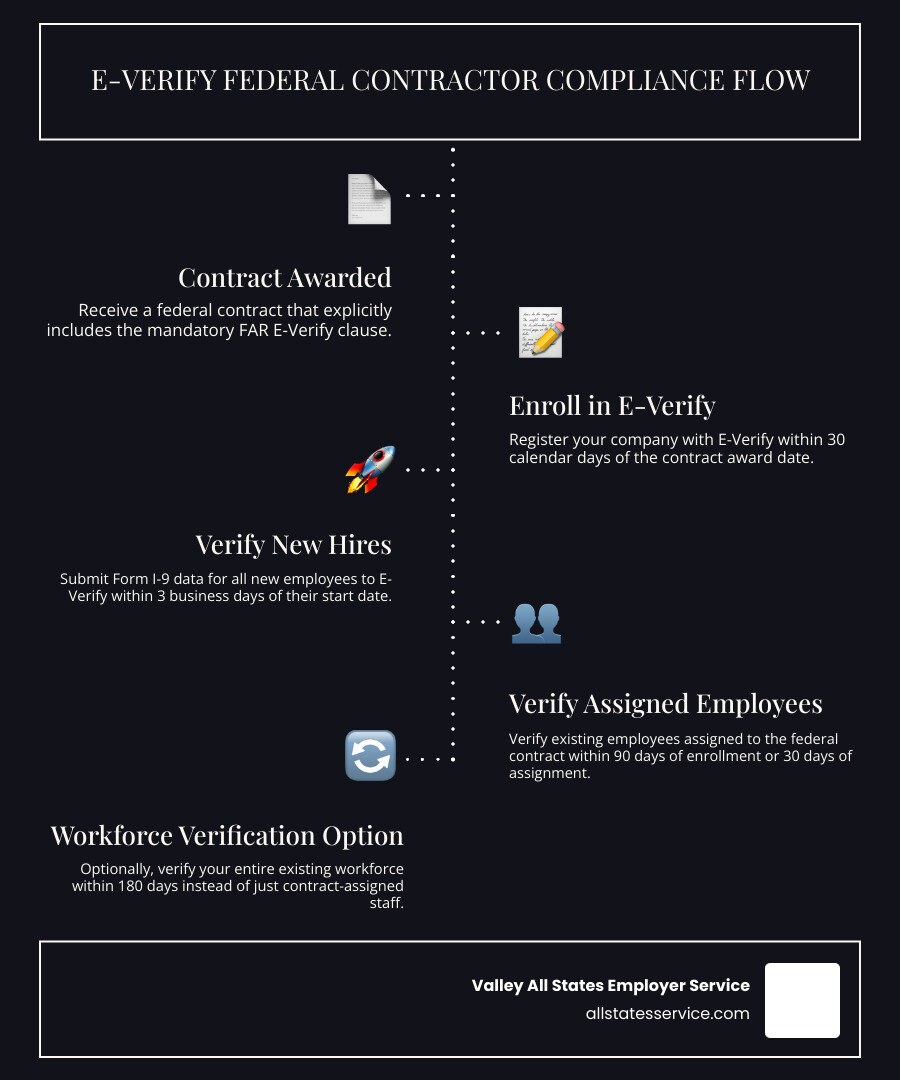
If your company holds federal contracts, the E-Verify for federal contractors rule likely applies to you. When a contract includes the FAR E-Verify clause, you must use E-Verify to confirm work authorization for new hires and certain existing employees.
Quick Overview: E-Verify Federal Contractor Requirements
- Who must comply: Federal contractors with contracts awarded on or after September 8, 2009, that contain the FAR E-Verify clause (48 C.F.R., Subpart 22.18).
- Contract thresholds: Prime contracts over $150,000 with performance periods longer than 120 days, subcontracts over $3,500 for services or construction.
- Enrollment deadline: Within 30 calendar days of contract award.
- New hire verification: Within 3 business days of the employee’s start date.
- Existing employee verification: Within 90 days of E-Verify enrollment or 30 days of assignment to the contract, whichever is later.
- Workforce option: Contractors can choose to verify their entire workforce within 180 days instead of just contract assigned employees.
Non compliance risks include contract termination, suspension, or debarment. Compared to voluntary E-Verify, the federal contractor rule also requires verification of certain existing staff. In practice, the system is efficient, and more than 96 percent of cases receive an Employment Authorized result almost instantly. Understanding these steps helps you protect your contracts and maintain a legal workforce.
What is the E-Verify Federal Contractor Rule?
The E-Verify Federal Contractor Rule stems from Executive Order 12989 and requires companies with specific federal contracts to verify their employees’ work authorization. Effective since September 8, 2009, this rule mandates the use of the E-Verify system to ensure a legal workforce on government-funded projects. For a general overview, see What is E-Verify?.
The rule is not retroactive. It applies to contracts awarded after this date or older contracts that are updated to include the E-Verify requirement.
The Role of the FAR E-Verify Clause
The key to this requirement is the FAR E-Verify clause (FAR 52.222-54). If this clause is in your contract, you must use E-Verify. It’s the legal trigger for compliance, found at 48 C.F.R., Subpart 22.18. Always check your contract documents carefully. If you’re unsure, your government contracting official can confirm if it applies. This clause outlines your specific obligations and deadlines. For more details, visit the government’s page on the Federal Acquisition Rule (FAR) – E-Verify.
How E-Verify Works
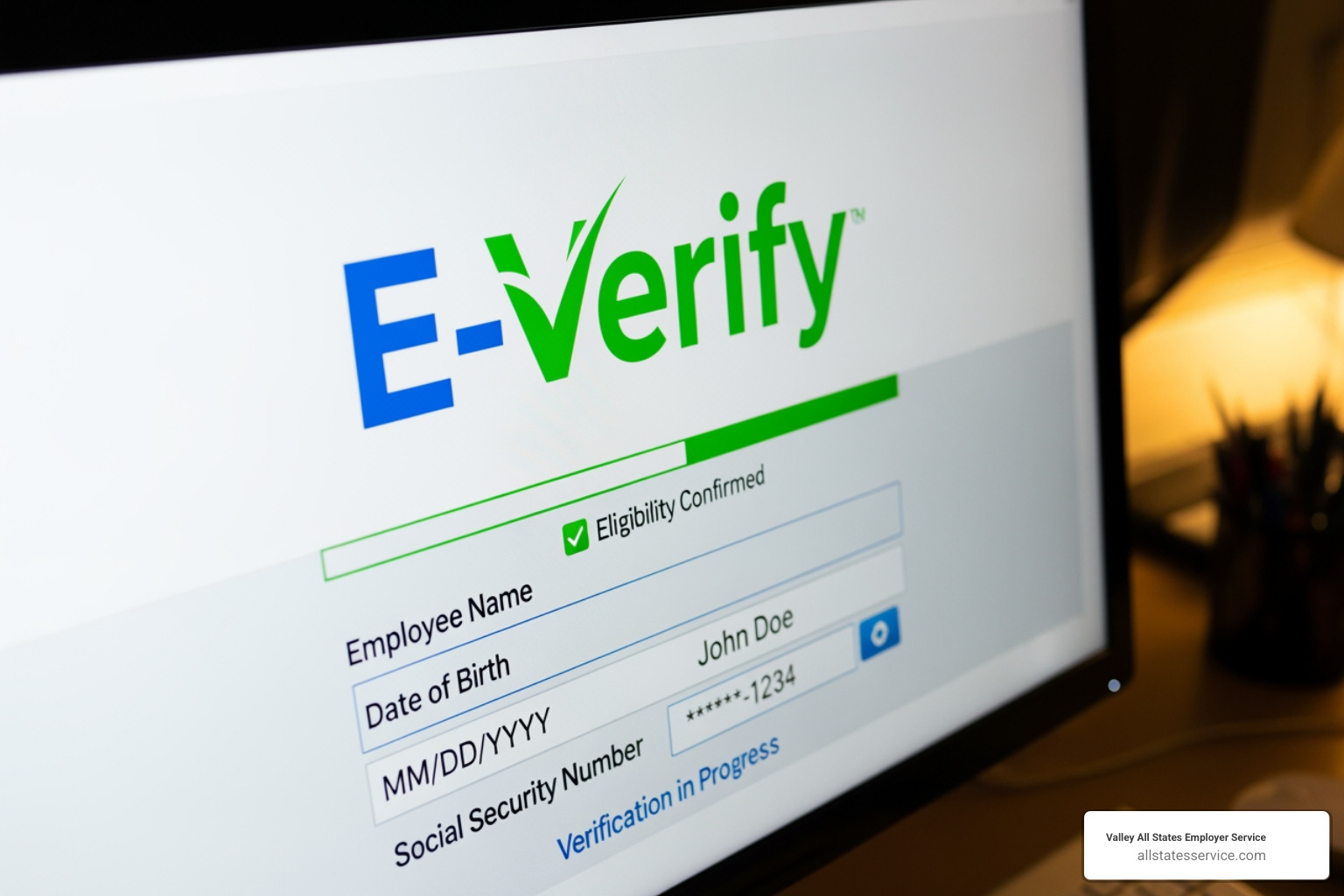
E-Verify is an online system from U.S. Citizenship and Immigration Services (USCIS) and the Social Security Administration (SSA) that confirms employment eligibility. The process is simple:
- Complete the Form I-9 for a new hire.
- Enter the employee’s information from the Form I-9 into the E-Verify system.
- The system checks the information against DHS and SSA databases.
In seconds, you’ll get a result. Over 96% of cases are instantly confirmed as “Employment Authorized.” If a mismatch occurs, the system issues a Tentative Nonconfirmation, and the employee has an opportunity to correct their records. E-Verify supplements, but does not replace, your Form I-9 obligations. Learn more about the E-Verify Verification System.
Who is Affected and What Contracts are Covered?
Wondering if the E-Verify federal contractor rule applies to you? It generally affects prime contractors and many of their subcontractors. The rule is not retroactive, so it only applies to contracts awarded on or after September 8, 2009, or older contracts that have been specifically updated to include the FAR E-Verify clause.
If you’re entering into new federal work or renewing existing agreements, you must check your contract for this requirement. For a broader understanding, see our guide on E-Verify for Contractors.
Prime Contract Requirements
For a prime contract to fall under the E-Verify rule, it must meet all of the following conditions:
- Value: The contract must be worth more than the simplified acquisition threshold, which is currently $150,000.
- Duration: The period of performance must be longer than 120 days.
- Location: The work must be performed in the United States (including D.C. and U.S. territories as defined in 8 U.S.C. 1101(a)(38)).
If your contract meets these criteria and contains the FAR E-Verify clause, you are required to enroll in E-Verify and follow its procedures.
Subcontractor Requirements
The E-Verify obligation often extends to subcontractors through a flow-down clause in the prime contract. A subcontractor must comply if their agreement meets these criteria:
- Type of Work: The subcontract is for services or construction.
- Value: The subcontract is for more than $3,500.
- Location: The work is performed within the United States.
Prime contractors are responsible for ensuring their subcontractors meet these requirements. This includes adding the FAR E-Verify clause to subcontract agreements and verifying their compliance.

Key Requirements for E-Verify for Federal Contractors
Once you’ve determined your contract falls under the E-Verify Federal Contractor Rule, you must follow specific obligations and strict deadlines. Missing these can lead to serious compliance issues and jeopardize your federal contracts. For a comprehensive look at general employer duties, see E-Verify Employer Requirements.
Enrollment and Verification Deadlines
Federal contractors must adhere to a strict timeline. Here are the key deadlines you need to know:
| Requirement | Deadline |
|---|---|
| Enroll in E-Verify | Within 30 calendar days of contract award. |
| Verify New Hires | Within 3 business days of their start date. |
| Verify Existing Employees (Assigned to Contract) | Within 90 days of enrollment or 30 days of assignment, whichever is later. |
For example, if you enroll on March 1st, you have until May 30th to verify existing staff on the contract. If you assign a different existing employee to that contract on May 15th, you have 30 days from that date to verify them. For more context on workforce verification, visit Workforce Eligibility Verification.
Options for Verifying Existing Employees
When it comes to your current staff, you have two choices:
-
Verify Assigned Employees Only: You can take a targeted approach and verify only the existing employees who are assigned to work on the federal contract. This requires careful tracking to ensure any newly assigned employees are also verified within 30 days of their assignment.
-
Verify Your Entire Workforce: Alternatively, you can choose to verify all your existing employees. If you select this option, you have 180 days from your E-Verify enrollment to complete the process. Many contractors prefer this option as it simplifies administration and ensures compliance for future contracts.
Whichever option you choose, you must apply it consistently and without discrimination.
The Role of Form I-9 in the E-Verify Process
It’s crucial to remember that E-Verify does not replace Form I-9. You must still complete and retain a Form I-9 for every employee. E-Verify is an additional step that uses the information from the I-9 to confirm work authorization electronically.
For federal contractors, there’s a specific rule: any List B document (which establishes identity) presented for the Form I-9 must contain a photograph. This is a unique requirement of the federal contractor rule. Proper record-keeping for both I-9s and E-Verify cases is essential for compliance. Learn more about how these two processes work together in our E-Verify and I-9 guide.
What is the E-Verify Federal Contractor Rule?
The E-Verify Federal Contractor Rule comes from Executive Order 12989 and the Federal Acquisition Regulation. If your new or modified federal contract includes the FAR E-Verify clause at 48 C.F.R., Subpart 22.18, you must use E-Verify. The effective date is September 8, 2009. For basics, see What is E-Verify?.
The Role of the FAR E-Verify Clause
FAR 52.222-54 is the trigger. If this clause is in your award, E-Verify is mandatory. Confirm with your contracting official and review guidance at Federal Acquisition Rule (FAR) – E-Verify.
How E-Verify Works
You complete Form I-9, then submit that information through E-Verify. The system checks DHS and SSA records and returns a quick result. Learn more at E-Verify Verification System.
Who is Affected and What Contracts are Covered?
The rule applies to prime contractors and, through flow down, to many subcontractors when the FAR E-Verify clause is included. It applies to contracts awarded on or after September 8, 2009, or to earlier contracts that are bilaterally modified to add the clause. For a broader overview, visit E-Verify for Contractors.
Prime Contract Requirements
Your contract is covered when all are true:
- Period of performance is over 120 days.
- Value is above the simplified acquisition threshold, currently $150,000.
- Work is performed in the United States as defined in 8 U.S.C. 1101(a)(38).
Subcontractor Requirements
Subcontracts for services or construction over $3,500, performed in the United States, must comply when they stem from a covered prime contract. Prime contractors should include the FAR E-Verify clause and monitor subcontractor compliance.
Key Requirements for E-Verify for Federal Contractors
Once covered, you face strict timelines. See also E-Verify Employer Requirements.
Enrollment and Verification Deadlines
- Enroll in E-Verify within 30 calendar days of contract award.
- Verify each new hire within 3 business days of their start date.
- Verify existing employees assigned to the contract within 90 days of enrollment or 30 days of assignment, whichever is later.
Options for Verifying Existing Employees
- Verify only employees assigned to the covered contract, or
- Elect to verify your entire existing workforce within 180 days of enrollment.
Apply your choice consistently and avoid discrimination. For program planning, see Workforce Eligibility Verification.
The Role of Form I-9 in the E-Verify Process
E-Verify supplements, and does not replace, Form I-9. For federal contractors, List B identity documents must contain a photo. Follow retention rules for I-9s and E-Verify cases. Details at E-Verify and I-9.
What is the E-Verify Federal Contractor Rule?
In short, if your contract includes the FAR E-Verify clause at 48 C.F.R., Subpart 22.18, you must use E-Verify to confirm work authorization. The requirement is rooted in Executive Order 12989 and has applied to new or modified contracts since September 8, 2009. Start with What is E-Verify?, confirm clause details at Federal Acquisition Rule (FAR) – E-Verify, and see how the system functions at E-Verify Verification System.
Who is Affected and What Contracts are Covered?
This rule impacts prime contractors and certain subcontractors when the FAR E-Verify clause is present. It covers contracts awarded on or after September 8, 2009, or older ones bilaterally modified to add the clause. For a full contractor overview, see E-Verify for Contractors.
Prime Contract Requirements
Covered when the performance period is over 120 days, the value exceeds $150,000, and the work occurs in the United States as defined in 8 U.S.C. 1101(a)(38).
Subcontractor Requirements
Flow down applies to subcontracts for services or construction over $3,500 performed in the United States. Prime contractors should include the clause and ensure compliance downstream.
Key Requirements for E-Verify for Federal Contractors
Getting the deadlines right is essential. For general employer duties, see E-Verify Employer Requirements.
- Enroll in E-Verify within 30 calendar days of contract award.
- Create E-Verify cases for new hires within 3 business days of the start date.
- For existing staff on the covered contract, verify within 90 days of enrollment or within 30 days of assignment, whichever is later.
- Decide whether to verify only assigned employees or your entire workforce within 180 days of enrollment.
- Keep Form I-9s for all employees and ensure any List B document has a photo if the federal contractor rule applies.
What is the E-Verify Federal Contractor Rule?
The rule, born from Executive Order 12989 and implemented through FAR 52.222-54, requires E-Verify use when the clause appears in your contract. It has applied to new or modified awards since September 8, 2009. For a primer, read What is E-Verify?. Review clause guidance at Federal Acquisition Rule (FAR) – E-Verify, and see system details at E-Verify Verification System.
Who is Affected and What Contracts are Covered?
Prime contractors and some subcontractors must comply when the FAR E-Verify clause is included. It applies to contracts awarded on or after September 8, 2009, or to older contracts modified to add the clause. Learn more at E-Verify for Contractors.
To be covered as a prime, your contract generally must run more than 120 days, exceed $150,000, and involve work performed in the United States, defined in 8 U.S.C. 1101(a)(38). Subcontracts for services or construction over $3,500 performed in the United States usually must comply through flow down.
Key Requirements for E-Verify for Federal Contractors
Here is a quick checklist to stay compliant. See E-Verify Employer Requirements for additional context.
- Enroll within 30 calendar days of contract award.
- Verify new hires within 3 business days of their start date.
- Verify existing employees assigned to the contract within 90 days of enrollment, or within 30 days of assignment.
- Choose either assigned employee verification or full workforce verification within 180 days.
- Continue completing and retaining Form I-9s, and ensure List B documents include a photo for federal contractor cases.
Ready to simplify E-Verify for federal contractors and reduce admin time? Learn more about our service at E-Verify for Contractors.