
A Step-by-Step Guide to Mastering Section 3 of I-9
What Is Section 3 of I-9 and Why It Matters for Your Business
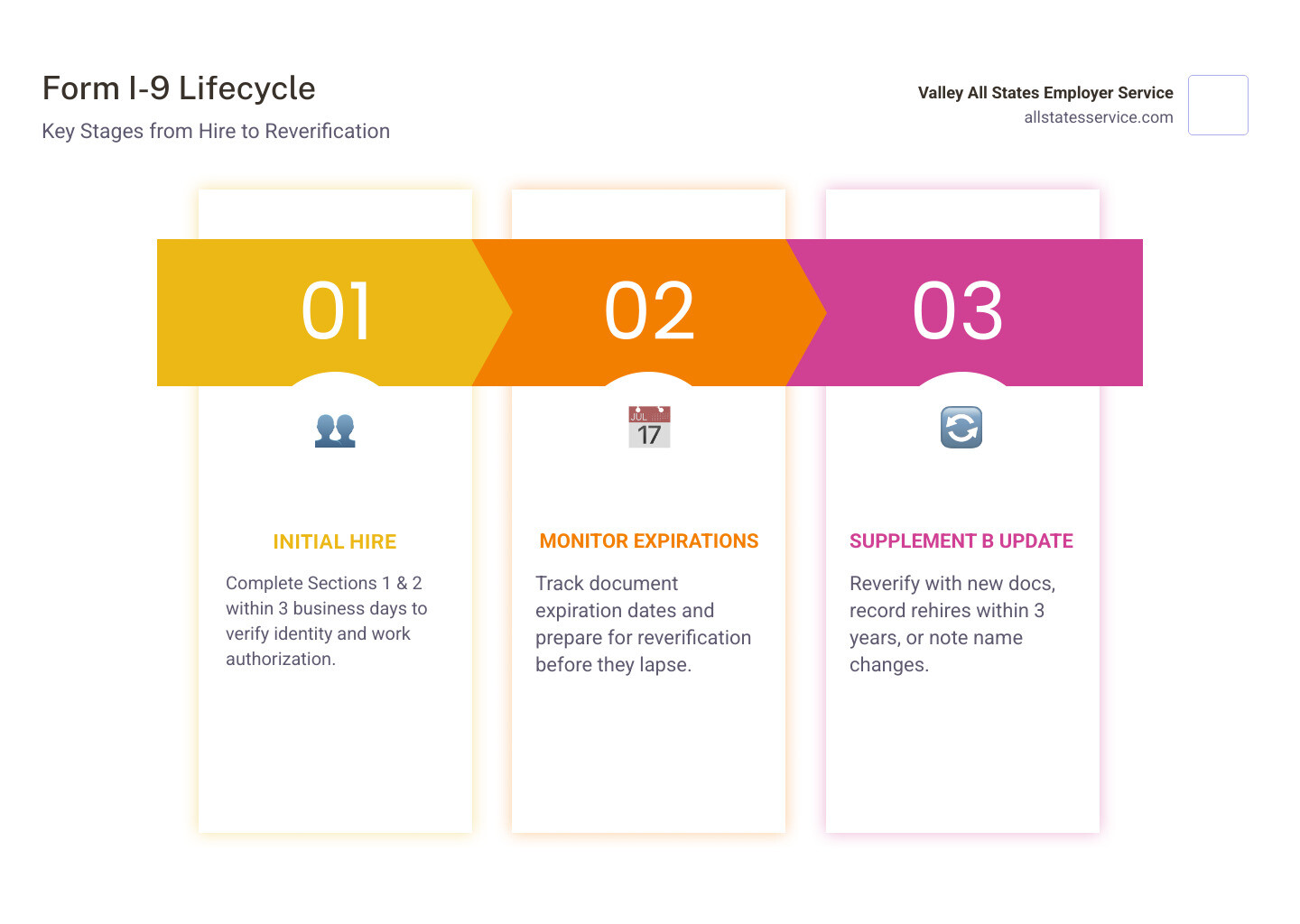
Section 3 of I-9 is the part of Form I-9 used to reverify an employee’s work authorization, document a rehire, or record a legal name change. On the current Form I-9 (edition 08/01/23), this process is handled through Supplement B, Reverification and Rehire, which officially replaces what was formerly called Section 3.
Here’s a quick summary of when you need to act:
- Reverification: An employee’s work authorization is expiring and you must record new documents before that date
- Rehire: A former employee is returning within 3 years of their original Form I-9 completion date
- Name change: An employee has legally changed their name and you want to update the record
You only need to complete Supplement B in one of these three situations. Not every employee requires it.
For a busy HR manager, keeping track of expiration dates, rehire windows, and document rules can feel like a moving target. One missed reverification can expose your business to fines during an ICE audit. Getting this right matters.
This guide walks you through exactly how to handle Supplement B, step by step, so your team stays compliant without the guesswork.
Understanding Section 3 of I-9 and Supplement B
When the federal government updated the Form I-9 in August 2023, they moved the old Section 3 into a standalone page called Supplement B. While the name changed, the purpose remains the same. It is a tool for employers to maintain a continuous record of an employee’s eligibility to work in the United States without having to start a brand-new form every time a status changes.
If you are wondering what is an i9 exactly, it is the federal requirement for every employer to verify the identity and employment authorization of every person they hire. Supplement B is simply the “maintenance” phase of that document.
The current edition (08/01/23) is valid through July 31, 2026. If you have older forms on file where Section 3 was still part of the main page, you do not need to redo them. However, if you need to perform a new reverification or document a rehire today, you must use the new Supplement B. You can find the official guidance on Completing Supplement B, Reverification and Rehires (formerly Section 3) | USCIS to ensure you are using the most up-to-date procedures.
Who is exempt from the section 3 of i9 reverification process?
One of the most common mistakes we see is “over-reverification.” It is important to know that you should not reverify everyone. In fact, reverifying someone who does not require it can sometimes be seen as a form of discrimination.
The following groups of people generally do not need their section 3 of i9 updated for reverification:
- U.S. Citizens and Noncitizen Nationals: Once their identity and authorization are verified in Section 2, you never need to look at them again for reverification purposes.
- Lawful Permanent Residents (LPRs): If an employee presented a “Green Card” (Form I-551) for Section 2, you do not reverify them when that card expires. The status of being a permanent resident does not expire just because the physical card does.
- List B Documents: You never reverify List B identity documents, such as a driver’s license or state ID. If a driver’s license expires after the hire date, the I-9 remains valid.
We only use Supplement B for employees who have temporary work authorization that has a specific expiration date. For example, an employee on an H-1B visa or someone with an Employment Authorization Document (EAD) will eventually need their records updated.
Acceptable documents for section 3 of i9 updates
When it is time to update the section 3 of i9, the employee must present a document that shows they are still allowed to work. They have the right to choose which document to present from the Lists of Acceptable Documents. As an employer, you cannot tell them which one to bring, but you can remind them of their options.
For reverification, employees must present either one document from List A or one document from List C. List B documents are not used here because we are only verifying their authorization to work, not their identity (which was already established during the initial hire).
| Document Category | Examples for Reverification | Key Requirement |
|---|---|---|
| List A | U.S. Passport, Permanent Resident Card (with specific conditions), EAD (Form I-766) | Establishes both identity and authorization. |
| List C | Unrestricted Social Security Card, Birth Certificate, DHS Authorization Document | Establishes employment authorization only. |
You must physically examine the original documents to ensure they appear genuine and relate to the person standing in front of you. If you want to see the full list of what is currently allowed, you can review the [PDF] Form I-9, Employment Eligibility Verification – USCIS.
When to Use Supplement B for Reverification
Timing is everything when it comes to federal compliance. If an employee’s work authorization expires, they are no longer legally allowed to work, and you could face significant penalties for continuing their employment.
We recommend setting up a “tickler” system or using automated HR software to track expiration dates. A good rule of thumb is to provide a 90-day reminder to the employee. This gives them plenty of time to renew their documents with USCIS, as some government processes can take months.
You must complete the reverification in Supplement B no later than the date the employee’s current work authorization expires. If the employee cannot provide proof of continued authorization by that date, you must stop scheduling them for work.
There are a few triggers to watch for:
- The expiration date the employee wrote in Section 1.
- The expiration date of the document you recorded in Section 2.
- A temporary I-551 stamp on a foreign passport or a Refugee Travel Document like the Form I-571, Refugee Travel Document (PDF).
If you need more help with the initial steps of this process, you can find more info about filling out an i-9 as an employer on our blog.
Managing Rehires and Name Changes
Supplement B is not just for expiring visas. It is also your best friend when a former employee comes back to the “nest” or when a current employee gets married and changes their last name.
The Three-Year Rule for Rehires
If you rehire an employee within three years of the date their original Form I-9 was completed, you have a choice. You can either complete a brand-new Form I-9 or you can use Supplement B to update the existing one.
Using Supplement B is usually much faster. To do this, you must:
- Confirm that the original I-9 still relates to the employee.
- Check if their work authorization has expired. If it has, you perform a reverification right there in Supplement B while documenting the rehire.
- If their authorization is still valid, you simply record the rehire date.
If it has been more than three years since the original form was signed, you cannot use Supplement B. You must start a new Form I-9 from scratch. For more details on this specific scenario, check out more info about the i-9 process for rehires.
Documenting Name Changes
While the law does not strictly require you to update the I-9 for a name change, USCIS strongly recommends it. Keeping the name on the I-9 consistent with your payroll records and E-Verify helps maintain “identity assurance.”
If an employee brings you a marriage certificate or a court order showing a legal name change, you can record this in Supplement B. This ensures that if an auditor looks at your files, they won’t be confused by why “Jane Smith” in your payroll is “Jane Doe” on her I-9.
Step-by-Step Instructions for Completing Supplement B
Ready to pick up the pen? Or, more likely, open the PDF? Here is the exact flow for filling out Supplement B correctly.
Step 1: Employee Information
At the top of Supplement B, you must enter the employee’s name exactly as it appears in Section 1 of the original Form I-9. This links the supplement to the correct person. If the employee has had a name change, you will record the new name in the designated “New Name” fields, but the top of the form must match the original record.
Step 2: Date of Rehire (If Applicable)
If you are documenting a rehire, enter the date the employee began (or will begin) work for pay in the “Date of Rehire” block.
Step 3: Recording Documents for Reverification
If the employee’s authorization has expired, this is where you enter the new document details:
- Document Title: (e.g., Employment Authorization Card)
- Document Number: (The unique number on the card)
- Expiration Date: (The new date the authorization ends)
Step 4: The Signature and Attestation
The employer or an authorized representative must sign and date the form. By signing, you are attesting, under penalty of perjury, that you have examined the documents and believe them to be genuine.
The Role of Authorized Representatives
Did you know you don’t have to be the one to sign the form? An employer can designate an “authorized representative” to fill out the I-9 on their behalf. This is common for remote hires. However, be careful, as the employer is still legally liable for any mistakes the representative makes. If you use a notary public as a representative, they are acting as your agent, not in their official capacity as a notary, so they should not use their notary seal on the Form I-9.
Compliance, Retention, and E-Verify Requirements
Completing the form is only half the battle. You also have to keep it for the right amount of time. The government’s retention rules are a bit like a math word problem. You must retain the Form I-9 (including Supplement B) for:
- Three years after the date of hire, OR
- One year after the date employment ends, whichever is later.
We recommend keeping I-9s in a separate folder from general personnel files. This protects employee privacy and makes it much easier to hand over the correct documents if an ICE agent shows up for a surprise audit. For a deeper dive into these rules, see more info about the ultimate guide to form i-9.
E-Verify and Supplement B
If your company participates in E-Verify, you generally do not need to create a new E-Verify case for a reverification. E-Verify is used primarily for new hires. However, if you are rehiring someone and you choose to complete a new Form I-9 instead of using Supplement B, you must run a new E-Verify case.
Also, E-Verify has a “photo match” requirement. If an employee presents a Permanent Resident Card or an EAD for reverification, and you are an E-Verify employer, you must keep a copy of that document in your files.
Frequently Asked Questions about Section 3
Can I use a new Form I-9 instead of Supplement B for rehires?
Yes! You always have the option to complete a new Form I-9 for a rehire, even if they are returning within the three-year window. Some companies prefer this because it keeps their files looking uniform. If you do this, just make sure to keep the old I-9 for the required retention period and link the two records in your filing system so it is clear why there are two forms for one person.
What are the penalties for failing to reverify an employee?
The penalties are no joke. Fines for “paperwork violations” (missing signatures, wrong dates, or failing to reverify) can range from a few hundred to over two thousand dollars per form. If the government finds that you “knowingly” continued to employ someone whose authorization expired, the fines can skyrocket into the tens of thousands of dollars and even lead to criminal charges in extreme cases.
How does E-Verify affect the reverification process?
As we mentioned, E-Verify is mostly for the initial hire. However, if your company is a federal contractor with the FAR E-Verify clause, your rules might be slightly different. In most cases, though, you will use Supplement B to handle the internal paperwork and won’t need to touch the E-Verify portal again for that specific employee unless there is a break in service that requires a new form.
Ready to find out how to make this even easier? Let’s look at how professional help can change your workflow.
Ready to Simplify Your Compliance?
Managing the section 3 of i9 and the new Supplement B requirements doesn’t have to be a source of stress for your HR team. Between tracking expiration dates, verifying complex immigration documents, and meeting strict retention windows, there is a lot of room for error.
At Valley All States Employer Service, we specialize in taking the administrative burden off your shoulders. We provide expert, impartial, and efficient E-Verify and I-9 processing for employers across the United States, including our local clients in Lutherville, MD, and throughout Maryland. Our goal is to minimize errors and ensure your business stays on the right side of federal law.
Whether you are dealing with a surge in rehires or a complicated set of visa renewals, we are here to help. Ready to simplify your compliance? Explore our complete guide to I-9 services. and let us handle the paperwork so you can focus on growing your business.