
I-9 Employee Verification: Essential & Easy 2025
Why I-9 Employee Verification Matters to Every U.S. Employer
I-9 employee verification is the federally mandated process that confirms every new hire’s identity and legal right to work in the United States. Here’s what you need to know:
Quick Facts:
- Required by law for all U.S. employers since November 6, 1986
- Must be completed for every new employee, citizen or noncitizen
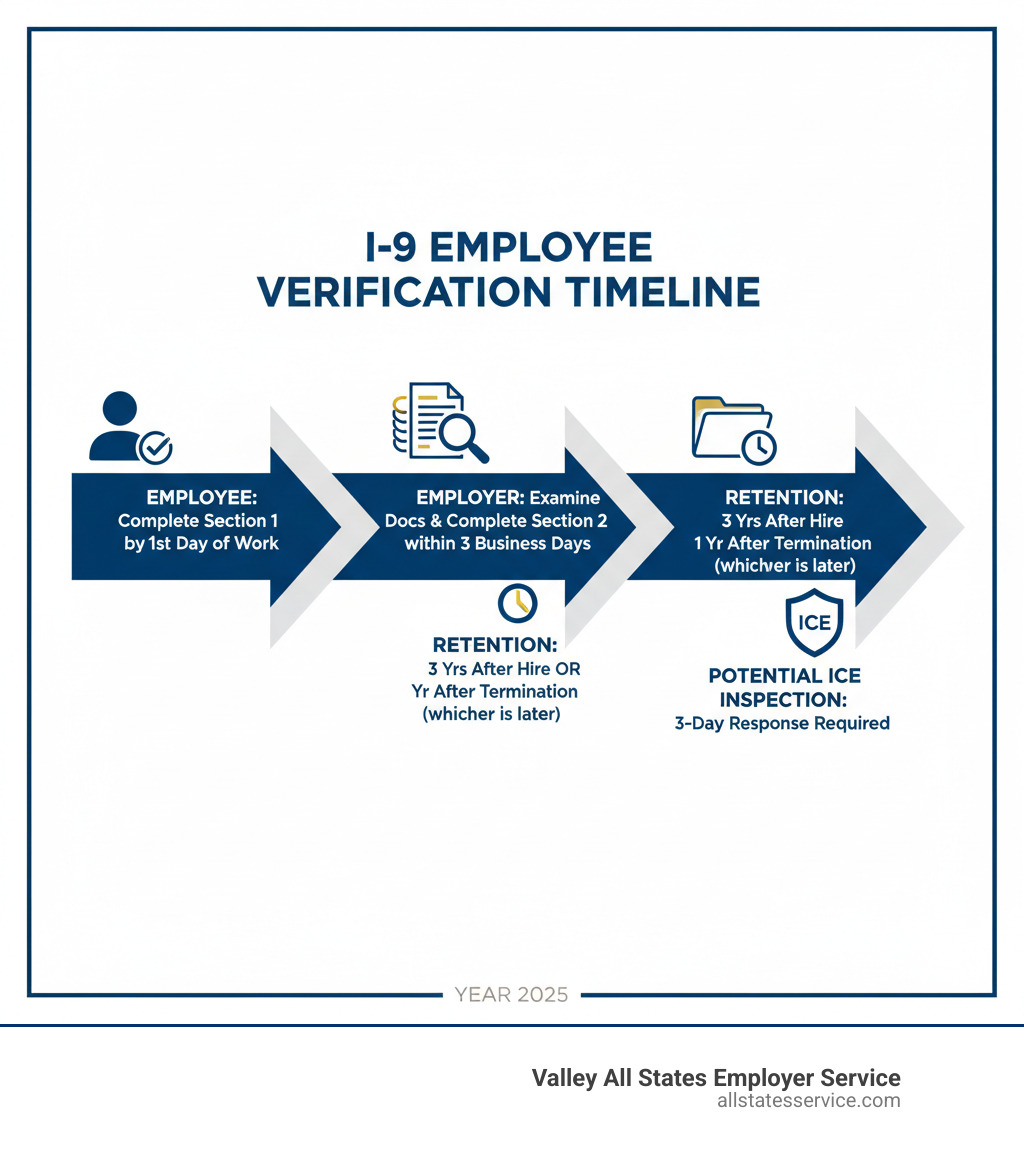
- Section 1: Employee completes by their first day of work
- Section 2: Employer verifies documents within 3 business days
- Retention: Keep forms for 3 years after hire date OR 1 year after termination (whichever is later)
- Penalties: Fines range from hundreds to thousands of dollars per violation
If you’re an HR manager, the I-9 process can feel like a legal minefield. One missed signature, an expired document, or a simple date error can trigger an audit and costly penalties. Federal law requires every employer to complete Form I-9 for each new hire, a process enforced by Immigration and Customs Enforcement (ICE) through surprise inspections.
The stakes are real. Even honest mistakes made during the rush of onboarding can result in fines that add up quickly. Knowingly hiring unauthorized workers can even lead to criminal charges.
But here’s the good news: when you understand the process and follow best practices, I-9 compliance becomes manageable. This guide walks you through every step, from examining documents to storing completed forms securely.
What is Form I-9? The Cornerstone of Lawful Employment
Form I-9, or Employment Eligibility Verification, is the document that stands between you and a potential compliance nightmare. Since the Immigration Reform and Control Act (IRCA) became law in 1986, every U.S. employer must complete this form for every new hire.
The U.S. Citizenship and Immigration Services (USCIS) manages the Form I-9 process. Its mission is to verify that each person you hire is legally authorized to work in the United States by confirming both identity verification and employment authorization.
This isn’t optional paperwork. Whether you’re a large corporation or a small business, if you hire employees, you must complete Form I-9. For a detailed look at the form, check out our guide on What is an I-9?.
Who Must Complete Form I-9?
Both employers and employees have responsibilities in the I-9 employee verification process. You can’t complete it alone.
- Employers: The requirement applies to anyone who recruits, refers for a fee, or hires someone for employment in the U.S. This includes businesses, staffing agencies, and agricultural recruiters.
- Employees: Everyone hired after November 6, 1986, must complete their portion of the form. This includes U.S. citizens, noncitizen nationals, lawful permanent residents, and aliens authorized to work. The process is the same for everyone, ensuring no one is singled out.
The Purpose Behind the Paperwork
Why does this form exist? The goal is to prevent unlawful employment in the United States. By requiring proof of identity and work eligibility, the federal government created a system to keep unauthorized workers out of the workforce.
Think of Form I-9 as your compliance foundation. It proves you’re hiring legally and is your first line of defense during an ICE inspection. This process also levels the playing field, ensuring companies that cut corners by hiring unauthorized workers don’t gain an unfair advantage.
For a comprehensive look at how employment eligibility verification works, explore our Employment Eligibility Verification Complete Guide. Understanding the “why” makes the “how” much easier to manage.
The Step-by-Step I-9 Employee Verification Process
Think of the I-9 employee verification process in three steps. Each has specific timing and responsibilities. When everyone knows their part, the process runs smoothly. Let’s walk through each step so you can feel confident onboarding new team members.

Step 1: Employee Information and Attestation (Section 1)
Section 1 belongs to your new employee. They must complete and sign this part by their first day of employment. This timeline is firm.
Your new hire will provide their personal information, like legal name, address, and date of birth. They must then attest to their citizenship or immigration status by checking one of four boxes: a U.S. citizen, a noncitizen national, a lawful permanent resident, or an alien authorized to work. Depending on their status, they may need to provide an A-Number or USCIS Number.
If an employee needs help, a preparer or translator can assist, but they must also complete and sign the certification section to ensure transparency. For more guidance, employees can review the Form I-9, Employment Eligibility Verification Employee Information Sheet. Our guide on Filling Out an I-9 Employer can also help you manage your responsibilities.
Step 2: Employer Examines Documents and Completes Section 2
Now it’s your turn. You or an authorized representative must complete Section 2 within three business days of the employee’s first day. For jobs lasting less than three days, this must be done on day one.
Your job is to physically examine the original, unexpired documents your employee presents. You must determine if they reasonably appear to be genuine and relate to the person. You are not expected to be a document expert, just to use reasonable judgment.
You cannot tell your employee which documents to bring. They must choose from the Lists of Acceptable Documents. Specifying documents can lead to discrimination claims. After examining the documents, record the title, issuing authority, number, and expiration date in Section 2. Then sign and date the form. For a detailed walkthrough, see our I-9 Section 2 Complete Guide.
For remote employees, the Department of Homeland Security has an alternative procedure for I-9 employee verification. This typically involves a live video call where you examine the documents the employee shows on camera. This procedure must be followed precisely according to DHS guidelines to ensure compliance.
Understanding the Lists of Acceptable Documents (A, B, & C)
The Lists of Acceptable Documents give employees flexibility. List A documents are the all-in-one option, while List B and List C documents work as a pair.
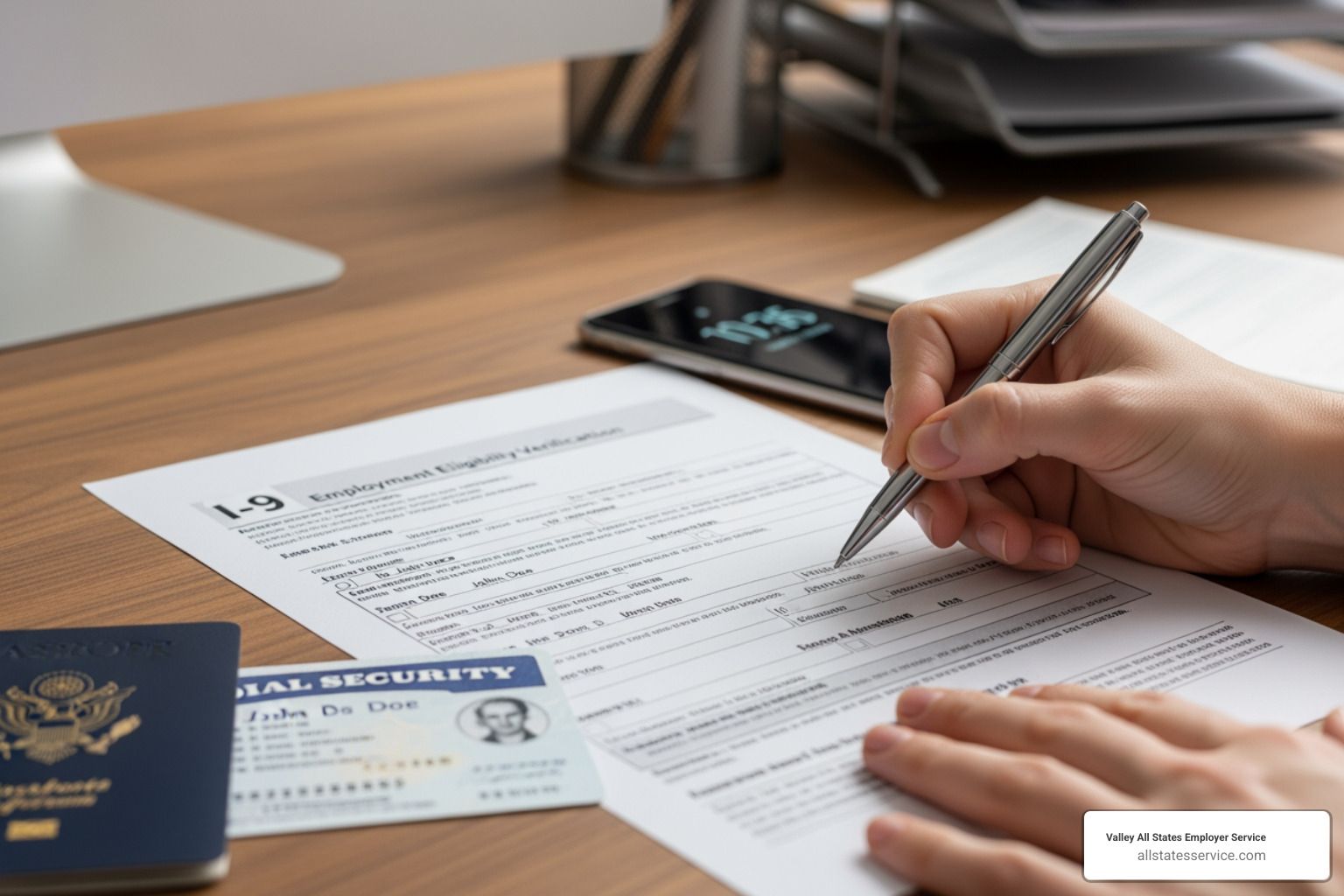
- List A documents establish both identity and employment authorization. Examples include a U.S. Passport, a Permanent Resident Card (Green Card), or an Employment Authorization Document (EAD). If an employee presents one valid List A document, you cannot ask for more.
- List B documents establish identity only. Examples include a driver’s license, state ID card, or school ID with a photo. An employee presenting a List B document must also provide a List C document.
- List C documents establish employment authorization only. Common examples are an unrestricted Social Security card or a birth certificate. An employee presenting a List C document must also provide a List B document.
All documents must be unexpired. The employee chooses which documents to present, not you. For a full breakdown, our I-9 Document Requirements Complete Guide has you covered.
Step 3: Handling Reverification and Rehires with Supplement B
The I-9 employee verification process sometimes continues after the initial hire. Supplement B (formerly Section 3) is used for these situations.
Reverification is necessary when an employee’s work authorization has an expiration date. Before it expires, you must reverify their continued eligibility. Missing this deadline can cause serious compliance issues.
Rehiring an employee within three years of their original Form I-9 completion also involves Supplement B. If their previous authorization is still valid, you can complete Supplement B on their existing form instead of starting over.
Legal name changes also require an update using Supplement B. Stay organized by setting calendar reminders for expiring documents. For more on rehiring, see our article on the I-9 Process for Rehires.
Form I-9 vs. E-Verify: Clearing Up the Confusion
Many employers confuse Form I-9 and E-Verify, but they play distinct roles in I-9 employee verification. While both are crucial for confirming work eligibility, understanding their differences is key.
Think of it this way: Form I-9 is the mandatory roadmap you must complete for every new hire. E-Verify is an optional, super-powered GPS that provides an extra layer of confirmation.
Form I-9 is the paper or electronic form where you document an employee’s identity and work authorization. E-Verify is an internet-based system that takes the I-9 information and compares it to records from the Social Security Administration (SSA) and Department of Homeland Security (DHS). This electronic check helps confirm an employee is authorized to work in the U.S.
Here’s a quick comparison:
| Feature | Form I-9 | E-Verify |
|---|---|---|
| Mandatory/Voluntary | Mandatory for all U.S. employers | Voluntary for most employers, but mandatory for some federal contractors and in some states (not currently for all employers in Maryland) |
| SSN Requirement | Does not require an SSN (unless employee has one and attests to certain statuses) | Requires an SSN for all employees |
| Photo ID (List B) | Does not require a photo on identity documents (List B) | Requires a photo on identity documents (List B) for photo matching |
| Reverification | Must be used to reverify expired employment authorization | MAY NOT be used to reverify expired employment authorization |
| Data Source | Employee-provided documents | Electronically compares I-9 data to SSA and DHS records |
These two systems complement each other but don’t replace one another. Form I-9 is always the starting point. While E-Verify is voluntary for most employers, it offers a powerful tool for improved compliance and greater confidence in your hiring decisions. Understanding how they work together is key to a robust I-9 employee verification strategy.
For a deeper dive, our I-9 E-Verify Ultimate Guide is an excellent resource.
Mastering Compliance and Navigating Remote Hiring
Staying compliant with I-9 employee verification is an ongoing commitment. It requires careful record-keeping and the ability to adapt, especially with a remote workforce. Understanding how to maintain compliance can save you from serious headaches.
Avoiding Costly Mistakes: I-9 Audits and Penalties
Immigration and Customs Enforcement (ICE) can conduct inspections with little warning. When a Notice of Inspection (NOI) arrives, you typically have just three business days to produce all your Forms I-9.
During an audit, inspectors look for two types of problems:
- Technical or procedural failures: Minor slip-ups like a missing date or an unchecked box. You’ll usually get 10 business days to fix these. If not corrected, they can become more serious.
- Substantive violations: These are major issues, like failing to complete a form, not examining documents, or knowingly hiring an unauthorized worker. Financial penalties can range from hundreds to thousands of dollars per violation and are adjusted annually for inflation.
Document fraud carries its own severe consequences, including fines and criminal prosecution. For a full breakdown of potential costs, our I-9 Audit Penalties Complete Guide has the details.
Best Practices for I-9 Employee Verification and Record-Keeping
The best defense against penalties is a good offense. Here are some best practices for I-9 employee verification and record-keeping:
- Retention: Keep completed Forms I-9 for three years after the hire date OR one year after employment ends, whichever is later.
- Secure Storage: Protect this sensitive information in a locked cabinet or a secure electronic system that meets DHS regulations.
- Separate Files: Store Forms I-9 separately from other personnel files. This protects employee privacy and simplifies the audit process.
- Anti-Discrimination: Never ask for specific documents or treat anyone differently based on their national origin or citizenship status. Your job is to accept any valid documents from the acceptable lists.
- Internal Audits: Regularly conduct self-audits to catch and fix errors before an official inspection. This can save you thousands of dollars.
For more on record-keeping, see our I-9 Record Keeping article. The M-274, Handbook for Employers from USCIS is also an invaluable resource.
A Guide to Remote I-9 Employee Verification
Remote work has changed hiring, and the I-9 employee verification process has evolved with it. The Department of Homeland Security has an alternative procedure for examining documents remotely.
Here’s how it works: your new employee sends you copies of their documents, and you then conduct a live video interaction to verify them. During the call, you examine the documents in real time, comparing them to the copies you received. This procedure must be followed exactly as authorized by DHS.
Some employers use authorized representatives to handle the physical document examination on their behalf. You are still responsible for ensuring the process is done correctly. For comprehensive strategies on remote verification, our I-9 Remote Verification Best Practices 2025 article has you covered.
Your Top I-9 Questions Answered
Specific questions about I-9 employee verification often pop up. Here are some of the most common ones, answered simply.
How long do I have to keep a completed Form I-9?
You must keep an employee’s Form I-9 for as long as they work for you. After they leave, the rule is: keep the form for either three years after their hire date OR one year after their employment ends, whichever date is later.
For example, if an employee works for five years, you must keep their I-9 for one year after they leave. If they work for only six months, you must keep it for three years from their start date. Proper I-9 Form Management is key to compliance.
Can I accept a photocopy of a document for Form I-9?
Generally, no. For I-9 employee verification, you must examine the original documents your employee presents. The only exception is a certified copy of a birth certificate. You cannot accept photocopies of driver’s licenses, passports, or other IDs.
While you can make photocopies for your records, you must always hand the originals back to the employee. Physically examining the original document is a cornerstone of the I-9 process. For more details, see our guide on Verifying I-9 Documents.
What if an employee cannot provide the required documents within three days?
If an employee’s document was lost, stolen, or damaged, you can accept a receipt showing they have applied for a replacement. This receipt acts as temporary proof and is typically valid for 90 days. Within that time, the employee must present the actual replacement document.
If an employee cannot provide an acceptable document or a valid receipt within three business days, or fails to present the actual document within 90 days, you must end their employment. This rule protects your business from penalties. For details on what’s acceptable, see our I-9 Document Requirements Complete Guide.
Simplify Your I-9 Compliance
We’ve covered a lot about I-9 employee verification. From understanding its purpose to navigating documentation and avoiding audits, it’s clear that staying on top of this federal requirement is a big job. It’s about protecting your business from costly mistakes and ensuring a legal workforce.
Even with the best intentions, I-9 compliance can be a maze. The risks of getting it wrong are real, with potential for significant fines and damage to your company’s reputation. This is especially true for businesses with high turnover or remote teams.
But you don’t have to go it alone. Valley All States Employer Service is here to help. We make I-9 employee verification simple, accurate, and stress-free.
We specialize in outsourced E-Verify workforce eligibility verification. Think of us as your expert partners, offering impartial and efficient processing. Our goal is to take the administrative burden off your plate, minimize errors, and ensure your business remains fully compliant. This lets you focus on what matters: building your team and growing your business with confidence.
Ready to take the guesswork out of compliance? Explore our Federal I-9 Document services today and find the peace of mind that comes with expert support.