
Streamline onboarding process in 5 Essential steps for Success
Why a Streamlined Onboarding Process Matters More Than Ever
Streamline onboarding process is more than an HR efficiency goal; it’s a strategic imperative. When 81% of new employees feel overwhelmed and 29% decide within a week if a job is right for them, getting onboarding right isn’t optional.
Quick Answer: How to Streamline Your Onboarding Process
To optimize your onboarding workflow effectively:
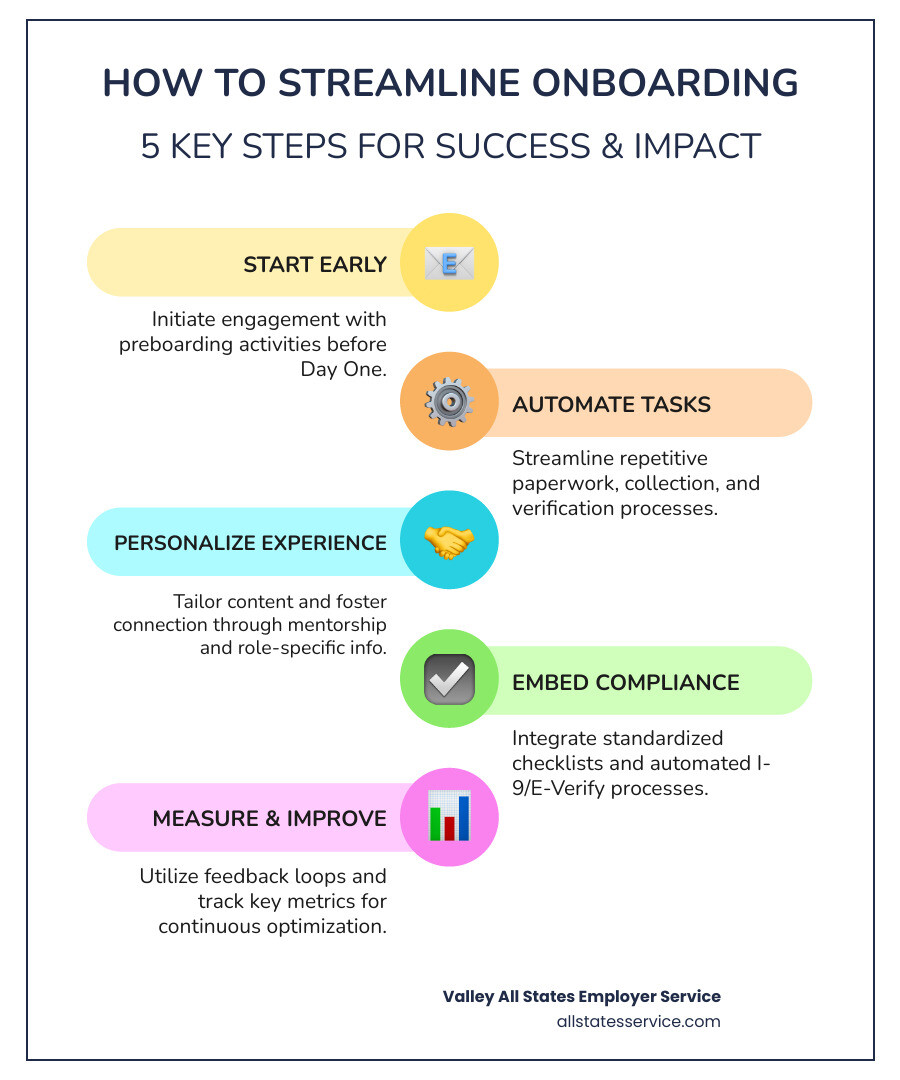
- Start early with preboarding activities before day one
- Automate repetitive tasks like paperwork, document collection, and eligibility verification
- Personalize the experience with role-specific content and mentorship programs
- Embed compliance through standardized checklists and automated I-9/E-Verify processes
- Measure and improve using feedback loops and key metrics like time-to-productivity
The stakes are real. Strong onboarding improves new hire retention by 82% and productivity by over 70%. In contrast, a negative experience makes employees twice as likely to look for new opportunities.
Yet, many HR managers are drowning in compliance paperwork and struggling to create a consistent experience. The result is frustrated new hires, overwhelmed managers, and costly turnover.
The good news is that you don’t need a massive budget to make dramatic improvements. You need a blueprint that balances efficiency with a human touch, helping you build a process that gets new hires productive faster and keeps them engaged longer.
The Foundation: What Is Employee Onboarding and Why It Matters
Employee onboarding is the structured process of integrating a new hire into your organization and culture. It’s more than a first-day orientation; it includes all activities that help an employee transition into their new role. A well-executed process profoundly impacts employee engagement and retention.
Organizations with strong onboarding programs retain more first-year employees, see 62% higher time-to-productivity, and achieve 54% higher employee engagement. When new hires have a positive experience, 51% say they would go ‘above and beyond’ at work. This is critical, as disengaged employees can cost businesses the equivalent of 18% of their annual salary.
We think of onboarding through the lens of the “4 C’s”:
- Compliance: Completing all necessary paperwork and legal forms, like I-9s and W-4s. This is non-negotiable for any business in the United States, including those in Maryland.
- Clarification: Clearly defining the new hire’s role, responsibilities, and performance expectations.
- Culture: Introducing the company’s values, mission, and the “unwritten rules” that foster a sense of belonging.
- Connection: Facilitating relationships with colleagues, managers, and mentors.
Common Challenges in Traditional Onboarding
Despite its importance, traditional onboarding often falls short:
- Paperwork Overload: Mountains of forms and manual data entry create compliance risks.
- Lack of Standardization: Ad-hoc approaches lead to inconsistent experiences across teams.
- Information Overwhelm: Bombarding new hires with too much information too quickly is counterproductive.
- Delayed Access to Resources: A frustrating start for new hires who can’t get their computer or software access.
- Limited Focus on Culture: Processes that ignore culture and connection miss a key opportunity for integration.
- Inconsistent Manager Engagement: Busy managers may lack the tools or time for consistent support.
These challenges lead to significant issues. Employees with a negative onboarding experience are twice as likely to look for other jobs. Conversely, 69% of employees are more likely to stay with a company for three years if they experience great onboarding. The first few weeks are critical, as 29% of employees know within a week if the job is right for them.
The Blueprint: How to Streamline Your Onboarding Process in 5 Key Steps
You know onboarding matters. Now let’s talk about how to make it work. These five steps will help you streamline onboarding process workflows without losing the human touch that makes new hires feel welcomed.
Step 1: Start Before Day One with Strategic Preboarding
Onboarding starts the moment a candidate says “yes” to your job offer, not on their first day. This preboarding period is your chance to reassure them and get a head start on administrative work.

A warm welcome email from their future manager can set the right tone. Share what the first day will look like or introduce the team. Getting IT accounts set up and equipment ready before day one is also non-negotiable. Nothing says “we weren’t prepared for you” like a new hire waiting for computer access.
Sending a welcome kit with company swag is a small gesture that makes people feel like part of the team. The real game-changer, however, is giving new hires access to digital paperwork before they start. Let them complete their I-9, W-4, and policy acknowledgements at their own pace. This addresses New Hire Verification requirements early and frees up their first day for more meaningful activities.
Step 2: How Technology Helps Streamline Your Onboarding Process
Managing onboarding with spreadsheets is a recipe for disaster. Technology is essential for creating a consistent, error-free experience.
Workflow automation is the single biggest improvement most companies can make. Set up systems that automatically trigger tasks, like sending a welcome email or reminding a manager to schedule a check-in.
A centralized HR platform eliminates chaos by keeping all information in one place. This prevents duplicate data entry and ensures no new hire gets lost in the shuffle. Digital document signing is faster, more secure, and legally binding.
AI-powered support bots can field repetitive questions about benefits or policies 24/7, freeing your HR team for more strategic work. Technology advancements such as AI are genuinely changing how we handle these tasks.
For businesses in the United States, automated eligibility verification is critical. An Automated Eligibility Verification System removes the headache of I-9 compliance. At Valley All States Employer Service, our expert E-Verify processing ensures this crucial step is handled accurately, letting your team focus on making real connections.
Step 3: Personalize the Journey and Foster Human Connection
Automation is powerful, but no one wants to feel like a number. The most effective way to streamline onboarding process workflows is to balance efficiency with genuine personalization.
Tailoring content by role should be standard practice. Customize learning paths and training for what a new software engineer or sales manager will actually be doing.
Buddy systems are one of the simplest, most impactful things you can do. Pair each new hire with a peer who can answer small questions and explain the unwritten cultural rules.
Manager check-ins need to be scheduled, not left to chance. Establish a clear cadence for one-on-ones during the first 90 days to discuss integration, challenges, and support needs.
Team introductions and social activities, like informal lunches or virtual coffee breaks, help transform coworkers into colleagues and build strong connections.
Research from Harvard Business School shows that acknowledging employees’ unique strengths during onboarding leads to higher engagement. When new hires feel seen and valued as individuals, they’re far more likely to stick around.
Step 4: Embed Compliance into the Workflow
Compliance is essential, but it doesn’t have to be a burden. Build it seamlessly into your workflow to protect your organization without overwhelming new hires.
Standardized compliance checklists are your safety net, ensuring all regulatory requirements are met consistently for every new hire.
Error-proof I-9 and W-4 forms using digital versions with built-in validation can dramatically reduce mistakes. For employers subject to E-Verify, automated E-Verify processes are invaluable. An integrated system for E-Verify Employment Verification ensures timely, accurate verification. Our expertise at Valley All States Employer Service shines here, as we handle E-Verify with precision.
Ensure your digital onboarding platforms adhere to strict data security protocols to protect sensitive personal information. Finally, make training on Employee Onboarding Compliance accessible and clear, presenting it as part of creating a fair and trustworthy workplace.
Step 5: Create a Culture of Continuous Improvement
A great onboarding process evolves with your company. What works today might not work in six months, so your process needs to keep pace.
Feedback loops are essential. Regularly gather input from new hires, managers, and your HR team through anonymous surveys or one-on-one conversations. Ask what worked, what was confusing, and what could be better.
30-60-90 day surveys provide structured data at critical milestones, gauging satisfaction, support, and role clarity.
Analyzing onboarding data helps you spot patterns. If turnover spikes around the 60-day mark, it signals a problem at that stage. The data tells a story you can act on.
Iterating on the process based on what you learn is where real improvement happens. Small, consistent adjustments often deliver the biggest long-term benefits. The best onboarding programs are never truly finished; they are living systems that adapt with your organization.
The Payoff: Measuring the Success of a Streamlined Onboarding Program
A well-executed streamline onboarding process delivers tangible business results that directly impact your bottom line. Investing in new hires from day one provides a clear return, both in hard numbers and in the energy of a motivated workforce.

Key Benefits of a Streamlined and Automated Onboarding Process
The benefits are compelling, focusing on keeping great people and getting them contributing quickly.
Organizations with strong onboarding improve new hire retention by 82%. This dramatically reduces recruiting costs and team disruption. New hires also get up to speed faster, with strong onboarding boasting 62% higher time-to-productivity.
Employee engagement gets a significant boost, too. Employees with exceptional onboarding are 2.6 times more likely to be “extremely satisfied” with their workplace. Automating compliance tasks like I-9 and E-Verify also minimizes human error, protecting your organization from costly fines.
Finally, a positive onboarding experience creates brand advocates. New hires who feel supported are more likely to share their experiences, improving your reputation as an employer of choice.
Key Metrics to Track When Measuring Onboarding Success
To understand the impact of your efforts, you need to measure what matters.
- Time-to-productivity: How long does it take a new hire to reach full productivity? Track this to see if your improvements are shortening the timeline.
- New hire satisfaction: Use surveys (like a Net Promoter Score) to ask new hires how satisfied they are with their experience.
- 90-day turnover rate: A high percentage of new hires leaving within 90 days is a critical warning sign that your early onboarding has issues.
- First-year retention rate: This provides a comprehensive view of long-term success and whether onboarding sets people up to stay.
- Training completion rates: Low completion rates may indicate your content is overwhelming or inaccessible.
- Manager feedback: Qualitative insights from managers can reveal issues that numbers alone won’t capture.
By focusing on these indicators and incorporating Workforce Management Best Practices, you can ensure your efforts make a real difference.
Frequently Asked Questions About Optimizing Onboarding
We talk to businesses every day about their onboarding challenges. Here are answers to the most common questions.
How can small businesses with limited resources effectively streamline onboarding?
You don’t need a massive budget. Some of the most effective improvements cost almost nothing.
- Use free tools: Google Workspace or Slack can handle communication and document sharing.
- Build reusable checklists: Create templates for each role. This saves time and ensures consistency.
- Start a buddy system: Pairing a new hire with an experienced team member costs nothing and provides immense value through human connection.
- Automate one piece at a time: Start with something simple like digital signatures to free up administrative time.
- Outsource compliance: For critical tasks like I-9 and E-Verify, partnering with a specialized service can be the smartest resource decision. We help small businesses handle New Hire Verification efficiently.
How can we streamline the onboarding process for remote teams?
Remote onboarding requires being more intentional about creating connections and providing resources.
- Create a digital hub: A central place on your intranet or file-sharing system where new hires can find everything they need.
- Use virtual orientation: Combine live video meetings for interaction with pre-recorded content for flexibility.
- Schedule video check-ins: Regular, short video chats with managers and team members combat isolation.
- Foster informal connection: Use digital “water cooler” channels for casual conversations and relationship building.
- Ship equipment early: Get laptops and other gear to new hires before day one, with clear setup instructions and available IT support.
How long should the onboarding process last?
Many companies get this wrong, thinking onboarding is just a week or two. In reality, it’s a much longer process.
The most intensive activities happen in the first 90 days. This is when you handle compliance like Employee Onboarding Compliance and E-Verify Employment Verification, clarify roles, and deliver core training.
However, you should continue structured check-ins and development throughout the first year. Research shows that effective onboarding is critical to employee retention when extended beyond the first few months. Companies that treat onboarding as a marathon, not a sprint, are the ones that see the best results in retention and engagement.
Conclusion: Turn Onboarding from a Chore into a Competitive Advantage
Onboarding has a reputation problem. For too many, it’s a checklist of tasks to get through before “real work” begins. But a streamline onboarding process is about rethinking how we welcome, support, and integrate the people who will shape our organization’s future.
When we start before day one, use technology to eliminate tedious work, personalize the journey, embed compliance, and commit to continuous improvement, we build a competitive advantage.
The numbers tell a compelling story. Organizations that get this right see 82% higher retention rates and 62% faster time-to-productivity. New employees are more satisfied, contribute more, and build careers with you. Those first 90 days set the tone, but extending support throughout the first year creates a foundation for long-term success.
Of course, none of this works if you’re worried about compliance. Employment eligibility verification, I-9 forms, and E-Verify processing are legal requirements that can expose your business to risk. These are not just administrative tasks. That’s where having an expert partner makes all the difference. Valley All States Employer Service takes the complexity out of compliance, ensuring you get it right from day one. We handle the details so you can focus on connecting with your new hires.
Ready to build a compliant, efficient onboarding workflow that transforms new hires into long-term contributors? Learn how an E-Verify Employer Agent can streamline your hiring process and take the administrative burden off your plate. Your future employees, and your bottom line, will thank you.