
Key Features of Modern employee payroll services
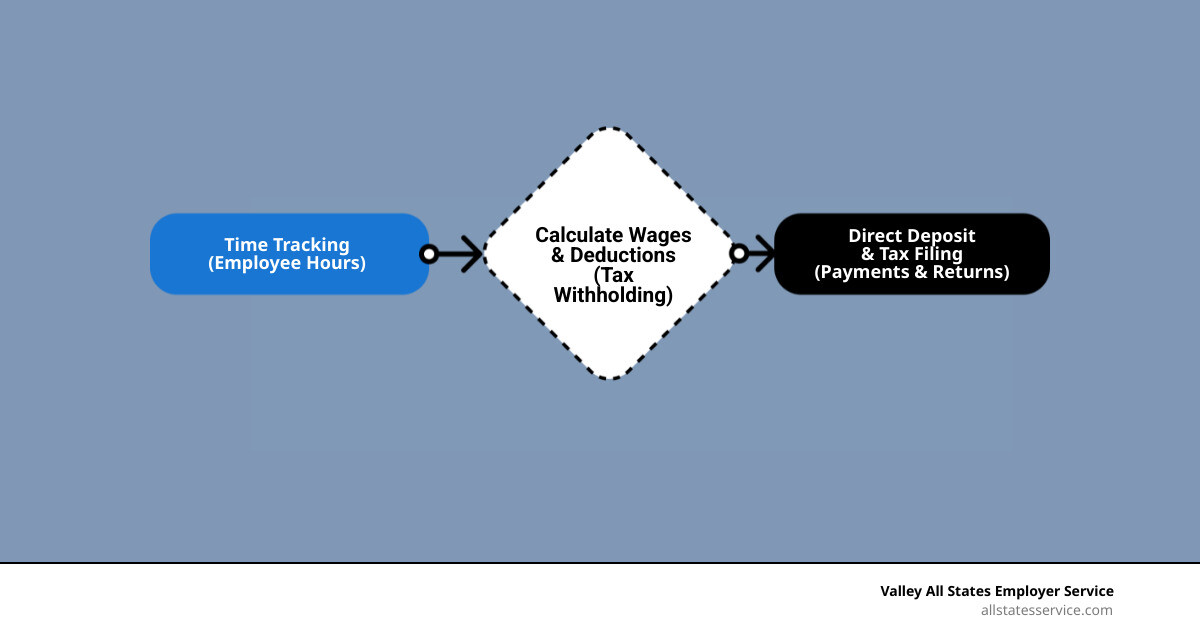
Employee payroll services are third-party solutions that handle everything from calculating wages and withholding taxes to filing returns and issuing direct deposits, so your team can focus on running the business instead of chasing spreadsheets.
Here’s what employee payroll services typically include:
- Automated wage calculations and deductions
- Payroll tax filing (federal, state, and local)
- Direct deposit and payroll card distribution
- Employee self-service portals for pay stubs and W-2s
- Integrated HR tools like onboarding, benefits, and time tracking
- Compliance support for ACA, workers’ comp, and multi-state regulations
If you manage payroll manually right now, you already know the pain. A single missed deadline or miscalculated withholding can mean IRS penalties, unhappy employees, and hours of cleanup. And as your team grows, the complexity only multiplies.
The good news? Modern payroll solutions have made this process dramatically faster. Some businesses report cutting payroll processing time from a full day down to just five minutes. Onboarding new hires, which used to take one to two days, can now be done in under two hours with the right platform.
This guide walks you through how today’s employee payroll services work, how the top providers compare, and how to find the right fit for your business size, industry, and budget.
Relevant articles related to employee payroll services:
- accounting and payroll services for small business
- outsourced payroll solutions for accounting firms
- employment agency outsourced payroll solution
In the past, payroll was often a disconnected series of spreadsheets and paper checks. Today, a web-based-payroll-service acts as the central nervous system for your business operations. Modern platforms go far beyond just cutting checks, they provide a comprehensive suite of tools designed to eliminate manual data entry.
If you want a plain-English overview of how payroll works behind the scenes, the IRS provides a helpful primer on employment taxes. It is a good reference point for understanding why accurate withholding, deposits, and filings matter.

When you look at leading solutions like Paycom, you see a shift toward total automation. These systems are built to handle the heavy lifting of tax calculations and compliance, ensuring that your business remains on the right side of the law without requiring you to become a tax expert.
Most high-quality employee payroll services also offer seamless accounting integrations. Whether you use QuickBooks, Xero, or another financial tool, your payroll data should flow directly into your general ledger. This connectivity reduces errors and provides your accountant with the real-time insights they need to manage your company’s financial health.
Streamlining with Automated employee payroll services
The primary goal of outsourcing-payroll-cloud solutions is to reclaim your time. Automation handles the repetitive tasks that eat up your afternoon, such as calculating local tax withholdings or processing 401(k) deductions.
One of the most effective ways to streamline is through employee self-onboarding. Instead of an HR manager manually typing in social security numbers and bank details, employees enter their own information into a secure portal. This not only saves time but also significantly reduces the risk of typos that lead to failed direct deposits.
The Power of a Single Database System
A common frustration for business owners is having to update employee information in multiple places. If a team member moves, you shouldn’t have to change their address in the payroll system, the benefits portal, and the time-tracking software separately.
A “truly single database” system, a concept championed by providers like Paycom, ensures that data flows seamlessly across all HR functions. When a change is made in one area, it reflects everywhere instantly. This “single source of truth” is essential for choosing the right accounting and payroll services because it prevents the data silos that often lead to compliance errors.
Comparing Top Providers: ADP, Paychex, and Beyond
Choosing between the giants of the industry can feel overwhelming. ADP and Paychex are the two largest names, collectively serving millions of clients worldwide. ADP is known for its massive scale and ability to handle complex, global payroll needs, while Paychex is often praised for its robust payroll-outsourcing-solutions tailored to small and mid-sized enterprises.
| Feature | ADP | Paychex | Paycor | OnPay |
|---|---|---|---|---|
| Best For | Enterprise & Global | Small to Mid-market | Industry-specific | Small Business |
| Ease of Use | Moderate | High | High | Very High |
| Support | 24/7 Phone/Chat | Dedicated Specialist | Online/Phone | Licensed Experts |
| Pricing | Quote-based | Tiered plans | Quote-based | Flat monthly fee |
While these big names offer extensive features, they aren’t the only players in the game. Providers like Paycor have made waves by focusing on specific industries and user experience, famously reducing payroll processing time from an entire day to just five minutes for some of their clients.
Cost-Effective employee payroll services for Small Businesses
For many small business owners, the price tag is a major factor. Some specialized providers claim that their affordable-payroll-services can be 30% to 40% less expensive than the big-name competitors.
Cost isn’t just about the monthly fee, it is also about the value of the service. Many smaller, high-touch providers boast a Net Promoter Score (NPS) around 80, which is significantly higher than the industry average. This suggests that while you might pay less, you often receive more personalized attention and a higher level of reliability.
Scalable Solutions for Growing Teams
As your business grows from five employees to fifty, your needs will change. You will likely need more advanced tools like outsourced solutions for employment agencies or sophisticated self-service portals.
Platforms like OnPay and Paycom are built to scale. They offer features that allow employees to manage their own profiles, view their pay history, and download W-2s without ever bothering the HR department. This scalability ensures that your payroll system remains a help rather than a hindrance as you expand your operations.
Beyond the Paycheck: Integrated HR and Compliance
Modern employee payroll services are rarely just about the money. They are full Human Capital Management (HCM) suites that handle the entire employee lifecycle. This integration is vital for outsourcing benefits administration, as it ensures that insurance premiums are deducted accurately and on time.
When your payroll and benefits are linked, the system automatically handles the complex math of pre-tax and post-tax deductions. This is especially helpful for maintaining ACA compliance and managing workers’ compensation, as the system can track hours and employee counts in real time to ensure you meet all legal requirements. Many businesses find that partnering with employee benefits outsourcing companies provides a level of security that manual tracking simply cannot match.
Industry-Specific Solutions for Healthcare and Manufacturing
Different industries face different hurdles. In healthcare, recruiting and retaining nurses is a top priority, requiring dynamic scheduling and quick onboarding. In manufacturing, tracking labor costs and managing overtime for skilled labor is the name of the game.
Providers like Paycor offer tailored online tours for healthcare and manufacturing, showing how their workflows can be customized for specific sectors. Restaurants, for example, benefit from features like same-day hiring and on-demand pay, which help combat the high turnover rates common in the food service industry. Staying compliant in these high-stakes environments is much easier when you follow a benefits outsourcing compliance guide integrated into your software.
Managing Workforce Eligibility and Tax Filings
One of the most critical aspects of payroll is ensuring that every person on your team is legally eligible to work. This is where E-Verify comes in. By integrating workforce eligibility checks into the onboarding process, you can minimize the risk of federal audits and penalties.
Beyond eligibility, the burden of tax filing is a major reason businesses switch to employee payroll services. A professional service handles:
- Calculating and depositing federal, state, and local taxes.
- Filing quarterly tax returns.
- Distributing W-2 and 1099 forms at year-end.
- Managing multi-state tax liabilities for remote teams.
By unlocking efficiency for your business, you remove the stress of tax deadlines from your plate entirely.
Getting Started with Your New Payroll Provider
Switching to a new provider might seem daunting, but most companies have turned it into a science. The process usually involves three main steps: account setup, data migration, and employee onboarding.
During the setup phase, your new provider will help you transfer your historical payroll data. This is crucial for ensuring that your year-end tax forms are accurate. Many companies, such as Paychex, provide dedicated specialists to walk you through this transition.
Once the data is moved, you can begin employee onboarding. Modern systems allow you to send a “welcome” email to your team, inviting them to set up their own accounts and enter their direct deposit information. This self-service approach is a win-win: it empowers your employees and saves you hours of data entry. To make sure everyone is comfortable, most providers offer training webinars and mobile app access so your team can check their pay stubs on the go.
Frequently Asked Questions about Payroll Outsourcing
How much time can I save with automated payroll?
The time savings are often dramatic. While manual payroll can take a full day of data entry and double-checking, automated systems can reduce the actual “processing” time to about five minutes. Furthermore, Paycor has noted that their onboarding tools can reduce the time it takes to bring on a new hire from two days to less than two hours.
What specific reports do payroll services provide?
You can expect a wide range of reporting tools that cover:
- Payroll tax liability and wage summaries.
- Detailed deduction and contribution reports.
- Vacation and sick leave tracking.
- Workers’ compensation and ACA compliance reports.
- Time and attendance activities.
How do these services handle multi-state compliance?
Top-tier employee payroll services are equipped to handle taxes in all 50 states, as well as U.S. territories like Puerto Rico and the Virgin Islands. They stay up-to-date on changing state regulations, so you don’t have to worry about the specific tax laws in Maryland versus California.
Choosing the Right Partner for Your Business
At Valley All States Employer Service, we understand that payroll is about more than just numbers, it is about people and compliance. While many providers can cut a check, we specialize in the critical “front-end” of the employment lifecycle: E-Verify workforce eligibility verification.
In a landscape where regulations are constantly shifting, having an impartial and efficient partner to manage your E-Verify processing is a strategic advantage. We help businesses in Maryland and across the United States minimize administrative burdens and avoid costly errors.
Ready to simplify your compliance and streamline your workforce management? Our team is here to provide the expert, impartial support your business needs to grow with confidence. Explore our payroll-outsourcing-solutions today and see how we can help you build a more efficient, compliant workplace.