
Not Eligible for Rehire? How to Survive the Verification Process
When “Not Eligible for Rehire” Follows You Into Your Next Job
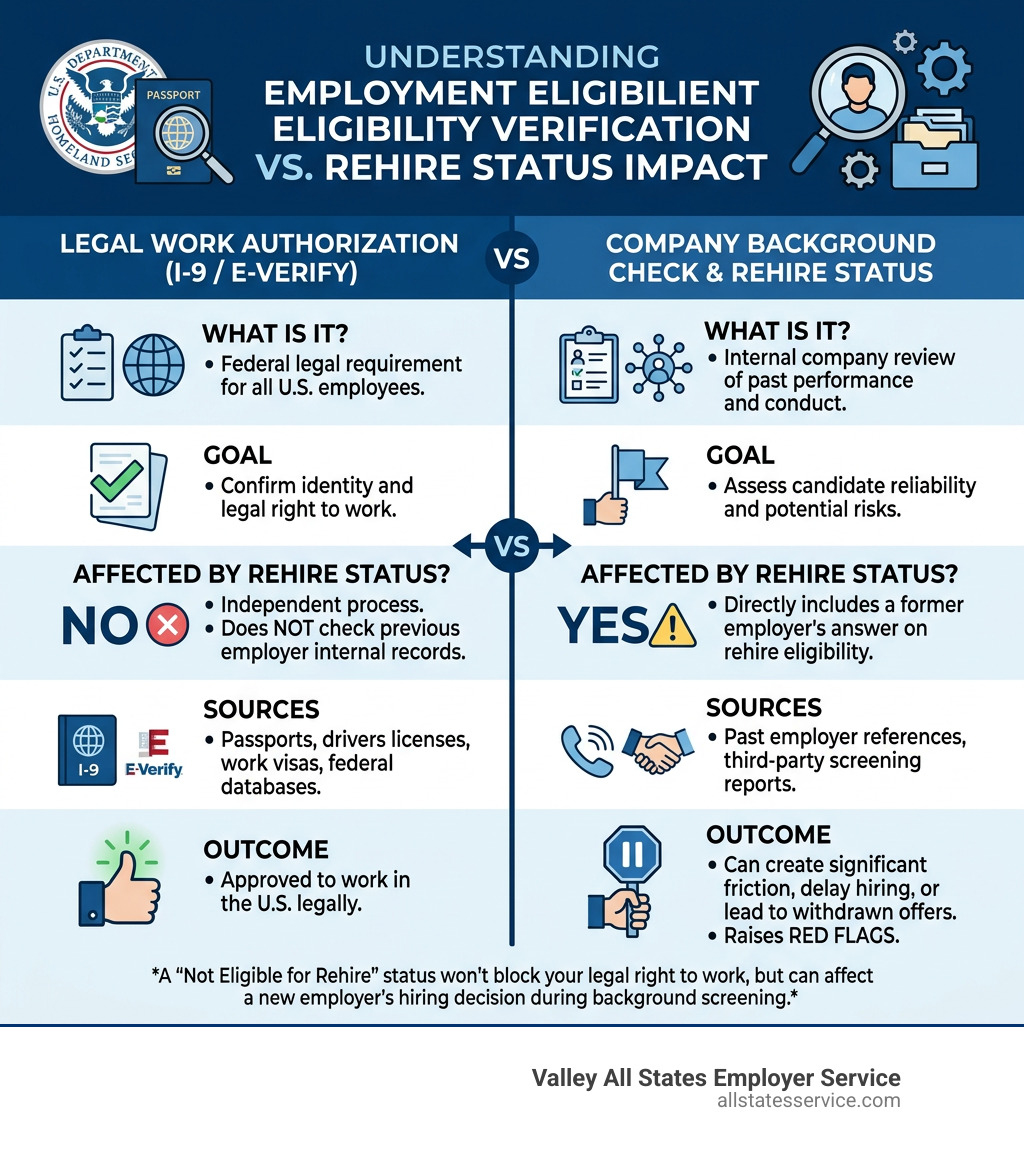
Can being not eligible for rehire hurt employment eligibility verification? Yes, but not in the way most people fear. Here’s the quick answer:
| Concern | Reality |
|---|---|
| Does it affect your legal right to work in the U.S.? | No. Form I-9 and E-Verify only check work authorization, not rehire status. |
| Can it show up in a background check? | Yes. Third-party screeners often ask former employers about rehire eligibility. |
| Will it automatically cost you a job offer? | Not automatically, but it raises red flags that you’ll need to address. |
| Is it permanent? | Usually. Most HR systems retain this status for a decade or more. |
So the short version: a “not eligible for rehire” flag won’t block you legally from working, but it can create real friction during background screening and reference checks with a new employer.
Picture this: you’ve gone through rounds of interviews, impressed the hiring team, and you’re days away from starting a new role. Then the background check comes back. Your former employer was asked one simple question, and they answered “no” to rehire eligibility. Suddenly, your offer is on hold.
This isn’t rare. It happens across industries, from consulting to healthcare to corporate HR. And for busy HR managers processing new hires, discovering a “not eligible for rehire” flag mid-onboarding creates its own compliance headache.
The good news? Knowing how this status works, what it does and doesn’t affect, and how to handle it strategically can make all the difference.
Can being not eligible for rehire hurt employment eligibility verification terms to remember:
- employment eligibility verification
- federal employment eligibility verification form i 9
- i 9 employment eligibility verification form 2025
Understanding the “Not Eligible for Rehire” Designation
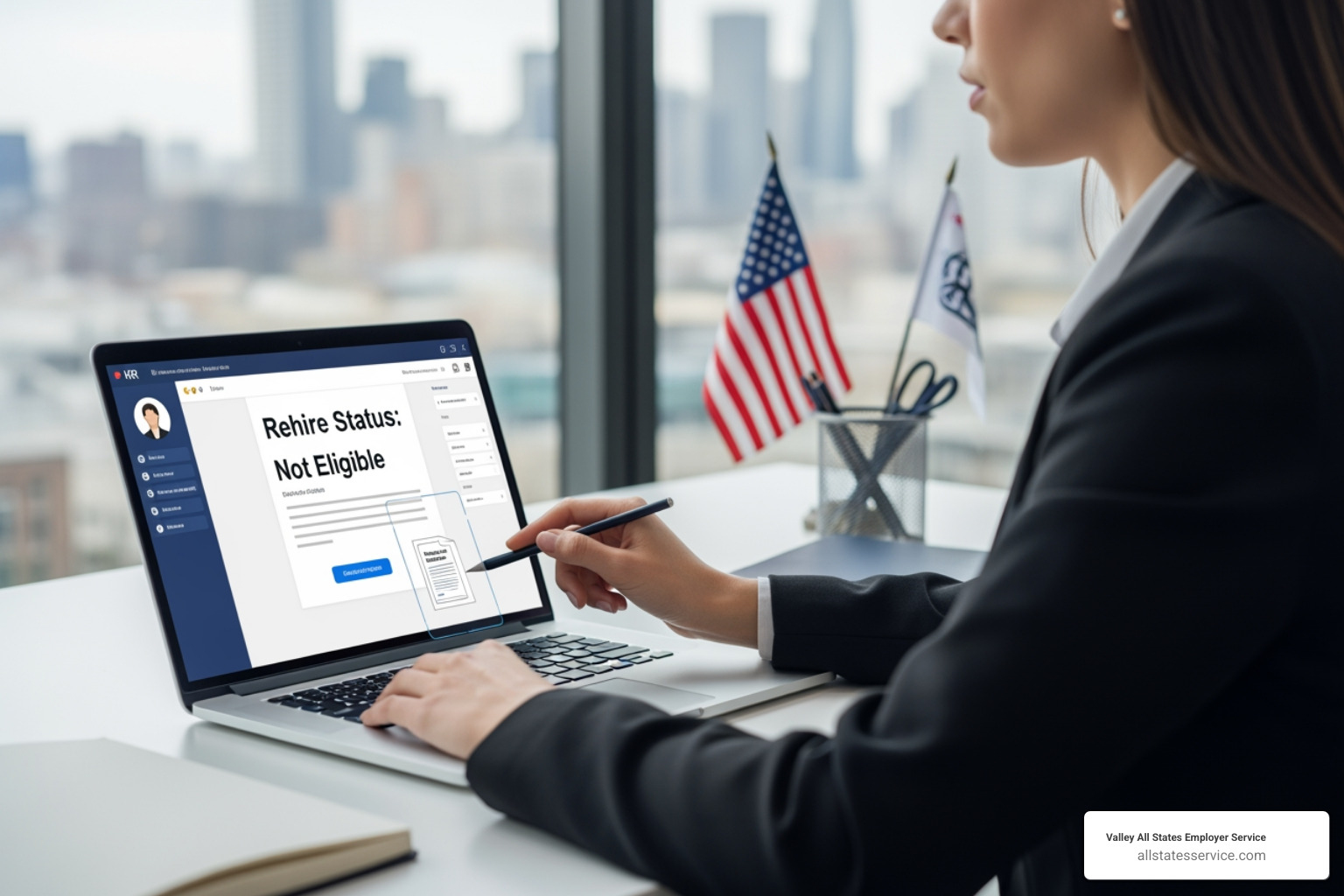
When a company marks a former employee as “not eligible for rehire,” they are essentially putting a digital padlock on that person’s file within their internal HR system. It is a internal policy tool used to manage risk and maintain workplace standards. If you try to apply for a different role at the same company five years later, the system will likely flag your profile immediately.
Employers use this designation to protect themselves. By documenting that an individual should not return, they aim to prevent future performance issues, safety concerns, or legal liabilities. It is a way of saying, “Based on our past experience, this relationship is permanently closed.”
Common reasons for ineligibility
Not every departure results in a “no-rehire” status. Most people who leave on good terms after giving two weeks’ notice are marked as eligible. However, several scenarios can trigger a negative mark:
- Termination for Cause: This includes gross misconduct, theft, workplace violence, or serious policy violations. In these cases, ineligibility is almost always automatic.
- Performance Issues: In high-pressure fields like consulting, being “counseled to leave” because you aren’t meeting targets often leads to an ineligible status.
- Job Abandonment: If you walk off the job or stop showing up without notice, most companies will blacklist you from returning.
- Resignation Without Notice: Even if you were a star employee, quitting with only 13 days of notice instead of 14 can land you on the “do not rehire” list at some strict organizations.
| Termination Type | Typical Rehire Status |
|---|---|
| Voluntary (with notice) | Eligible |
| Layoff / Reduction in Force | Eligible (often preferred) |
| Resignation (no notice) | Often Ineligible |
| For Cause (Misconduct) | Almost Always Ineligible |
To understand how companies set these rules, you can look at rehire eligibility criteria and HR best practices to see the logic behind the “no” vote.
How long does this status last?
In modern HR software, “forever” is often the intended duration. While some companies might reconsider a candidate after a mandatory waiting period, such as six months or a year, many do-not-rehire marks are functionally permanent.
Because HR databases retain records for a decade or more, that “no” can sit in your file long after your former manager has retired. This is particularly important for large corporations where the left hand might not know what the right hand is doing, but the computer system remembers everything. If you are considering returning to a former employer, you might want to check out more info about I-9 compliance for rehires to see how the paperwork side is handled.
Can being not eligible for rehire hurt employment eligibility verification?
This is where the confusion usually starts. We need to distinguish between two different types of “eligibility.”
First, there is legal employment eligibility, which is verified using the Form I-9 and E-Verify. This confirms you are who you say you are and that you have the legal right to work in the United States.
Second, there is company rehire eligibility, which is a private policy decided by your former boss.
Can being not eligible for rehire hurt employment eligibility verification? If we are talking about the legal I-9 process, the answer is no. A former employer cannot “cancel” your work authorization just because they didn’t like your performance. However, if we are talking about the broader “verification” process that happens during a background check, the answer is a resounding yes.
Why being not eligible for rehire might hurt employment eligibility verification in background checks
During a standard background check, a third-party screening company will call your previous employers. They typically verify your job title and dates of employment. However, a very common third question is: “Is this person eligible for rehire?”
If the former employer says “no,” it sends a massive signal to the new employer. They might worry that you were fired for something serious or that you are a “high-risk” hire. In some cases, a negative rehire status can lead to an automatic rejection if the new company has a strict policy against hiring anyone with such a flag. You can find more details on this in our complete guide to employment eligibility verification.
For those worried about how this appears on a report, there is an expert Q&A on handling rehire status that explains how to navigate these disclosures.
How to explain why being not eligible for rehire won’t hurt employment eligibility verification for legal work status
If a recruiter asks you about your rehire status and tries to link it to your legal right to work, you should politely clarify the difference. Your legal work authorization is tied to your citizenship or visa status, not your past job performance.
When a new employer runs an E-Verify check, they are looking for a “work authorized” result from the government. They are not looking at your old HR file from three years ago. For a deeper dive into the technical side, read our E-Verify rehire requirements guide.
The Legal Boundaries of Rehire Status Disclosure
You might wonder, “Is it even legal for them to tell another company I’m not eligible for rehire?” In most U.S. states, the answer is yes. Under “at-will” employment, employers have significant discretion. Many states even have “reference immunity” laws that protect employers from being sued by former employees, as long as the information they share is truthful and not motivated by malice.
However, there are strict prohibited employment policies and practices that employers must follow. They cannot use the “ineligible for rehire” label as a weapon for illegal reasons.
When a “no rehire” mark is unlawful
A “no rehire” status becomes illegal if it is based on discrimination or retaliation. Federal laws like Title VII of the Civil Rights Act and the Americans with Disabilities Act (ADA) protect you from being blacklisted because of your race, religion, sex, age, or disability.
For example, if an employer marks everyone over the age of 50 as “ineligible for rehire” during a layoff while marking younger workers as eligible, that is a violation of the law. You can read the specific language in 42 U.S.C. § 2000e-2 regarding unlawful practices.
Protections against retaliation
It is also illegal for an employer to mark you as ineligible because you exercised your legal rights. This is called retaliation. Common protected activities include:
- Filing an OSHA safety complaint.
- Using your protected leave under the Family and Medical Leave Act (FMLA).
- Reporting workplace harassment or “whistleblowing” on illegal activities.
If you were a whistleblower and suddenly found yourself with a “no rehire” tag, you may have legal grounds to challenge it. Check 29 U.S.C. § 2615 regarding family and medical leave protections for more on how these rights are guarded.
Strategies to Mitigate a Negative Rehire Status
If you know a “not eligible for rehire” status is lurking in your past, don’t panic. Many people have successfully navigated this and landed great jobs. The key is to be proactive rather than waiting for the background check to “catch” you.
We recommend being prepared with a neutral, honest explanation. If you were “counseled to leave” a consulting firm, you might say, “The firm and I agreed that my strengths were better suited for a different type of environment, and I’ve used that feedback to grow in my subsequent roles.” For more on the paperwork side of starting fresh, see our I-9 compliance guide for 2025.
Addressing the status during interviews
Honesty is almost always the best policy, but you should be strategic. If you think the “no rehire” question will come up, bring it up first with the recruiter once a conditional offer is on the table.
Explain the situation without being defensive or blaming your former boss. Take responsibility for what you learned. If you’ve had other jobs since then where you were successful, highlight those as proof of your growth. Practicing this via roleplaying can help you stay calm during the real conversation. You can learn more about mastering I-9 rules and verification to ensure you handle the formal side of hiring with confidence.
Alternative ways to verify your history
If one former employer is giving you a hard time, use other sources to vouch for your character.
- Personal References: Provide contact info for former colleagues or lower-level supervisors who liked your work.
- Performance Reviews: If you have copies of old, positive reviews, keep them handy.
- Letters of Recommendation: A signed letter from a former manager can often outweigh a generic “no” from an HR database.
Having these ready shows that the “ineligible” mark is an outlier, not the whole story. For more on how these systems work together, check our what is an E-Verify verification guide.
Frequently Asked Questions about Rehire Eligibility
Will a “not eligible for rehire” status automatically disqualify me?
No. While it is a red flag, many hiring managers look at the “total person.” If you have a great interview, strong skills, and other positive references, they may choose to overlook one negative mark from a past job. It often comes down to the company’s culture and how much they value “second chances.”
Does “not eligible for rehire” show up on E-Verify?
No, it does not. E-Verify is a government system designed to confirm your identity and legal authorization to work in the U.S. It does not have access to private company HR files or your rehire status. If you are curious about how the system actually works, read what is E-Verify?.
Can I dispute my rehire status with a former employer?
Yes, you can try. You can contact the HR department of your former employer and ask to see your personnel file. If the “ineligible” mark was a mistake (for example, you gave notice but they recorded it as job abandonment), you can provide proof to have it corrected. Some companies even have an internal appeals process. To understand the documents involved in your file, see what is an I-9 form?.
Moving Forward with Confidence
At Valley All States Employer Service, we see the “not eligible for rehire” issue from both sides. We help employers navigate the complexities of workforce compliance, ensuring that every hire is legally authorized and that the onboarding process is as smooth as possible.
We know that a single mark in an old HR file shouldn’t define your entire career. By staying informed about your rights and being prepared to explain your history, you can move past old hurdles and build a professional reputation that lasts.
If you are an employer looking to streamline your compliance or a professional wanting to ensure your team is following best practices, we are here to help. Our expert, impartial E-Verify processing minimizes errors and takes the administrative burden off your shoulders.
Ready to simplify your workforce eligibility verification? Let’s get your team compliant today.