
What the OPT EAD Card Process Looks Like (And Why It Matters)
The ead card opt process is one of the most time-sensitive steps an international student faces after graduation, and one of the most important compliance checkpoints for HR teams onboarding new hires.
Here’s a quick overview of what you need to know:
| Stage | Key Detail |
|---|---|
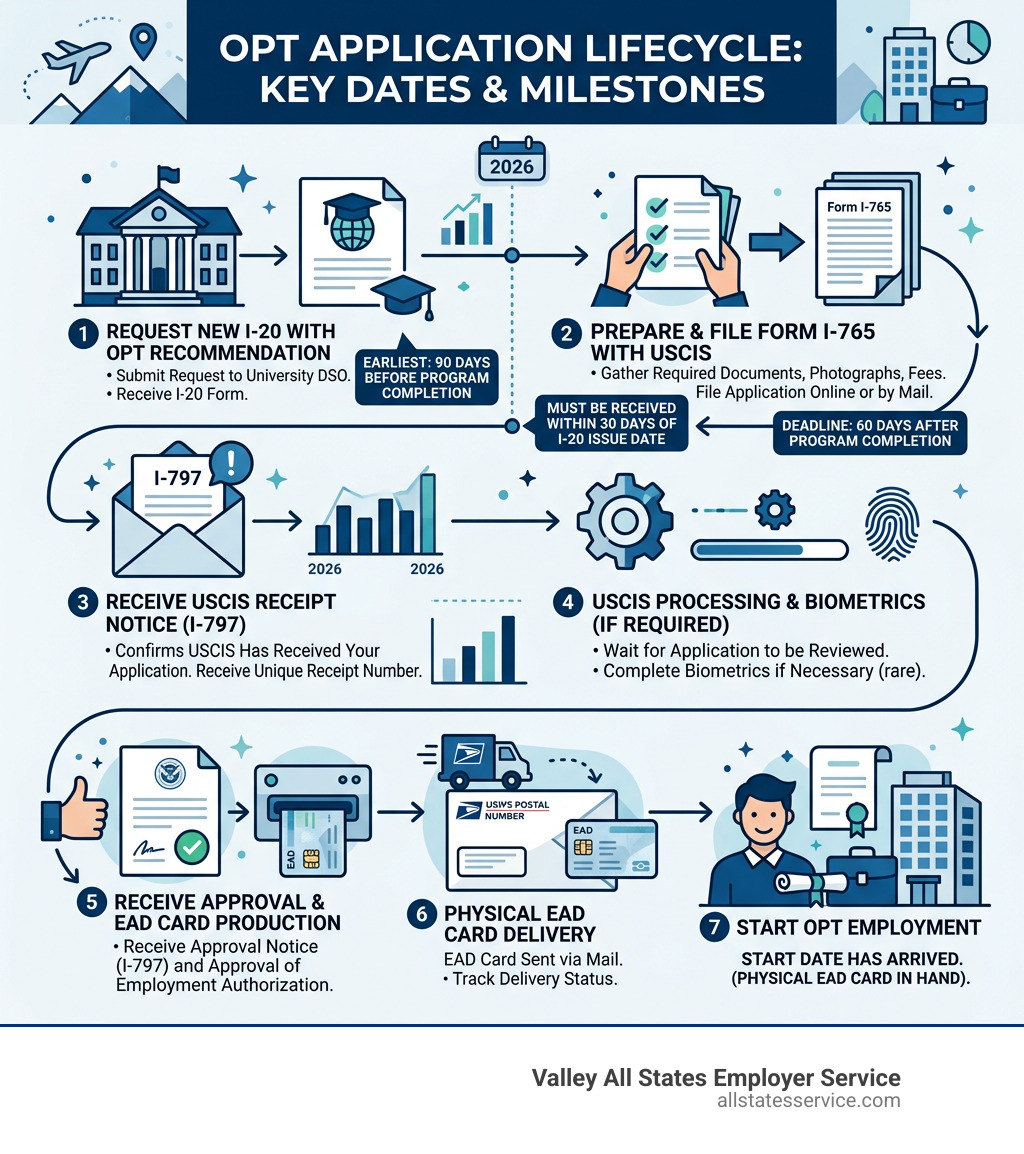
| Apply for OPT | No earlier than 90 days before, no later than 60 days after program completion |
| USCIS processing | Average around 100 days (30 business days with Premium Processing) |
| EAD card delivery | Typically 2 to 3 weeks after approval |
| Start working | Only after physical EAD card is in hand and start date has arrived |
| Unemployment limit | Maximum 90 days during the 12-month OPT period |
| Minimum work hours | At least 20 hours per week to maintain valid status |
For F-1 students finishing their degree, the EAD card is the physical document that makes legal employment possible. Without it, no work can begin, regardless of approval status online.
For HR managers, this matters too. You cannot complete Form I-9 verification for an OPT employee without their physical EAD card in hand. Delays happen, cards get lost, and timelines shift. Knowing how the process works protects your team from compliance gaps.
This guide walks through every stage, from application to arrival to troubleshooting, so both students and employers know exactly what to expect.
Understanding the Basics of OPT and EAD
To navigate international student employment, we first need to define the terms. OPT stands for Optional Practical Training. It is a form of temporary employment authorization that allows F-1 students to gain practical experience directly related to their major field of study. For most students, this provides up to 12 months of work authorization per higher degree level, whether that is a Bachelor’s, Master’s, or PhD.
The physical proof of this authorization is the Employment Authorization Document (EAD). You might hear it called a “work permit” or a “plastic card,” but in the eyes of the law, it is a List A document. This means it establishes both identity and employment authorization for the purpose of acceptable-i-9-documents.
While you are on OPT, you technically remain in F-1 status. Your school’s Designated School Official (DSO) still maintains your SEVIS record, but your primary “status” is defined by your employment. This document is not employer-specific, which gives you the flexibility to change jobs or work for multiple employers, provided every role relates to your degree.
Eligibility and the Application Timeline
Timing is everything when it comes to the ead card opt application. USCIS is very strict about when they will accept your paperwork. If you file too early or too late, your application will be rejected, and you could lose your chance to work in the U.S. entirely.
The “90/60 Rule” is your golden guide. You can apply for post-completion OPT no earlier than 90 days before your program completion date. Conversely, you must apply no later than 60 days after your program completion date, which is your “grace period.”
It is vital to understand that your “program completion date” is usually the day you finish your academic requirements, not necessarily the day of your graduation ceremony. For PhD students, this date can be more flexible depending on thesis defense timelines, but for most, it is the end of the final semester.
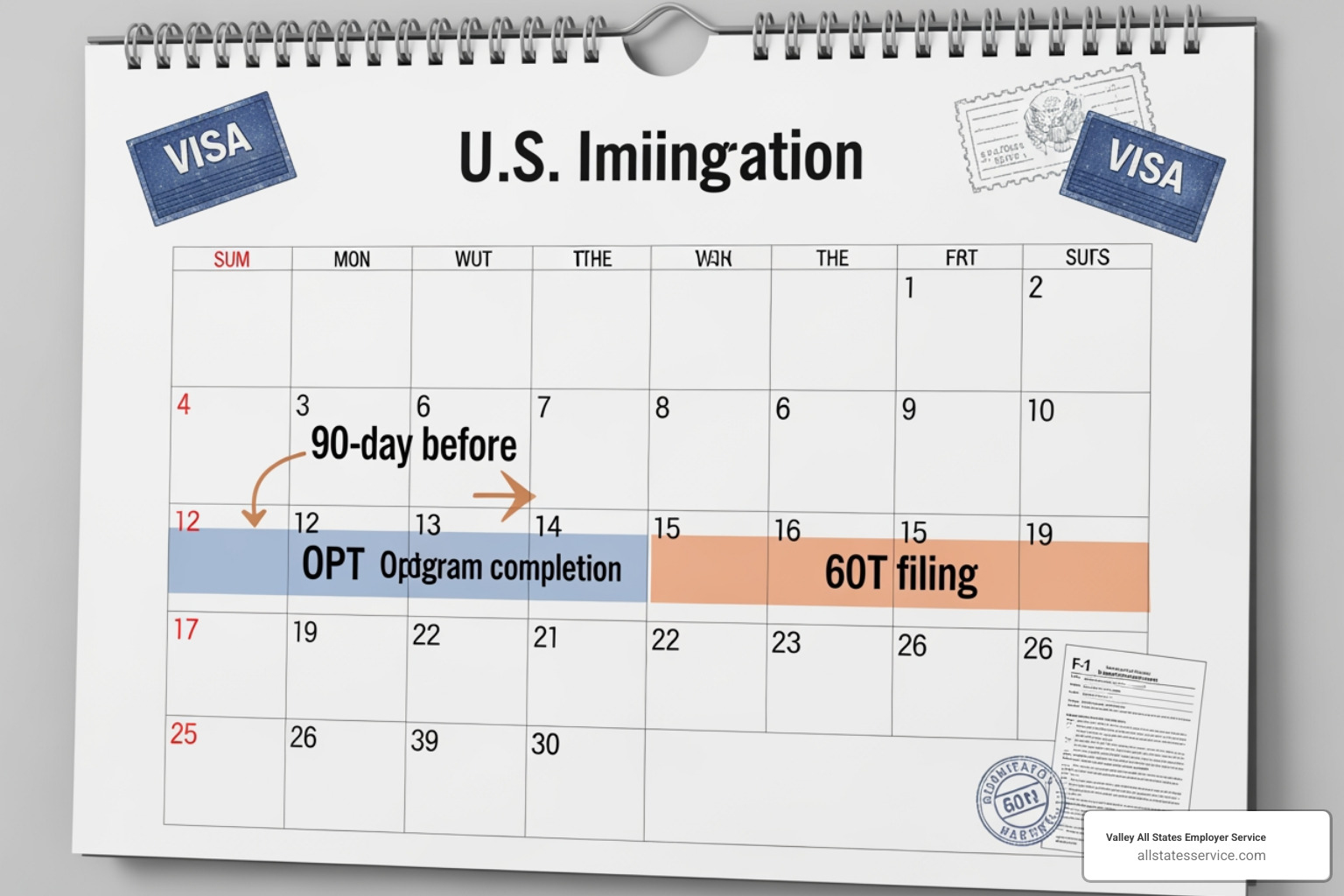
When you are preparing your start date, you cannot change it once the application is mailed or submitted online. Many students wonder, “what-i-9-documents-do-i-need” to prove they are eligible to apply. Primarily, you need a new Form I-20 from your school that specifically recommends OPT. Without this recommendation on page two of your I-20, USCIS will deny your request immediately.
Step-by-Step Guide to Getting Your EAD Card OPT
Applying for your ead card opt has become significantly easier thanks to the USCIS online filing system. While paper applications are still allowed, we highly recommend filing online to avoid mail delays and to get an instant receipt notice.
The first step is to create an account with USCIS. This portal allows you to upload documents, pay the filing fee via credit card or ACH transfer, and track your case status in real time. You will be filing Form I-765, which is the official Application for Employment Authorization.
For employers, this form is the precursor to the i-9-section-2-acceptable-documents process. Once the student has the card, the employer will use the information on the card, such as the USCIS number and the expiration date, to complete the I-9 verification.
Required Documents for Your EAD Card OPT
When you sit down to file your I-765, have your digital “packet” ready. Accuracy is key here. Even a small typo can lead to a Request for Evidence (RFE) or a denial. You will need:
- A copy of your passport identity page.
- Your electronic I-94 printout showing your most recent entry into the U.S.
- The new Form I-20 with the OPT recommendation (make sure you have signed it!).
- Two identical passport-style photos taken within the last 30 days.
- Copies of any previous EAD cards you may have had.
When taking your photos, ensure they are on a plain white background with no glasses. A helpful tip from our experience is to lightly write your name and I-94 number on the back of the photos if you are mailing a paper application, just in case they get separated from your file.
Managing Delays in EAD Card OPT Arrival
If you have a job offer starting soon and your application is still pending, you might feel a bit of panic. Standard processing times can hover around 100 days, though some students see approvals in as little as 40 to 60 days.
To take the guesswork out of the timeline, you can opt for Premium Processing. By filing Form I-907 and paying a fee of $1,685 (as of late 2024), USCIS guarantees action on your case within 30 business days. “Action” means they will either approve, deny, or issue an RFE.
| Feature | Regular Processing | Premium Processing |
|---|---|---|
| USCIS Fee | $410 (online) / $470 (mail) | Base fee + $1,685 |
| Timeline | ~2 to 4 months | 30 business days |
| Best For | Students applying 90 days early | Students with immediate job offers |
Tracking Arrival and Delivery Timelines
Once your status changes to “Approved” in your USCIS account, the wait for the physical ead card opt begins. Generally, it takes about one week for the card to be produced and another week for it to arrive in your mailbox.
You should receive a Form I-797 Approval Notice in the mail first. While this is a great sign, the approval notice itself is not a valid document for starting work. You must wait for the plastic card.
To keep tabs on your delivery, we strongly recommend signing up for USPS Informed Delivery. This free service sends you a digital preview of your mail and provides tracking numbers for packages, including your EAD. You can also look up your case status online to see if a tracking number has been assigned to your card.
Troubleshooting Non-Delivery and Employment Rules
What happens if your card is “delivered” but you can’t find it? Or what if your 90-day unemployment clock is ticking and the card is nowhere to be found?
First, let’s look at the rules. During your 12-month OPT period, you are allowed a maximum of 90 days of unemployment. This clock starts on the “Start Date” printed on your EAD card, not the day you graduated. To stop the clock, you must work at least 20 hours per week in a role related to your major. This can be paid, unpaid, an internship, or even self-employment.
If your card goes missing, USCIS offers an inquiry into non-delivery. However, be warned: if the USPS tracking says the card was delivered, USCIS will rarely take responsibility. They will likely tell you to file for a replacement card and pay the fee all over again.
What to Do if Your Card is Lost or Never Received
If your card is truly lost, you must act quickly. You will need to file a new Form I-765 for a “Replacement” card. This involves paying the filing fee again and submitting a new set of documents.
There is a small silver lining for employment. According to Form I-9 Employment Eligibility Verification rules, if you are applying for a replacement of a lost, stolen, or damaged document, the receipt notice for the replacement application can sometimes be used as a “receipt” for I-9 purposes. This allows you to work for a temporary period (usually 90 days) while you wait for the new card to arrive. However, this only applies to replacements, not initial applications.
Frequently Asked Questions about OPT EAD
Can I start working before my physical EAD card arrives?
No. This is a hard rule. You must have the physical ead card opt in your hand, and the start date on the card must have arrived before you can begin any work. Even if you can see the “Approved” status online, working without the card is a violation of your F-1 status and can lead to serious immigration consequences.
Do I need a Social Security Number to begin my OPT employment?
Technically, you can start working without the physical SSN card if you have “applied for” it, but most employers will want to see the number for payroll purposes as soon as possible. You can actually request an SSN directly on your Form I-765 application. If you do this, the SSA will usually mail your card within two weeks of your OPT approval. If you didn’t request it on the form, you must wait until you have your EAD and then visit a Social Security office in person.
How do I report changes to my employer or address while on OPT?
You are legally required to report any change of address or change in employment within 10 days. Most schools use a portal (like M-Passport or a similar SEVP portal) for this. Failing to report employment can result in your SEVIS record automatically terminating if the system thinks you have exceeded your 90 days of unemployment.
Staying Compliant with Valley All States Employer Service
Navigating the ead card opt process is a journey that requires patience and precision. For students, it is the bridge to a professional career in the United States. For employers, it is a vital part of maintaining a legal and compliant workforce.
At Valley All States Employer Service, we specialize in making this transition seamless for businesses. We provide outsourced E-Verify workforce eligibility verification to ensure that every hire, including those on OPT, is processed correctly and efficiently. By partnering with us, you minimize the risk of administrative errors and take the burden of compliance off your HR team’s shoulders.
The complexities of I-9 documentation and E-Verify don’t have to be a headache. Whether you are onboarding your first OPT student or managing a large international team, we are here to help. Ready to simplify compliance? Contact our team today.