
Why the 2025 New I-9 Form Matters for Your Business
The 2025 new I-9 form is here, and if you’re responsible for hiring in the United States, you need to know what’s changed. The U.S. Citizenship and Immigration Services (USCIS) released a revised Form I-9 dated 01/20/25, valid through May 31, 2027. This isn’t just another paperwork update. With penalties for violations now ranging from $2,861 per paperwork error to $28,619 per unauthorized worker for repeat offenses, getting this right matters more than ever.
Quick Facts About the 2025 New I-9 Form:
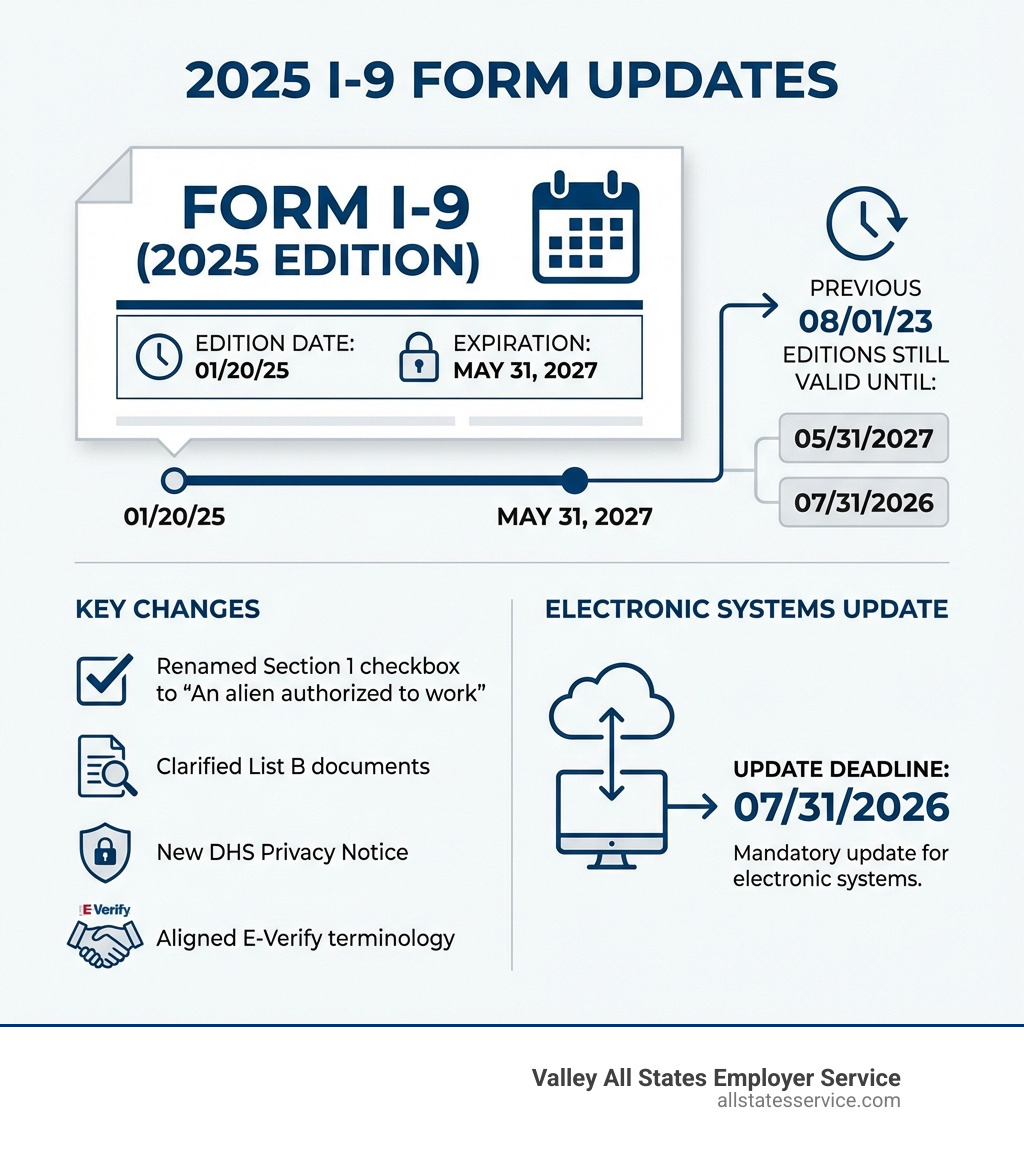
- Edition Date: 01/20/25
- Expiration Date: May 31, 2027
- Previous Editions Still Valid: Yes, 08/01/23 editions remain valid until their expiration dates (05/31/2027 or 07/31/2026)
- Electronic System Update Deadline: July 31, 2026
- Key Changes: Renamed Section 1 checkbox, clarified List B documents, updated instructions with new DHS Privacy Notice, aligned E-Verify terminology
Here’s what makes this update different. Immigration and Customs Enforcement (ICE) has ramped up worksite enforcement actions, and they’re using AI tools to flag discrepancies. Even minor clerical errors can trigger audits and steep fines. Industries like hospitality, agriculture, and manufacturing face particular scrutiny.
The good news? The changes to the form are relatively minor. The bad news? The stakes for getting it wrong have never been higher. Every U.S. employer must complete Form I-9 for every person hired after November 6, 1986. That’s federal law. No exceptions.
Whether you’re updating your onboarding packets or training your HR team, understanding the 2025 new I-9 form is essential. This guide breaks down exactly what you need to know, from the specific changes in the latest edition to proven strategies for staying compliant in an environment of heightened enforcement.
Find more about 2025 new i 9 form:
What’s New? Unpacking the 2025 New I-9 Form
The U.S. Citizenship and Immigration Services (USCIS) has rolled out a new edition of Form I-9, Employment Eligibility Verification. This latest version carries an edition date of 01/20/25 and is valid through May 31, 2027. This isn’t a complete overhaul, but rather a set of refinements designed to clarify instructions and align with current terminology. We know how crucial it is to stay on top of these updates.
Employers should be aware that while the new form is available, previous editions of Form I-9 are not immediately obsolete. The 08/01/23 editions, for instance, remain valid until their respective expiration dates of 05/31/2027 and 07/31/2026. This staggered approach gives us some breathing room, but know which forms to use and when.
For those using electronic systems for I-9 management, there’s a specific deadline to keep in mind. You’ll need to update your electronic systems with the latest Form I-9 expiration dates, specifically the 05/31/2027 date, by July 31, 2026. Missing this update could lead to using an expired form, which is a compliance headache we all want to avoid.
Key Changes in the 01/20/25 Edition
Let’s explore the specifics of what’s new in the 01/20/25 edition of Form I-9. The changes are largely about clarity and consistency, aiming to make the process smoother for both employees and employers.
First, you’ll notice some streamlined instructions and a slightly more condensed layout. The goal here is to make the form easier to steer. A notable change in Section 1 is the renaming of the checkbox for certain non-citizens to “An alien authorized to work.” This aligns terminology across various immigration forms and systems, including E-Verify.
Additionally, two List B document descriptions have been clarified in the instructions. These subtle adjustments help reduce ambiguity when employees present their identity documents. The instructions also include updated statutory language and a new DHS Privacy Notice, ensuring transparency about how personal information is handled. Finally, E-Verify terminology now aligns with the “alien authorized to work” label in case creation screens, providing a more cohesive experience for employers using the system.
Are Previous I-9 Forms Still Valid?
Yes, they are! It’s a common misconception that a new form immediately invalidates all previous versions. Thankfully, that’s not the case with the 2025 new I-9 form. Employers can continue to use previous editions of Form I-9, specifically those with an 08/01/23 edition date, until their printed expiration dates. One version of the 08/01/23 form is valid until 05/31/2027, and another until 07/31/2026.
This means you don’t necessarily have to discard all your existing forms right away. However, it’s a best practice to start transitioning to the newest edition as soon as it’s practical. Updating your onboarding packets with the latest 01/20/25 edition ensures you’re always using the most current version and helps prevent future compliance issues. While there isn’t a strict “sunset date” requiring immediate cessation of older, valid forms, proactive adoption of the new form is always a good strategy for maintaining impeccable compliance.
Mastering the Form: A Section-by-Section Guide
Understanding each part of Form I-9 is crucial for accurate completion and compliance. The form is a shared responsibility between the employee and the employer, each with specific tasks and timelines. Let’s break down the different sections and supplements.
Section 1: Employee Information and Attestation
This is where the employee steps in. Section 1 is designed for the new hire to provide their personal information and attest to their employment authorization status. It’s their responsibility to complete and sign this section no later than their first day of employment. However, it’s important to remember they should not complete it before accepting a job offer.
For employees who need assistance completing Section 1, there’s a dedicated part for a preparer and/or translator. If someone helps the employee, that individual must complete and sign Supplement A, the Preparer and/or Translator Certification. This ensures transparency and accountability in the process. Employees must accurately choose one of the four options attesting to their citizenship or immigration status, which determines their eligibility to work in the United States.
Section 2: Employer Review and Verification
Once Section 1 is complete, the ball is in the employer’s court. As the employer or an authorized representative, you must complete and sign Section 2 within three business days after the employee’s first day of employment. This section involves examining the documents presented by the employee to establish their identity and employment authorization.
You have two main options for document examination:
- Physical Examination: This is the traditional method, where you physically inspect the original documents presented by the employee. You must ensure they appear genuine and relate to the person presenting them.
- Remote Examination (Alternative Procedure): The Department of Homeland Security (DHS) has authorized an alternative procedure for document examination, particularly beneficial for remote hires. This allows employers enrolled in E-Verify to remotely examine documents via live video interaction. If you use this method, you must indicate it by checking the appropriate box in Section 2.
You cannot specify which documents an employee must present. They choose from the Lists of Acceptable Documents. You can find the official Form I-9 and its instructions directly from USCIS. Get the official Form I-9 here.
Supplements and Reverification
Form I-9 also includes supplements to address specific scenarios.
- Supplement B (Reverification and Rehire): This is used when an employee’s work authorization expires and needs reverification, if an employee is rehired within three years of the date the original Form I-9 was completed, or if the employee provides proof of a legal name change. It’s crucial to complete this section accurately to maintain ongoing compliance. When reverifying, employees can present any acceptable List A or List C document to show continued employment authorization.
These supplements are integral to maintaining a complete and accurate Form I-9 record throughout an employee’s tenure.
Employer Obligations: Compliance, Retention, and Penalties
As an employer, the responsibility for Form I-9 compliance rests squarely on your shoulders. Federal law mandates that every employer verify the identity and employment authorization of all new hires. This means completing, retaining, and making Forms I-9 available for inspection. Failing to comply can lead to significant consequences, especially with intensified enforcement efforts.
I-9 Retention and Inspection Rules
Proper retention of Form I-9 is just as important as accurate completion. Employers must retain each completed Form I-9 for a specific period: either three years after the date of hire, or one year after the date the employee’s employment is terminated, whichever is later. This ensures that you have the necessary documentation should an audit occur.
It’s a best practice to store completed I-9s separately from personnel files to protect employee privacy. These forms must be readily available for inspection by authorized U.S. government officials from agencies such as DHS, the Department of Labor, and the Department of Justice. Being organized and prepared for inspection is a key part of our commitment to employer services.
The High Cost of Non-Compliance: Understanding the 2025 Penalties
The landscape of I-9 compliance has become increasingly stringent. In 2025, penalties for I-9 violations have seen a significant increase, underscoring the importance of meticulous adherence to regulations. We’re talking about serious financial repercussions.
For paperwork errors, employers can face fines starting from $2,861 per infraction. If an employer is found to have hired or continued to employ unauthorized workers, the penalties escalate dramatically, reaching up to $28,619 per unauthorized worker for repeat offenses. These figures highlight the severe financial risk associated with non-compliance.
What’s driving this intensified enforcement? Immigration and Customs Enforcement (ICE) has resumed aggressive worksite enforcement actions, including unannounced raids and audits. Furthermore, USCIS is deploying advanced analytics and AI tools to flag I-9 discrepancies, meaning even minor clerical errors can trigger an audit. Beyond the monetary fines, non-compliance can lead to operational disruption, reputational damage, and increased scrutiny, especially for businesses in high-risk sectors like hospitality, agriculture, and manufacturing. It’s a wake-up call for all employers to audit their I-9 processes and ensure they are watertight.
Best Practices for Bulletproof I-9 Compliance
Navigating Form I-9 requirements doesn’t have to be a minefield. By implementing robust best practices, we can help ensure your business maintains bulletproof compliance, minimizes errors, and avoids costly penalties. It’s all about being proactive and leveraging the right tools.
Conducting Internal I-9 Audits
One of the most effective ways to ensure compliance is to regularly conduct internal I-9 audits. Think of it as a health check for your I-9 processes. These reviews help you identify and correct errors before a government audit brings them to light. When you find an error, document the correction process thoroughly. This proactive approach not only helps you prepare for potential government audits but also demonstrates a good faith effort to comply with federal regulations. We recommend using self-audit checklists to ensure no detail is overlooked.
Leveraging Technology for the 2025 New I-9 Form
Technology is your ally in I-9 compliance. Electronic I-9 systems offer a streamlined approach to managing the verification process. These systems often come with built-in error-checking features that catch common mistakes in real-time, significantly reducing the likelihood of paperwork errors. Automated reminders can alert you to expiring work authorizations, ensuring timely reverification.
Furthermore, integrating with E-Verify, the official web-based system that allows enrolled employers to confirm the eligibility of their employees to work in the United States, adds another layer of verification. Secure electronic storage solutions also ensure that your I-9 forms are retained correctly and are easily accessible for inspection. As Valley All States Employer Service, we understand the power of automated eligibility verification systems to minimize administrative burden and maximize accuracy. You can learn more about the official E-Verify program.
Handling Remote Hires and Virtual Verification
Remote work is here to stay, and the 2025 new I-9 form acknowledges this reality. The DHS has provided alternative procedures for document examination, particularly for remote hires. For E-Verify enrolled employers, this means you can perform remote document inspection via live video interaction. This flexibility is a game-changer for businesses with distributed workforces.
When using this alternative procedure, it’s crucial to document the remote inspection process carefully. This includes noting the date of the live video interaction and how the documents were examined. If you’re not using the alternative procedure, or if you’re not enrolled in E-Verify, you’ll need to designate an authorized representative to physically examine the documents. This could be a notary public, a trusted third party, or even a colleague in the employee’s location. The USCIS I-9 Central is an excellent resource for detailed guidance on these procedures. USCIS I-9 Central is a key resource.
Frequently Asked Questions about the 2025 I-9 Form
We encounter many questions from employers regarding Form I-9, and with the 2025 new I-9 form, some common concerns are resurfacing. Let’s tackle a few of them head-on.
Where do I file the completed 2025 new I-9 form?
This is a common question, and the answer might surprise some: you do not file Form I-9 with USCIS or any other government agency. The completed Form I-9 must be retained by the employer. It’s an on-site retention document. Whether you choose paper or electronic storage, the key is to keep it safe and readily available for inspection by authorized government officials. Think of it as a record-keeping obligation, not a filing requirement.
Can I ask an employee to show a specific document, like a Green Card?
Absolutely not. This is a critical point regarding anti-discrimination practices. Federal law explicitly states that employers cannot ask employees for specific documents, such as a Green Card or a U.S. Passport. Employees have the right to choose which acceptable documents from List A, or a combination of List B and List C documents, they wish to present to establish their identity and employment authorization.
Prohibited employer actions include:
- Requesting specific forms of documentation.
- Refusing to accept a document that reasonably appears to be genuine and relates to the employee.
- Treating employees differently based on their citizenship, immigration status, or national origin.
- Asking for more documents than required.
Respecting an employee’s choice of documents is not just a best practice; it’s a legal requirement to avoid discrimination.
What happens if an employee’s work authorization expires?
If an employee’s work authorization document has an expiration date, you are responsible for reverifying their employment eligibility before that date. This is where Supplement B, Reverification and Rehire, comes into play. The employee must present new documentation from either List A or List C to demonstrate their continued authorization to work in the United States. It’s crucial to initiate this reverification process in a timely manner to ensure there’s no gap in their authorization. Failing to reverify can lead to serious compliance issues, similar to hiring an unauthorized worker.
Conclusion: Stay Ahead of I-9 Compliance
The 2025 new I-9 form represents a crucial update in the ongoing effort to ensure employment eligibility verification. While the changes are subtle, the stakes for compliance have never been higher. Proactive compliance, accurate completion, and meticulous record-keeping are your best defense against the escalating penalties and intensified enforcement actions.
We understand that navigating these complexities can be daunting. That’s why at Valley All States Employer Service, we specialize in providing outsourced E-Verify workforce eligibility verification. Our expert, impartial, and efficient E-Verify processing minimizes errors and administrative burden, allowing you to focus on what you do best – running your business.
Don’t let I-9 compliance become a source of stress or risk for your organization. Review your HR processes, train your staff on the new form, and consider leveraging technology to streamline your efforts. Ready to simplify your hiring and ensure peace of mind? Streamline your hiring with an automated eligibility verification system.