
The Post-Pandemic Puzzle of Remote I-9s
I-9 verification for remote employees 2022 marked a critical turning point in employment compliance. As temporary COVID-19 flexibilities began winding down, HR teams faced mounting pressure to understand rapidly changing rules while keeping their remote hiring processes compliant.
Quick Answer for 2022 Remote I-9 Verification:
- May 1 – October 31, 2022: DHS extended temporary flexibility for remote document inspection
- Temporary rules allowed: Email, fax, or video conference verification for remote-only employees
- Required notation: “COVID-19” in Form I-9 Additional Information field
- Critical deadline: Physical re-examination required within 3 business days when normal operations resumed
The pandemic forced millions of workers remote virtually overnight. What started as emergency flexibility became a years-long juggling act of extensions, deadlines, and policy changes. As one immigration attorney noted during this period, the temporary policy had been a “lifesaver during an uncertain time, allowing employers to onboard employees quickly and safely.”
But here’s where it gets tricky. Those 2022 rules were just temporary patches on a system built for in-person verification. The real story is what happened next.
By July 2023, those COVID-19 flexibilities expired completely. Employers who had been relying on temporary remote verification suddenly faced a hard deadline of August 30, 2023, to physically re-examine all documents for employees hired under the temporary rules.
However, this wasn’t the end of remote I-9 verification. Instead, it marked the beginning of a permanent, structured approach. Starting August 1, 2023, qualified employers enrolled in E-Verify gained access to a new DHS-authorized alternative procedure for remote document examination.
The shift from emergency flexibility to permanent policy represents more than just regulatory housekeeping. It reflects how fundamentally the workplace has changed and how employment verification must adapt to serve both compliance needs and practical realities.
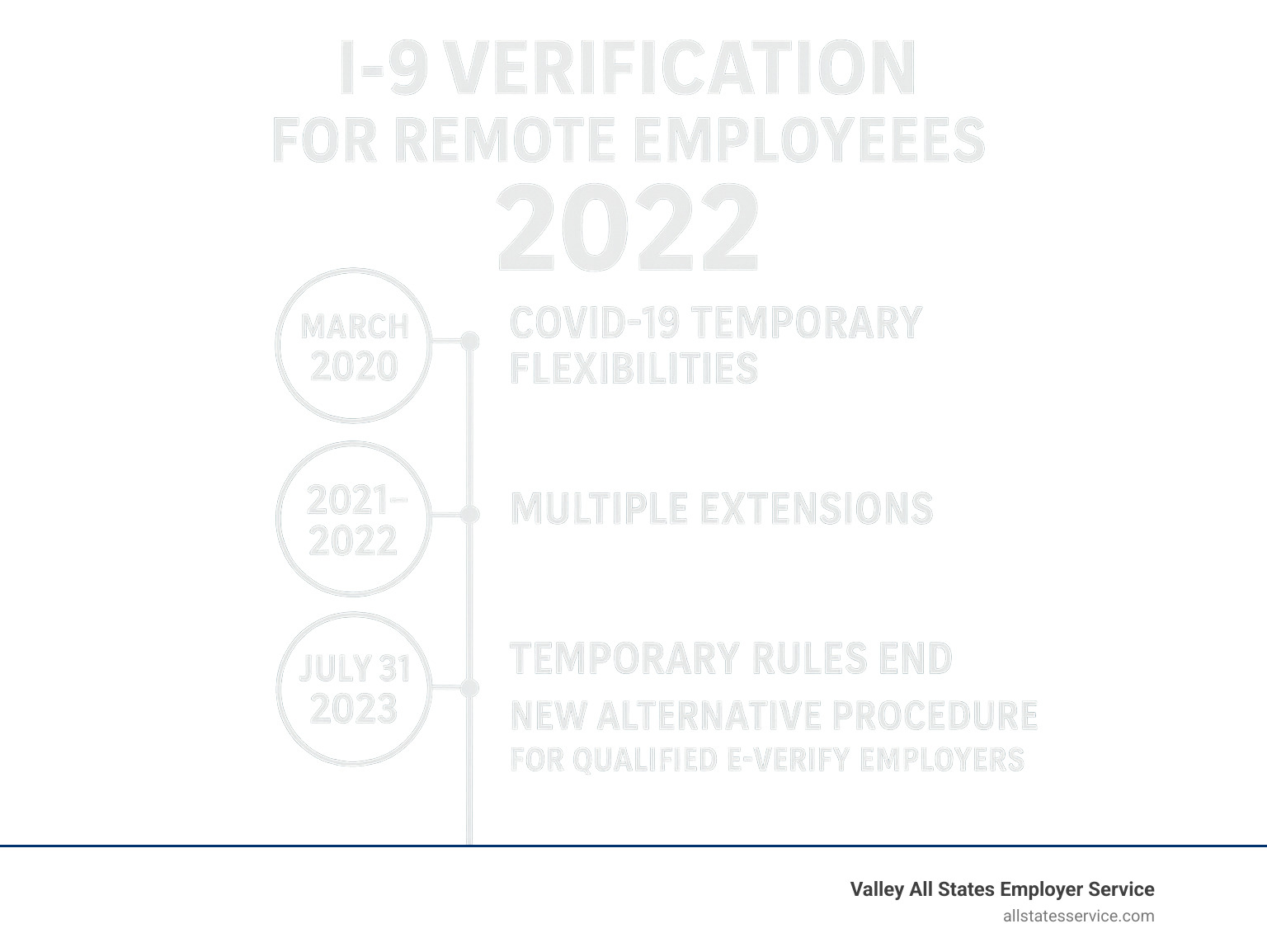
The Era of Flexibility: COVID-19 Rules and Extensions
The I-9 verification process went through a roller coaster of changes during the pandemic years. What started as emergency measures became a complex web of extensions and deadlines that kept HR professionals on their toes for nearly three years.
A Look Back at I-9 Verification for Remote Employees 2022
The year 2022 was all about extensions and uncertainty. I-9 verification for remote employees 2022 continued under the same temporary COVID-19 flexibilities that had been keeping remote hiring afloat since March 2020. But by this point, what felt temporary was starting to feel permanent.
In May 2022, the Department of Homeland Security threw employers another lifeline. They extended the Form I-9 requirement flexibility through October 31, 2022, giving businesses breathing room to continue their remote operations without the headache of in-person document verification.
During this period, employers could still inspect I-9 documents remotely through video calls, fax, or email. The key was documenting everything properly. You had to write “COVID-19” in the Additional Information field of Section 2 on the Form I-9. This little notation was your paper trail showing you followed the temporary rules correctly.
The process felt straightforward enough, but there was always that nagging reminder that this wasn’t forever. Every employee hired under these flexible rules would eventually need an in-person physical inspection once normal operations resumed. For detailed guidance on these extensions, the DHS extends Form I-9 requirement flexibility announcement laid out all the specifics.
The Sunset of Temporary Rules
All good things must come to an end, and the COVID-19 flexibilities were no exception. July 31, 2023 marked the official expiration date for the temporary remote verification rules that had sustained remote hiring for over three years.
This expiration created a critical deadline that caught some employers off guard. Every single employee whose documents were initially reviewed remotely had to undergo physical re-verification by August 30, 2023. No extensions, no exceptions.
The re-verification process required employers to physically examine the actual documents that had previously been viewed through screens or scanned copies. Once completed, you needed to update the Form I-9 by adding “documents physically examined” along with the inspection date in the Additional Information field of Section 2 or Section 3.
Missing this deadline wasn’t just an administrative oversight. It could trigger compliance issues and potential penalties that made the temporary convenience seem not so convenient after all. Smart employers used this transition period to conduct thorough reviews of their I-9 processes. For those looking to ensure their documentation was bulletproof, resources like I-9 Self Audits became invaluable tools for identifying and fixing potential problems before they became costly mistakes.
The New Permanent Solution for Remote I-9 Verification
With the end of temporary measures came a permanent, modern solution for employers who qualify. Understanding this new process is crucial for maintaining compliance.
What is the New Alternative Procedure?
When the COVID-19 flexibilities sunset in July 2023, remote I-9 verification didn’t disappear. It got a major upgrade. Starting August 1, 2023, the DHS introduced a permanent remote option through their Final Rule, creating a structured path forward for qualifying employers.
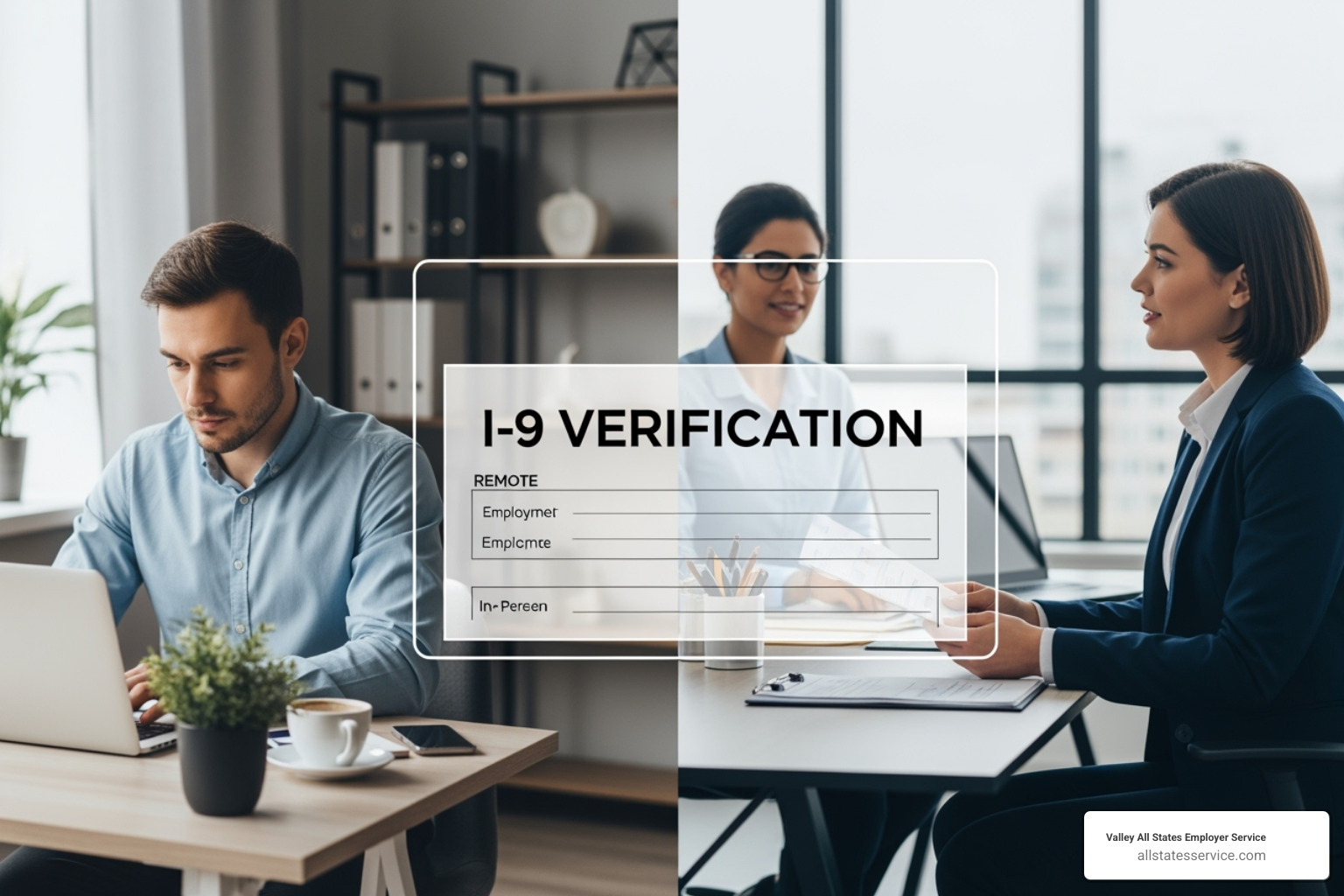
This new alternative procedure is a complete game-changer for distributed workforces. Unlike the emergency measures that defined i-9 verification for remote employees 2022, this permanent solution is built to last. No more scrambling for extensions or worrying about expiration dates.
Here’s the catch: you need to be a qualified employer. That means being enrolled in E-Verify and maintaining good standing across all your hiring sites. Think of E-Verify as your ticket to the remote verification club. Without it, you’re back to in-person document checks or authorized representatives.
The E-Verify integration makes perfect sense when you think about it. The government wants employers who’ve already proven they can handle electronic employment verification before adding remote I-9 capabilities to the mix. For employers already using both systems, this creates a streamlined, centralized approach to compliance. You can learn more about how these systems work together through More info about E-Verify and I-9.
The benefits are substantial: streamlined onboarding for remote hires, reduced administrative burden, and the ability to maintain consistent processes across multiple locations. It’s the modern solution remote-first companies have been waiting for.
Is the New Remote Process Mandatory?
The short answer? No. The new remote verification process is an optional alternative, not a requirement. You can stick with traditional in-person verification if that works better for your business model.
But here’s where it gets interesting. If you choose to offer remote verification, you need to be consistent about it. You can’t cherry-pick which employees get the remote option based on personal preferences or assumptions. That’s a fast track to discrimination claims.
The good news is you have flexibility in how you apply this consistency. You could offer remote verification to all remote employees while requiring in-person checks for office-based staff. Or you might use remote verification for all employees at certain E-Verify sites while using traditional methods at others. The key is having a clear, non-discriminatory consistency policy.
For hybrid workforce considerations, many employers are finding creative solutions. Some use remote verification for employees who work from home full-time, while requiring in-person verification for hybrid workers who come to the office regularly. As long as your policy is applied uniformly and doesn’t create unfair advantages or disadvantages for protected groups, you have room to tailor the process to your operational needs.
If an employee can’t or won’t participate in the remote process, you must still provide the standard in-person option. Avoiding discrimination means ensuring everyone has a path to complete their I-9 verification.
[TABLE] comparing COVID-19 Flexibilities vs. The New Permanent Alternative Procedure
| Feature | COVID-19 Temporary Flexibility | New Permanent Alternative |
|---|---|---|
| Eligibility | Employers with remote-only operations due to COVID-19 | Qualified employers enrolled in E-Verify in good standing |
| Process | Remote document inspection (email, fax, video) | Live video call examination |
| Documentation | Note “COVID-19” on Form I-9 | Check a dedicated box on the new Form I-9 |
| Follow-Up | Required in-person physical inspection by Aug 30, 2023 | No subsequent in-person inspection required |
| Document Retention | Standard retention rules | Must retain copies of documents presented |
Your Step-by-Step Guide to the New Remote I-9 Process
Following the correct steps is essential to leverage the new remote verification option without risking penalties. Here’s exactly what you need to do.
Step 1: Confirm Your Eligibility as a “Qualified Employer”
Think of the “qualified employer” status as your golden ticket to remote I-9 verification. Without it, you’re stuck with traditional in-person inspections, no matter how scattered your remote workforce might be.
The foundation of this entire system rests on E-Verify enrollment. Your company must be enrolled in E-Verify for all hiring sites in the U.S. where you plan to use remote verification. This isn’t a pick-and-choose situation. If you have offices in three different states and want to verify remotely at all of them, each location needs to be registered.
But enrollment alone isn’t enough. You need to maintain good standing status throughout the entire time you’re using remote verification. This means staying current with all E-Verify requirements, submitting timely queries for new hires, and keeping your compliance record spotless.
Here’s where it gets interesting: if your company falls out of good standing, you immediately lose the ability to use remote verification. It’s like having your driver’s license suspended. You can get it back, but only after you’ve resolved whatever compliance issues caused the problem in the first place.
Not enrolled in E-Verify yet? No problem. You can Enroll in E-Verify through the official website. The process typically takes a few business days, so plan ahead if you’re eager to start remote verification for upcoming hires.
Step 2: Conduct the Live Video Examination
Now comes the heart of the process. The live video examination replaces the traditional face-to-face document inspection, but it’s not as simple as hopping on a video call and waving documents at the camera.
First, your new employee needs to transmit clear digital copies of their chosen I-9 documents. We’re talking front and back images that are sharp enough for you to read every detail. Blurry photos or partial scans won’t cut it. Think of this as the preview before the main event.
Next, you’ll examine these copies for genuineness. You’re looking for obvious red flags: documents that appear altered, information that doesn’t match up, or anything that seems suspicious. This preliminary review helps you catch potential issues before the live call.
Here’s where the magic happens: the live video interaction. During this call, the employee must present the same physical documents they sent copies of. You’ll compare what you see on screen to the digital copies, confirming that the documents are consistent and that they clearly belong to the person on the call.
The entire process must happen within three business days of the employee’s first day of work, just like traditional I-9 verification. No extensions, no exceptions. This timing requirement keeps the process moving and ensures compliance with federal regulations.
Step 3: Complete the New Form I-9 (Rev. 08/01/23)
The new Form I-9 is like getting an upgraded smartphone. It does everything the old version did, but it’s sleeker, more intuitive, and designed specifically for today’s remote work reality.
The most obvious change? The single-page format. Gone are the days of flipping between multiple pages for Sections 1 and 2. Everything fits neatly on one side of a single sheet, making the form less intimidating for both employers and employees.
But the real game-changer is the dedicated checkbox in Section 2. This little box is specifically for indicating that you’ve used the DHS-authorized alternative procedure for remote document examination. It’s your official way of saying, “Yes, we did this remotely, and we did it by the book.”
The form also includes separate supplements for less commonly used sections. The preparer/translator certification and reverification sections now live on their own pages, only used when needed. This keeps the main form clean and focused.
Even the instructions got a makeover, shrinking from a daunting 15 pages down to a more manageable 8 pages. Less reading, more doing.
This revised form became mandatory on November 1, 2023. Using an outdated version can create compliance headaches down the road. Always grab the latest version from the official source: Download the new Form I-9.
The beauty of this streamlined process is that it brings i-9 verification for remote employees into the modern era while maintaining the same rigorous standards that have always protected both employers and workers.
Best Practices for Compliant I-9 Verification for Remote Employees 2022 and Beyond
Staying compliant involves more than just following the steps. It requires a solid understanding of risks, retention policies, and best practices.
Benefits vs. Potential Risks
The new permanent remote I-9 verification option is like having your cake and eating it too, but only if you follow the recipe exactly. Let’s be honest about what you’re gaining and what you need to watch out for.
The streamlined onboarding benefit alone is worth celebrating. Your remote employees no longer need to drive hours to the nearest office or hunt down authorized representatives in their small towns. Instead, they can complete their verification from their home office, probably in their pajama pants (though we recommend business casual for the video call).
Centralized HR function becomes a reality when your entire I-9 process can be managed from one location, even with employees scattered across multiple states. This consistency means fewer errors and better control over your compliance process.
The reduced administrative burden is substantial. No more playing phone tag with authorized representatives or dealing with scheduling nightmares across time zones. Your HR team can handle everything directly, which saves both time and money.
However, this convenience comes with its own set of challenges. Increased audit scrutiny means government auditors will pay extra attention to your remote verification processes. They’re not just looking at your completed forms anymore. They want to see that you followed every step of the new procedure correctly.
Risk of procedural errors becomes more significant because the process has specific requirements. Miss the live video call step or forget to retain document copies, and you’ve got a violation on your hands. It’s like following a GPS route that only works if you take every turn exactly as directed.
Overdocumentation can also backfire. While you must retain copies of documents, avoid recording entire video calls without explicit employee consent. Some employers get nervous and want to document everything, but this can create privacy issues and additional compliance burdens.
The biggest risk? Discriminatory application of the remote process. If you offer remote verification to some employees but not others at the same location without a legitimate business reason, you’re asking for trouble. Consistency isn’t just good practice; it’s legally required.
Document Retention and Audits
Think of document retention as your insurance policy. When done right, it protects you during audits. When done wrong, it becomes evidence against you.
For remote verifications using the new alternative procedure, you must retain clear and legible copies of all identity and employment authorization documents presented by the employee. This isn’t optional or recommended; it’s required. These copies must be stored with the completed Form I-9, creating a complete record of your verification process.
The 3-year/1-year rule hasn’t changed, but it’s worth repeating because it trips up so many employers. Keep each Form I-9 for three years after the date of hire OR one year after employment ends, whichever date comes later. For a long-term employee, you’ll likely keep their I-9 for three years after hiring. For someone who quits after six months, you’ll keep it for one year after they leave.
Audit preparedness becomes more critical with remote verification. Government auditors want to see that the documents you examined during the video call actually appeared genuine and belonged to the employee. Having those clear digital copies readily available demonstrates you took the process seriously.
Your storage system needs to be secure and organized, whether you choose digital or paper storage. Electronic systems must meet DHS standards, which means proper security measures and the ability to reproduce clear, legible copies when requested. For comprehensive guidance on managing these complex compliance requirements, explore our Employer HR Compliance services.
Penalties for Non-Compliance
Let’s talk numbers because I-9 penalties can hit your bottom line hard. Whether you’re dealing with i-9 verification for remote employees 2022 legacy issues or current violations under the new permanent rules, the financial impact is serious.
Civil fines for Form I-9 paperwork violations currently reach up to $2,701 per violation. That’s per form, not per employee or per audit. If you have 50 employees with I-9 errors, you could be looking at over $135,000 in fines. These amounts aren’t theoretical; they’re what employers actually pay when caught with violations.
The monetary penalties range gets even steeper for knowingly hiring unauthorized workers, with fines from $573 to $20,130 per violation. Repeat offenders face the higher end of this range, and the government has little sympathy for employers who claim ignorance.
Criminal penalties come into play for severe or repeated violations. We’re talking potential fines and imprisonment for employers who systematically violate I-9 requirements. While criminal prosecution is less common, it’s not unheard of, especially in cases involving large numbers of violations or clear intent to circumvent the law.
Debarment from government contracts adds another layer of consequences. If your business relies on government contracts, I-9 violations could cost you far more than just the immediate fines.
The silver lining? Correcting errors promptly can sometimes minimize penalties. Technical errors caught and fixed during self-audits may avoid fines entirely, while substantive violations still result in penalties but potentially smaller ones.
Understanding these penalties underscores why many employers choose professional assistance. Our expertise at Valley All States Employer Service focuses on expert, impartial, and efficient E-Verify processing, helping minimize errors and administrative burden. For detailed information about specific violations and their associated costs, review our guide on I-9 Compliance Penalties.
Simplify Your Remote Onboarding and Stay Compliant
The journey from i-9 verification for remote employees 2022 to today’s permanent system has been quite the ride. What started as emergency pandemic measures has evolved into a sophisticated, permanent solution that actually works better than the old way.
Let’s be honest: keeping up with all these changes while running a business isn’t easy. One day you’re scrambling to meet COVID-19 flexibility deadlines, the next you’re learning about live video examinations and new Form I-9 checkboxes. It’s enough to make anyone’s head spin.
But here’s the good news. Once you understand the new system, it’s actually more straightforward than the temporary patchwork we lived with for years. No more wondering when the next extension will expire. No more frantic August deadlines for physical re-verification. Just a clean, permanent process that works for the modern workplace.
The key is getting your foundation right. If you’re enrolled in E-Verify and maintaining good standing, you have access to one of the most flexible I-9 verification systems we’ve ever seen. The live video examination process streamlines onboarding while keeping you fully compliant. And the new single-page Form I-9? It’s a breath of fresh air compared to the old version.
Of course, with great flexibility comes great responsibility. Document retention is more important than ever. Those digital copies aren’t just nice-to-have files, they’re your audit lifeline. Getting the live video process wrong, or applying it inconsistently, can land you in hot water faster than you’d think.
That’s where having the right partner makes all the difference. At Valley All States Employer Service, we’ve helped countless employers steer these changes without missing a beat. Our expertise in E-Verify processing means you can focus on growing your business while we handle the compliance complexities.
Whether you’re still catching up from the 2022 changes or planning your remote workforce strategy for the future, you don’t have to figure this out alone. We specialize in making employment eligibility verification as painless as possible, with the kind of expertise that comes from handling thousands of cases.
Ready to master your remote I-9 process? Explore our I-9 Verification Assistance services and find how much easier compliance can be.