
I 9 Section 2 Acceptable Documents: Avoid 3 Mistakes
The High Stakes of I-9 Document Verification
I 9 section 2 acceptable documents are critical for ensuring every new hire is legally authorized to work in the United States. Mistakes can lead to steep penalties, from $272 per form for paperwork violations to over $27,000 per unauthorized worker for knowingly hiring someone without proper authorization.
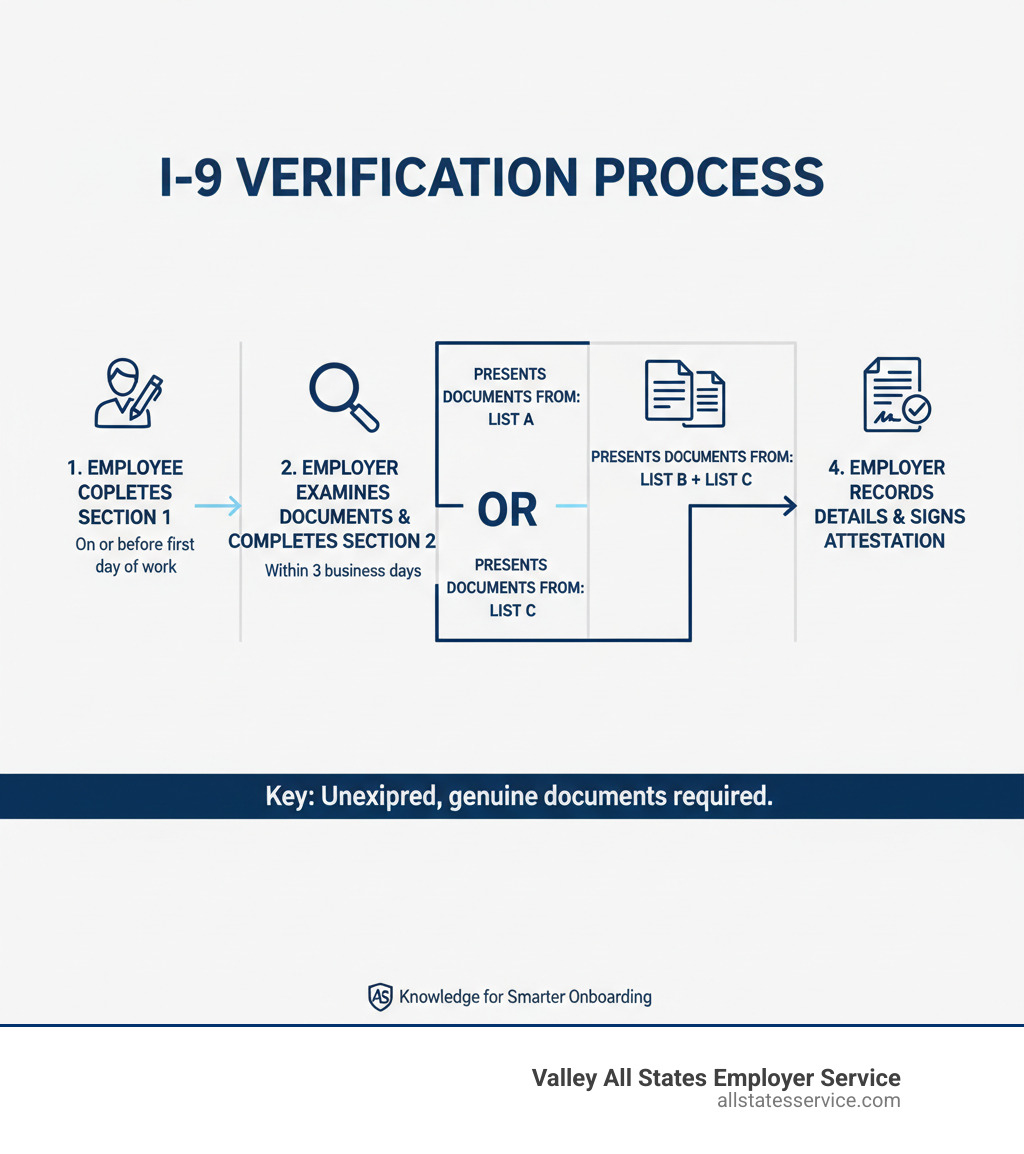
Here’s the basic requirement:
- Employees must present one of these options:
- List A: One document proving both identity and work authorization (e.g., U.S. Passport).
- List B + List C: One document proving identity (e.g., driver’s license) plus one proving work authorization (e.g., Social Security card).
- All documents must be unexpired and appear genuine.
As an employer, you must complete Section 2 of Form I-9 within three business days of an employee’s start date. This involves physically examining original documents to verify identity and employment authorization. With increased Immigration and Customs Enforcement (ICE) actions, errors like missing forms or accepting invalid documents can trigger audits and fines. For more on the repercussions, see our guide on I-9 Compliance Penalties.
Fortunately, understanding which documents are acceptable is straightforward. The U.S. Citizenship and Immigration Services (USCIS) provides clear lists. This guide will walk you through every acceptable document, explain the lists, and cover special cases to help you avoid common pitfalls.
The Three Lists Explained: What’s the Difference Between List A, B, and C?
After an employee completes Section 1 of Form I-9, you must verify their eligibility by examining their documents. USCIS organizes I-9 Section 2 acceptable documents into three lists to simplify this process.
Crucially, the employee chooses which documents to present. They can provide one document from List A, or a combination of one from List B and one from List C. You cannot specify which documents they provide. The difference between the lists is what they prove:
- List A documents establish both identity and employment authorization. A U.S. Passport is a prime example.
- List B documents establish only identity.
- List C documents establish only employment authorization.
A List B and List C document together serve the same purpose as a single List A document. Both options are equally valid. For official details, consult the Handbook for Employers (M-274).
List A: One and Done
List A is the express option. One document establishes both identity and the right to work. Common List A documents include a U.S. Passport or U.S. Passport Card, a Permanent Resident Card (Form I-551), or an Employment Authorization Document (Form I-766). Form I-766 is a List A document, a point that sometimes causes confusion. These documents simplify verification for both you and the employee. If you’re new to the process, our article What is an I-9 Form? provides a solid foundation.
List B & List C: The Combination Approach
If an employee doesn’t have a List A document, they can use the combination approach: one document from List B and one from List C.
- List B is for identity. These documents, like a driver’s license, typically have a photo or identifying details to confirm the person’s identity.
- List C is for employment authorization. These documents, like an unrestricted Social Security card, confirm the person is legally allowed to work.
For example, a driver’s license (List B) and a Social Security card (List C) is a perfectly acceptable combination. This approach offers flexibility while meeting all legal requirements. For help recording this information, see our guide on Filling Out Employment Eligibility Verification.
A Deep Dive into I-9 Section 2 Acceptable Documents
As the employer, you or an authorized representative must physically examine the original documents your employee presents. You must confirm they appear genuine, relate to the person, and are unexpired. This is a careful inspection using reasonable judgment, not a forensic analysis. Check if the photo matches the person and if there are obvious signs of tampering.
List A: Documents That Prove Both Identity & Work Authorization
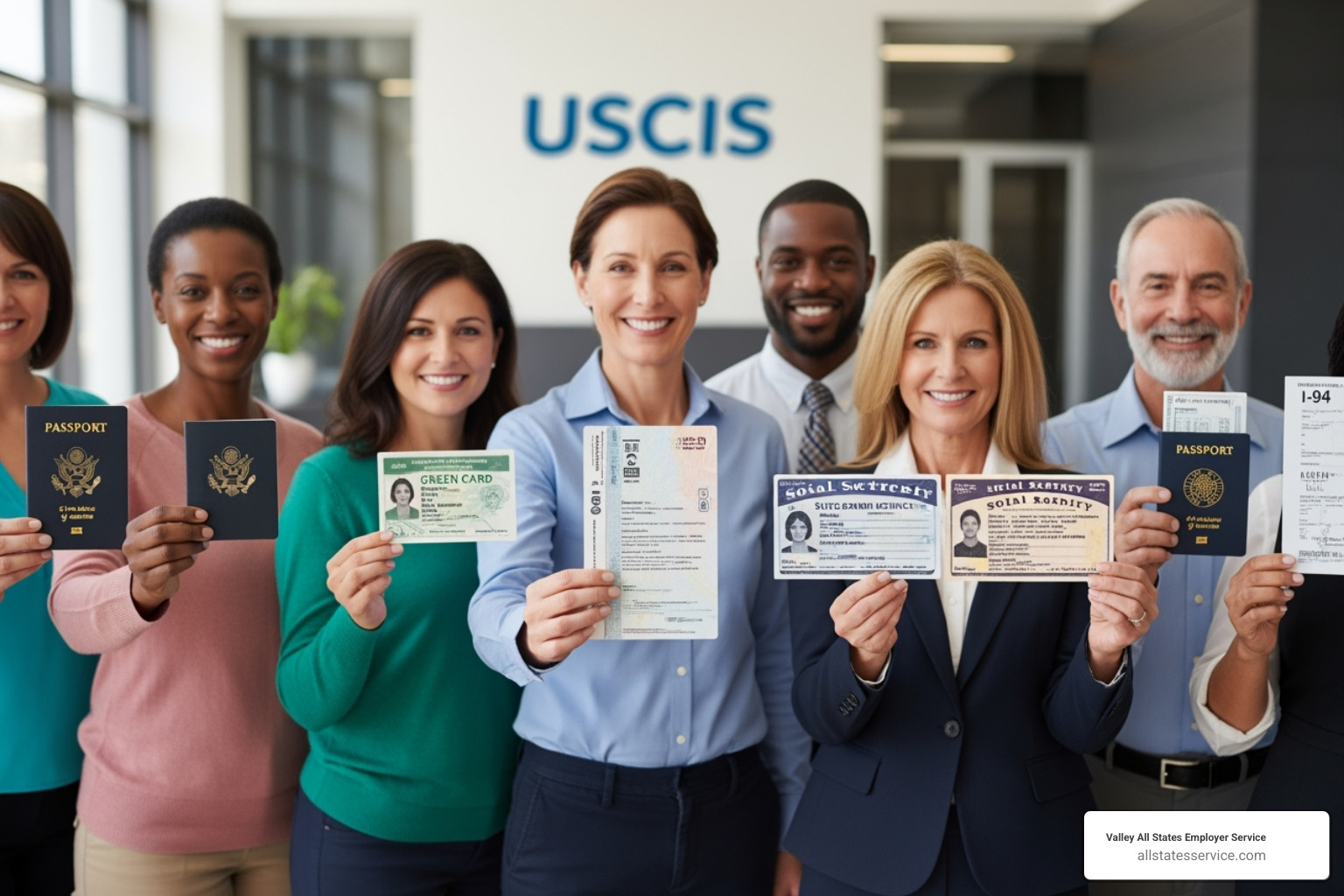
When an employee presents one of these I-9 Section 2 acceptable documents, the document portion of Section 2 is complete.
- U.S. Passport or U.S. Passport Card: The gold standard, proving citizenship and identity.
- Permanent Resident Card (Form I-551): Also known as a “Green Card,” it proves lawful permanent residents can work without restriction. Older versions remain valid until their expiration date.
- Foreign passport with a temporary I-551 stamp or notation: This serves as temporary proof of permanent residency.
- Employment Authorization Document (Form I-766): This card, also called an EAD, is issued by USCIS and includes a photo. It is a List A document, not List C.
- Foreign passport with Form I-94/I-94A: For certain nonimmigrants authorized to work for a specific employer.
- Passport from the Federated States of Micronesia (FSM) or the Republic of the Marshall Islands (RMI) with Form I-94/I-94A.
List B: Documents That Only Prove Identity
If an employee uses a List B document, they must also provide one from List C. Common List B documents include:
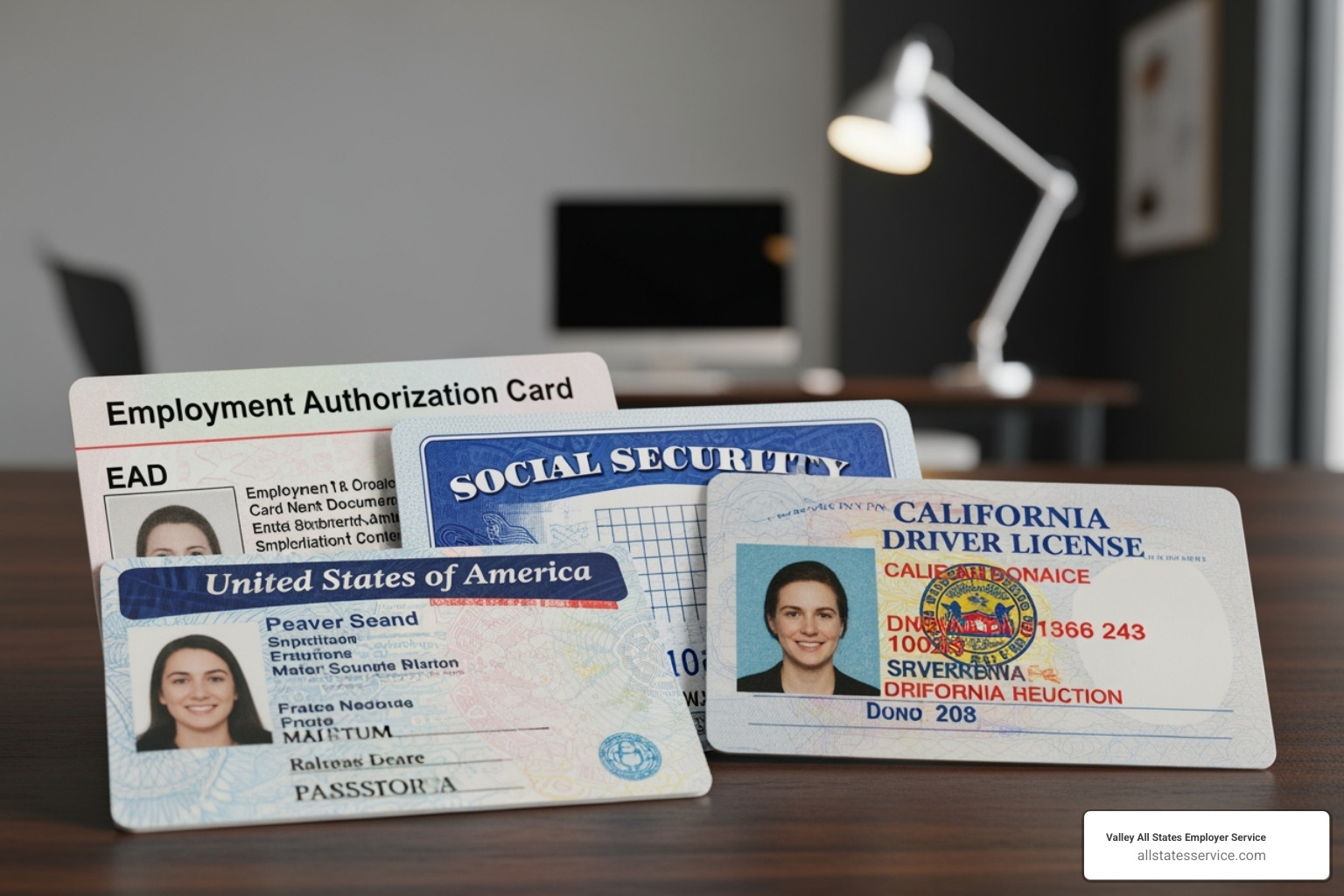
- Driver’s license or ID card issued by a state, which must contain a photograph or identifying information (name, DOB, etc.). A notation like “Not for Federal Identification” is acceptable for I-9 purposes.
- ID card issued by a federal, state, or local government agency.
- School ID card with a photograph.
- Voter’s registration card.
- U.S. Military card or draft record.
- Military dependent’s ID card.
- U.S. Coast Guard Merchant Mariner Card.
- Native American tribal document.
- Driver’s license issued by a Canadian government authority.
For more guidance, our article on Verifying I-9 Documents offers best practices.
List C: Documents That Only Prove Employment Authorization
A List C document must be paired with a List B document. The most common is a Social Security Account Number card, but it must be unrestricted. Cards with phrases like “NOT VALID FOR EMPLOYMENT” are not acceptable.
Other List C documents include:
- Certification of report of birth issued by the Department of State (Forms FS-545, DS-1350, or FS-240).
- Original or certified copy of a birth certificate from a U.S. state or territory with an official seal. (Note: Puerto Rico birth certificates issued before July 1, 2010, are not valid).
- U.S. Citizen ID Card (Form I-197).
- Identification Card for Use of Resident Citizen in the United States (Form I-179).
- Native American tribal document.
- Employment authorization document issued by the Department of Homeland Security (DHS).
Understanding these documents helps you avoid verification mistakes and remain compliant.
Navigating Special Cases: Receipts, Minors, and Document Rules
The world of I-9 section 2 acceptable documents has nuances. Situations like a stolen wallet or hiring a minor require special knowledge to handle correctly and avoid compliance issues. Knowing these rules is manageable and essential for fairness. For comprehensive team guidance, consider our I-9 Compliance Training.
When Can an Employee Use a Receipt?
When documents are lost, stolen, or damaged, a receipt may be used temporarily in specific cases. You can accept a receipt for a replacement of a List A, B, or C document. The employee must then present the actual document within 90 days of their hire date.
Other acceptable receipts include:
- For lawful permanent residents: The arrival portion of Form I-94/I-94A with a temporary I-551 stamp and photo. The actual card must be presented before the stamp expires.
- For refugees: The departure portion of Form I-94/I-94A with a refugee stamp. They must present an EAD (Form I-766) or Permanent Resident Card within 90 days.
You cannot accept a receipt for an initial application for employment authorization. Receipts are also not allowed for jobs lasting less than three business days. For details, see the Acceptable Receipts information in the M-274.
I 9 Section 2 Acceptable Documents for Employees Under 18
If an employee is under 18 and lacks a standard List B identity document, they can present one of the following instead:
- A school record or report card
- A clinic, doctor, or hospital record
- A day-care or nursery school record
These alternatives satisfy the identity requirement for minors, but they must still present a List C document to prove employment authorization.
Unexpired Documents and Restrictive Notations
As a rule, all documents must be unexpired. However, USCIS sometimes grants automatic extensions for certain documents like Employment Authorization Documents (EADs) and Permanent Resident Cards. You must stay aware of these public announcements to avoid rejecting valid documents. Check the Employment Authorization Extensions page on I-9 Central for current information.
Additionally, you can accept List B documents with notations like “Not for Federal Identification.” These restrictions do not invalidate the document for Form I-9 purposes.
Your Role as an Employer: Examination, Deadlines, and E-Verify
Your role in Section 2 is a legal attestation that you have examined the documents and believe them to be genuine and related to the employee. This is a serious responsibility. For a complete overview of your duties, see our Employer I-9 Verification Guide.

Examining and Recording Document Information
You or your authorized representative must physically examine the original documents. Photocopies or digital images are not sufficient. However, employers who participate in E-Verify and meet certain criteria may be eligible to examine documents remotely via live video. Stay current with the latest rules on USCIS I-9 Remote Verification.
In Section 2, you must record the document title, issuing authority, document number, and expiration date (if any). After recording the information, return the documents to the employee. You may choose to make copies, but you must do so for all employees to avoid discrimination claims.
Deadlines and Authorized Representatives
You must complete and sign Section 2 within three business days of the employee’s first day of work. For jobs lasting less than three days, it must be done on the first day.
If you cannot examine the documents yourself, you can designate an authorized representative. This can be any person you authorize to act on your behalf. However, you, the employer, remain liable for any violations or mistakes made by your representative. Choosing a reliable representative is critical. For help with this, explore Third-Party I-9 Verification.
The Role of E-Verify in the Document Process
E-Verify is a USCIS system that compares Form I-9 information to government records, adding another layer of verification. It works with Form I-9, not as a replacement.
E-Verify has a specific rule for I-9 Section 2 acceptable documents: if an employee presents a List B document, it must contain a photograph. This is for E-Verify’s photo matching tool. While E-Verify adds requirements, it also adds confidence to your hiring. Learn more about how it works with our article on E-Verify and I-9 or visit the official site at e-verify.gov.
Frequently Asked Questions about I-9 Documents
Here are answers to common questions about i 9 section 2 acceptable documents to help you stay compliant.
What if an employee presents an expired document?
Generally, expired documents are not acceptable. A document with an expiration date must be unexpired at the time of examination. The only exception is when a document’s validity has been automatically extended by a government agency. For example, USCIS sometimes extends certain Employment Authorization Documents (EADs). Unless you can confirm an automatic extension applies, the employee must provide a different, unexpired document. You can check for current extensions on the Employment Authorization Extensions page on I-9 Central.
Can I specify which documents an employee should present?
No. You cannot tell an employee which documents to present. Doing so can be considered discrimination. Employees have the legal right to choose whether to present one document from List A or a combination of one from List B and one from List C. Requesting specific documents is an unfair immigration-related employment practice and can lead to penalties. Accept any valid, unexpired document(s) the employee chooses.
What information must be recorded for I-9 Section 2 acceptable documents?
For each document, you must accurately record the following information in Section 2:
- Document title (e.g., “U.S. Passport”)
- Issuing authority (e.g., “U.S. Department of State”)
- Document number
- Expiration date (if any)
Incomplete or inaccurate information can cause compliance issues during an audit, so it’s important to record these details carefully.
Simplify Your I-9 Process and Ensure Compliance
Getting i 9 section 2 acceptable documents right protects your business and ensures you treat employees fairly. The process is manageable once you understand the rules: employees choose their documents, you examine them within three business days, and you record the information accurately without specifying which documents to provide or accepting expired ones (barring official extensions).
However, managing I-9s can be an administrative burden. A single mistake can trigger an audit, and staying current with regulations is time-consuming.
That’s where Valley All States Employer Service can help. We specialize in E-Verify processing and I-9 compliance, taking the complexity off your plate. Our experts handle the details with precision, minimizing your errors and administrative workload so you can focus on growing your business. We ensure your paperwork is bulletproof.
Ready to simplify your I-9 process and reduce compliance risk? Streamline your process by Verifying I-9 Documents with us. Let us handle the compliance, so you don’t have to.